"The purpose of music is the glory of God and the renewing of the mind."
https://www.youtube.com/watch?v=ET1eTAmjX_g
Showing posts with label music. Show all posts
Showing posts with label music. Show all posts
Tuesday, October 01, 2019

Monday, March 21, 2011
Thursday, May 27, 2010
Bach vs. Arius
This article was published as “Three-Fold Chords” in the October, 2004 issue of Touchstone, a Journal of Mere Christianity.
Robert Hart on the Trinity in Bach
Whether his art is visual, musical, or verbal, the Christian artist presents an apologetic. He does more than refute error; he transcends the mind that holds error. Whether or not he explains the truth, he shows it, that we may see and hear it also.
Theology in Music
Johann Sebastian Bach wrote many a choral piece for the Church, and the words of those pieces reflect his deep faith. Some of the cantatas have texts by an unknown poet, which I suspect was Bach himself, for he wrote poetry as a pastime. Every part of Christian devotion is expressed in his music, from the lofty grandeur of his Sanctus in the B-Minor Mass, to the simple expression of grief at the end of the St. Matthew Passion:
Wir setzen uns
mit Tranen nieder
Und rufen dir im Grabe zu:
Ruhe sanfte, sanfte ruh!
(We prostrate ourselves with tears
and call to you within the grave,
Rest gently,
gently rest!)
And yet, Bach’s music expresses the truth even when no words are used. The very order and logic of it speak of a universe ruled and governed by its Creator. Even more, Bach was able to put theology into the music itself. He did so without any loss to the musical art; for the piece of which I am about to speak is a masterpiece, as moving and inspiring as any can be for the sheer joy of the listening ear. To those who pay attention, a very clear demonstration of the truth is presented in the “St. Anne” Fugue in E-flat Major for organ (BWV 552).

The fugue is a contrapuntal form of music, which means that different lines of melody are played against each other, without strophic chords. A fragment of a melody is stated, which is called the “subject,” in one voice. It is answered and repeated in another voice, which enters, usually in the interval of a fifth, while the first voice plays what is called the “counter-subject.” A third voice enters, usually returning to the “root” key, and so on. Most fugues have four voices.
The art of the fugue lies in the development of the piece, with its subject always being repeated, as it modulates into different keys and keeps the lines of melody moving with good harmonic flavor throughout. Sometimes the subject disappears very briefly and we are treated to what is called an “episode.” The purpose of the “episode” is to lead us into the next statement of the subject.
The “St. Anne” Fugue is a triple fugue. Each of the three sections, which I will identify as A, B, and C, is part of the fugue and yet is at the same time itself a complete fugue. The opening notes of the hymn “O God, Our Help in Ages Past” are clearly stated as the subject for A. It develops as all fugues do, as each voice comes in and the fugue modulates from key to key, but then it resolves rather quickly in an unsatisfying conclusion. This is because we are not done, and are meant to anticipate more.
B starts, with its mysterious-sounding subject, and we are treated to the typical fugal voice entries; but when it starts to develop, we hear suddenly that the subject of A has reappeared. Is it being used as a counter-subject to each subsequent entry of the B subject as it develops and modulates, or is B an “episode” rather than a new fugue?
But still we are not done. For this section also concludes too suddenly for us to feel that it is over, and the entrance of a very joyful-sounding subject introduces the third fugue, or the third section. Again, C goes through its entries of voices with subject and counter-subject, and then we hear the subjects of A and B played together in counterpoint as an “episode.” In fact, this combination provides an “episode” between entrances of the C subject a few times, until the whole piece ends with the clear statement of the A subject.
The fact that the piece ends with the subject of A unifies it and makes it one fugue, but it also sounds like three fugues. Also, B and C both derive from and depend on A, yet each of them is equal to A. Is the “St. Anne” Fugue one piece or three pieces?
Bach Against Arius
It seems that we have a problem similar to that which confronted Arius, the fourth-century heretic who made the Council of Nicea necessary. He could not believe that it made any sense that Christians worship a God who is three Persons. The doctrine of the Trinity offended his sense of mathematical purity, a purity based upon a simplistic, undeveloped understanding.
He did not deny that the Word is a Person to be worshiped, and so he made of him a god, but one who is a creature of the One God. He also denied the existence of the Holy Spirit as a Person. His devotion to pure monotheism had the ironic effect of leading him into advocating a kind of polytheism. At the root of it was a simple inability to appreciate the complexity of divine transcendence, combined with an inability to appreciate that complexity as reflected within creation, as a genuine student of mathematics should be able to do.
One of the heroes of the Council of Nicea, St. Athanasius, spent a lifetime refuting the error of Arius, and did so at great personal expense, going more than once into exile. For centuries, Christian theologians have refuted the Arian heresy, mostly by proving that the Trinity is a doctrine revealed clearly in the Scriptures and understood to be true by the Church in every age. No one claims to understand the Trinity fully, but rather to understand the doctrine of the Trinity that has been revealed to the Church, for the first would be to fully understand God, which we cannot do, and the second is to understand what he has said, which we can.
The Christian artist Johann Sebastian Bach did something, however, that theologians and scholars cannot do with all of the words of every language. Bach did not refute Arius; instead, he showed musically how the problem that vexed Arius could be solved. The “St. Anne” Fugue does not explain the truth; it demonstrates it with mathematical complexity, and yet with the simplicity of genius.
Is the “St. Anne” Fugue one or three? The answer, which every ear can hear for itself, is that “these three are one.”
The author recommends Jaroslav Pelikan’s Bach Among the Theologians as a treatment of Bach’s religious music.
Sunday, May 16, 2010
Monday recreation
For those who want it, here is a link to my music videos, to which some new items will be added here and there when Mondays afford a little time "off."
Thursday, May 13, 2010
Vespers
The Vesper light is soft and golden. It is the image of this time that I have sought to write into music. The theme chants in measured tones, not hurried or even interpreted. Through the glowing colors of stained glass windows the light of the setting sun stretches eastward across the sanctuary and lands above the altar over the tabernacle. In that tabernacle is the Reserve Sacrament: Here is the Shekinah. In that presence, the fragile light of the dying sun invites our prayers, sung as chants, at once restful and intense, outwardly calm, inwardly moving. So we rest in the work of prayer, refreshment that comes only by ascending a while out of the cares of the world into the presence of God.
Wednesday, May 12, 2010
More original compositions played on a Monday afternoon
The first piece is a baroque form but modal and modern. The second I improvised in my church organist days, because I needed a postlude and had not been given time to prepare. Both of these I adapted to piano. If the pope can relax at a piano, so can I-when possible.
"Music is to the glory of God and for the renewing of the mind."
-Johann Sebastian Bach
Friday, April 30, 2010
Prelude & Fugue in D minor
Since the last one was well received, here is more from what my son Joseph recorded of my musical recreation on Monday, when the clergy try to have a day off. Of course priests are never off duty, like firmen, police officers, doctors, and Groucho Marx (he was never off duty). Jack Miller "accused" me of Lutheran leanings (tongue in cheek) after my last musical offering. This piece sounds even more so, for it shows the influence of J.S. Bach and comes from my having been a church organist way, way back before the turn of the century. The fugue subject is from the Christmas Carol "Here betwixt ass and oxen mild" number 38, the tune name being Gevaert, in the hymnal 1940. This kind of music really could not exist without the Incarnation, for it is the product of Christian culure. To play it on the piano, I adapted my own music from the organ, originally a piece that was written for Church.
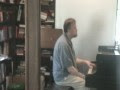
(Click the picture for a link to the music. My son's video program has some interesting features.)
Tuesday, April 27, 2010
Battle Music
This has nothing to do with our general subject matter, but sometimes we need a break. Monday is, when possible, a day off for most clergy. So, yesterday, my youngest son made a video of me playing one of my compositions (I wrote this in 1980). So, think in terms of Ephesians 6 and spiritual warfare.
Canon Tallis (as a reader calls himself) suggested that we make use of videos and YouTube. I did not have the technology, or any idea of how good it is and easy to get. I think we are getting there.
Monday, September 17, 2007
Bach vs. Arius
This article was published as “Three-Fold Chords” in the October, 2004 issue of Touchstone, a Journal of Mere Christianity.
Robert Hart on the Trinity in Bach
Whether his art is visual, musical, or verbal, the Christian artist presents an apologetic. He does more than refute error; he transcends the mind that holds error. Whether or not he explains the truth, he shows it, that we may see and hear it also.
Theology in Music
Johann Sebastian Bach wrote many a choral piece for the Church, and the words of those pieces reflect his deep faith. Some of the cantatas have texts by an unknown poet, which I suspect was Bach himself, for he wrote poetry as a pastime. Every part of Christian devotion is expressed in his music, from the lofty grandeur of his Sanctus in the B-Minor Mass, to the simple expression of grief at the end of the St. Matthew Passion:
Wir setzen uns
mit Tranen nieder
Und rufen dir im Grabe zu:
Ruhe sanfte, sanfte ruh!
(We prostrate ourselves with tears
and call to you within the grave,
Rest gently,
gently rest!)
And yet, Bach’s music expresses the truth even when no words are used. The very order and logic of it speak of a universe ruled and governed by its Creator. Even more, Bach was able to put theology into the music itself. He did so without any loss to the musical art; for the piece of which I am about to speak is a masterpiece, as moving and inspiring as any can be for the sheer joy of the listening ear. To those who pay attention, a very clear demonstration of the truth is presented in the “St. Anne” Fugue in E-flat Major for organ (BWV 552).
The fugue is a contrapuntal form of music, which means that different lines of melody are played against each other, without strophic chords. A fragment of a melody is stated, which is called the “subject,” in one voice. It is answered and repeated in another voice, which enters, usually in the interval of a fifth, while the first voice plays what is called the “counter-subject.” A third voice enters, usually returning to the “root” key, and so on. Most fugues have four voices.
The art of the fugue lies in the development of the piece, with its subject always being repeated, as it modulates into different keys and keeps the lines of melody moving with good harmonic flavor throughout. Sometimes the subject disappears very briefly and we are treated to what is called an “episode.” The purpose of the “episode” is to lead us into the next statement of the subject.
The “St. Anne” Fugue is a triple fugue. Each of the three sections, which I will identify as A, B, and C, is part of the fugue and yet is at the same time itself a complete fugue. The opening notes of the hymn “O God, Our Help in Ages Past” are clearly stated as the subject for A. It develops as all fugues do, as each voice comes in and the fugue modulates from key to key, but then it resolves rather quickly in an unsatisfying conclusion. This is because we are not done, and are meant to anticipate more.
B starts, with its mysterious-sounding subject, and we are treated to the typical fugal voice entries; but when it starts to develop, we hear suddenly that the subject of A has reappeared. Is it being used as a counter-subject to each subsequent entry of the B subject as it develops and modulates, or is B an “episode” rather than a new fugue?
But we are still not done. For this section also concludes too suddenly for us to feel that it is over, and the entrance of a very joyful-sounding subject introduces the third fugue, or the third section. Again, C goes through its entries of voices with subject and counter-subject, and then we hear the subjects of A and B played together in counterpoint as an “episode.” In fact, this combination provides an “episode” between entrances of the C subject a few times, until the whole piece ends with the clear statement of the A subject.
The fact that the piece ends with the subject of A unifies it and makes it one fugue, but it also sounds like three fugues. Also, B and C both derive from and depend on A, yet each of them is equal to A. Is the “St. Anne” Fugue one piece or three pieces?
Bach Against Arius
It seems that we have a problem similar to that which confronted Arius, the fourth-century heretic who made the Council of Nicea necessary. He could not believe that it made any sense that Christians worship a God who is three Persons. The doctrine of the Trinity offended his sense of mathematical purity, a purity based upon a simplistic, undeveloped understanding.
He did not deny that the Word is a Person to be worshiped, and so he made of him a god, but one who is a creature of the One God. He also denied the existence of the Holy Spirit as a Person. His devotion to pure monotheism had the ironic effect of leading him into advocating a kind of polytheism. At the root of it was a simple inability to appreciate the complexity of divine transcendence, combined with an inability to appreciate that complexity as reflected within creation, as a genuine student of mathematics should be able to do.
One of the heroes of the Council of Nicea, St. Athanasius, spent a lifetime refuting the error of Arius, and did so at great personal expense, going more than once into exile. For centuries, Christian theologians have refuted the Arian heresy, mostly by proving that the Trinity is a doctrine revealed clearly in the Scriptures and understood to be true by the Church in every age. No one claims to understand the Trinity fully, but rather to understand the doctrine of the Trinity that has been revealed to the Church, for the first would be to fully understand God, which we cannot do, and the second is to understand what he has said, which we can.
The Christian artist Johann Sebastian Bach did something, however, that theologians and scholars cannot do with all of the words of every language. Bach did not refute Arius; instead, he showed musically how the problem that vexed Arius could be solved. The “St. Anne” Fugue does not explain the truth; it demonstrates it with mathematical complexity, and yet with the simplicity of genius.
Is the “St. Anne” Fugue one or three? The answer, which every ear can hear for itself, is that “these three are one.”
The author recommends Jaroslav Pelikan’s Bach Among the Theologians as a treatment of Bach’s religious music.
Subscribe to:
Posts (Atom)