Showing posts with label Theology. Show all posts

Wednesday, May 09, 2018

CHRIST AND ANTICHRIST

(Reposted from 2011)

Beloved, believe not every spirit, but try the spirits whether they are of God: because many false prophets are gone out into the world. Hereby know ye the Spirit of God: Every spirit that confesseth that Jesus Christ is come in the flesh is of God: And every spirit that confesseth not that Jesus Christ is come in the flesh is not of God: and this is that spirit of antichrist, whereof ye have heard that it should come; and even now already is it in the world. Ye are of God, little children, and have overcome them: because greater is he that is in you, than he that is in the world. (I John 4:1-4)

And he said unto them, Ye are from beneath; I am from above: ye are of this world; I am not of this world. (John 8:23)

I am come a light into the world, that whosoever believeth on me should not abide in darkness. And if any man hear my words, and believe not, I judge him not: for I came not to judge the world, but to save the world. (John 12:46,47)

Christ Jesus came into the world to save sinners. (I Tim. 1:15)

In the science of theology, finally and ultimately, every nature belongs to one of two categories; either a nature is created or not created. Of the category not created is but one nature, alone without equal; that is God. Everything else is created, and belongs to the same category with natures sub or super to each respective created nature. God exists, and by His will creatures exist; that is all there is, and nothing more. Angels do not share the nature of God. Rather, they share our created nature. Nothing shares with God the Divine nature; God is wholly other from every created nature. Perhaps the day will come when man-made technology can detect the presence of angels, demons and even departed human spirits (and sketchy evidence is reported to exist already). Matter is organized energy, and it is likely that a kind of energy is the stuff of which created spirits are made. The point is, God alone is wholly other from everything created; God alone is of that distinct order that is not part of the creation we live in. 
Really, we cannot speak of "the supernatural" as a wholly different order except when we mean God. Used otherwise, "supernatural" is merely a relative term, such as the supernatural order of man over that of dog (or the sub-natural order of dog compared to that of man). Here too we must distinguish between details, in which the intelligence of man is supernatural to the intelligence of dog, but the nasal ability of man is sub-natural to the superior smelling ability of dog. Like dog and angel, we belong to the created order; we belong to it along with demons, and insects, and along with angels and archangels. 
True Christology must begin with this distinction between God and the whole of creation. This is where St. John begins his Gospel, deliberately alluding to Genesis, to the Greek translation called the Septuagint (LXX) in his opening words. That connection is obvious: "In the Beginning" (בְּרֵאשִׁית) B'Rashet(ν ρχ)  En archē. 

ν ρχ ν  λόγος   or, "In the beginning was the Word." 

Unlike the opening of Genesis, which leads with the creative works of God, John leads by telling about God as God. 

"And the Word was with God, and the Word was God. The same was in the beginning with God."

Only after this does he write of God's work of creation. He builds on the ancient revelation in the Hebrew text, where God's word causes the creation to come to life. Genesis says, "And God said," using the word "said" (אָמַר) as the source of power. So, John writing with fuller and richer revelation teaches us that the Word or the λόγος (Logos) is more than an utterance; the Word is a Person Who is Himself God (κα  λόγος ν πρς τν Θεόν), and goes on to reveal concerning the Word, "All things were made by him; and without him was not any thing made that was made." "And God said, Let there be light: and there was light," is answered by "In him was life; and the life was the light of men. And the light shineth in darkness; and the darkness comprehended it not." 
The Word - that is, the Logos - is God (Θεόν) in the opening of John's Gospel, existing by, in and with the Father ("Begotten not made," as the Creed says). He gives life and light to the creation, and the whole creation is dependent on Him for its existence. It is made by Him; all of its order and all of its life comes by Him as a gift. He, the Logos, is separate from all creation because He is God. He is supernatural to every created nature, and wholly other from the entire order of creation. 

Creatio ex nihilo
Creatio ex nihilo, or creation from nothing, is not some idea imposed on the Biblical texts. It comes from the opening of Genesis itself, declaring that the heavens and the earth were created by God. They are not part of Him, neither did He give birth to creation. That is, we have no goddess who is one with Mother Earth; rather, part of the revelation of God as Father begins with creation strictly by His will.           
Some modern English versions of the Bible connect the first two verses of Genesis along the lines of, "In the beginning when God created the heavens and the earth, the earth was..." The connection of the first two verses into one long sentence, usually by adding the word "when," can suggest Pantheism; that God is the stuff of creation, or that the universe is God, implying that "the heavens and the earth" existed before creation. The King James Version, or the old (not the New) Revised Standard Version, for example, got it just right. The opening verse is a whole and complete sentence, indeed a separate sentence from verse two. In fact, the opening of verse two with the word "and" is a literal and perfect translation of the Hebrew. That is, God made it all, "and the earth" (וְהָאָרֶץ), after He made it initially, was without form and void at that early stage of its existence (of incidental interest, science tells us that the infant earth was dark because it was not yet in the orbit of the sun). In the Biblical text we read that God then spoke to create light and life, bringing us back to the point we have seen in the Gospel of John.          
The opening words of the Bible, when translated accurately, simply and straightforwardly, provide the revelation that God created everything by His will, that He made it out of absolutely nothing (Hebrews 11:3), for nothing that belongs to creation had already existed. Both the doctrine of Creatio ex nihilo and of God as Wholly Other, are revealed in the beginning of Scripture.

Come into the world
And the Word was made flesh, and dwelt among us, (and we beheld his glory, the glory as of the only begotten of the Father,) full of grace and truth. (John 1:14) 

And he said unto them, Ye are from beneath; I am from above: ye are of this world; I am not of this world. (John 8:23) 

In a simple phrase of St. John that separates the doctrine and spirit of Christ from the spirit of Antichrist, "Jesus Christ is come in the flesh." As used above in a quoted passage (...every spirit that confesseth not that Jesus Christ is come in the flesh is not of God: and this is that spirit of antichrist, etc. I John 4:1-4), we may well appreciate the incarnate meaning of His human name, and the familiar reality of "flesh." But, the word "come" also is loaded with meaning. No one else has ever come into the world; all the rest of us originated here. The word "come" is the operative word that speaks of Christ's Divinity as the Logos, a Person not created. For, the spirit of Antichrist denies that He is come in the flesh; that is, it denies the Incarnation of the Word by one of two means: Either the spirit of error denies that Jesus Christ is truly human in every real way; or it denies that He is God, the One Who has come into the world of His own making.  This is an essential fact of Christology, that he came into the world. We do well to consider the Greek word translated "world" in the original New Testament; it is the familiar word κόσμος (cosmos). The Logos, a Person equal to the Father Who is not part of the creation at all ("begotten not made"), but rather is God in His own true nature, entered the created order.  He took the fullness of human nature into His Divine Person.   
The First Council of Nicea (325 AD) rejected the teaching of Arius (who asserted that the Word was a creature) by recalling the revelation that Christ alone saves us from sin and death. Yes, the texts of Scripture showed clearly all of the things we have seen in the portions quoted from the Gospel of John, and several more such passages that unmistakably teach that the One who is Himself called both the Logos and the Son, is equal to and one with the Father, without beginning or end. But, in the final analysis, they recognized above every other consideration that Soteriology, the study of salvation, always centers on the Person of the Son of God.   
It is no small matter, therefore, to understand the Gospel. Unless we see Christ as Divine, and as coming into His creation by taking a second nature alien to His "begotten not made" Person as "Light of Light, very God of very God, of one substance (ομοουσιον) with the Father," we may be inclined to feel a need for an additional savior, or perhaps some means of making our own atonement. If we limit His atonement we limit Him, treating Him as less than God. We can add nothing more to His salvation, nor can there be any need to do so.
The words of our own Holy Communion liturgy, which come from the Scriptures and most directly reflect the Epistle to the Hebrews, are as much a matter of Christology as they are of Soteriology: "All glory be to thee, Almighty God, our heavenly Father, for that thou, of thy tender mercy, didst give thine only Son Jesus Christ to suffer death upon the Cross for our redemption; who made there (by his one oblation of himself once offered) a full, perfect, and sufficient sacrifice, oblation, and satisfaction, for the sins of the whole world."    
These words also reflect the First Epistle of John, "And He is the propitiation for our sins: and not for ours only, but also for the sins of the whole world." (2:2) For, although Christ by His death as our full atonement and propitiation has met with limited reception from the fallen human race, His work is "full, perfect and sufficient" because of Who He is.        
"Who has believed our report?" said the prophet (Isaiah 53:1), and in that same Suffering Servant passage spoke of the One and the many; for "many" in that passage is not properly contrasted against the concept of all; rather the one man upon Whom the burden of sin is placed, is one contrasted against the "many." 

But he was wounded for our transgressions, he was bruised for our iniquities: the chastisement of our peace was upon him; and with his stripes we are healed. All we like sheep have gone astray; we have turned every one to his own way; and the LORD hath laid on him the iniquity of us all...He shall see of the travail of his soul, and shall be satisfied: by his knowledge shall my righteous servant justify many; for he shall bear their iniquities (Isaiah 53: 5,6,11)        

That is, "many" speaks of the entire human race, everyone except this Man Who takes away all sin; and this is taken up by Saint Paul: "Therefore as by the offence of one judgment came upon all men to condemnation; even so by the righteousness of one the free gift came upon all men unto justification of life. For as by one man's disobedience many were made sinners, so by the obedience of one shall many be made righteous." (Romans 5:18, 19) There we see the One and the many. So, although not everyone believes, from the Divine perspective and by Divine initiative, salvation is offered to everyone in Christ. However one views the mystery of predestination, a very large subject indeed, it is very dangerous to speak of Christ's work as "Limited;" for, we might then imagine that His death is not sufficient, meaning that He is not sufficient, to take away the sins of the world. (John 1: 29)       
Just as it is unnecessary, not to mention unorthodox, to try to add to the Atonement, whether by the merits of saints from some supposed "treasury," or by calling the Lord's blessed virgin mother "Co-redemptrix" (a popular idea among some contemporary Roman Catholics), and so forth, it is also error to use the term "Limited Atonement" when speaking of Christ's sacrifice. From two opposite ends these ideas limit Christ's work, and therefore treat Him as less than fully Divine. "Full, perfect and sufficient" means just that, as does "once for all." (Hebrews 10:10)   
We serve no need by solving false problems. Reconciling the full, perfect and sufficient work of Christ with the unbelief of a fallen world, is a false problem; and, it would be no solution to undervalue the meaning of the words, "And he is the propitiation for our sins: and not for ours only, but also for the sins of the whole world." (I John 2:2) For that speaks of God's generous will and infinite love, whatever men may do about it.          
Finally, the great Christological passage from Paul's Epistle to the Philippians also connects Soteriology to the whole study of Christ's Person and Incarnation, rehearsing the Gospel in the context of Christ's two natures:

Let this mind be in you, which was also in Christ Jesus: Who, being in the form of God, thought it not robbery to be equal with God: But made himself of no reputation, and took upon him the form of a servant, etc. (see Phil. 2:5-11)

Exorcising the spirit of Antichrist
The revelation recorded in Scripture shows only Christ as coming from outside the fallen world, coming into it by taking our nature to save us from sin and death. No one else is from above; no one else came into the world (cosmos). No one else entered the created order from some other venue. The other venue is His Divine nature that is itself separate from the created order. The mystery of the Incarnation is beyond our comprehension. But, though we can never understand it fully, we are given grace to believe what has been revealed. "Jesus Christ is come in the flesh."

Friday, December 22, 2017

Fourth Sunday in Advent


Isaiah 40:1-11 * Psalm 80 * Phil. 4:4-7 * John 1:19-28 

Again we see that mysterious image of John the Baptist, the burning and shining light who bore witness by his life and death to Jesus Christ. “He must increase, and I must decrease,” said this prophet, this man whose unique vocation was that he bridged the Old Testament and the New. Two weeks ago we saw that all of the scriptures bore witness to Jesus Christ; and now, this last prophet of the Old Covenant bears direct witness to Christ, baptizing Him, and seeing the Spirit of God come upon Him as a dove out of Heaven. This last prophet of the Old Covenant is the first prophet of the New Covenant. The Lord said through the prophet Isaiah, “Behold, I will do a new thing; now it shall spring forth; shall ye not know it? I will even make a way in the wilderness, and rivers in the desert (Isa. 43: 19).” God called this prophet, this unique prophet, to show that the new thing, the New Covenant spoken of by Jeremiah the prophet (Jer. 31:31f) was upon them. John’s father was a priest under the Law of Moses, a descendent of Aaron. Therefore, John was also, by that Law, a priest. Yet, John the son of Zechariah, went into the desert to be the voice of one crying in the wilderness, “prepare the way of the Lord.”


Advent is about the last things, and especially meant to remind us that Christ will come again in glory to judge the quick and the dead, to make the heavens and the earth new, and to rule forever on His throne, surrounded by saints whom He has redeemed from sin and death to rule forever with Him. But, as we have seen, instead of having us read the many passages of scripture that deal very directly with eschatology- the study of the end- the Gospel readings appointed by the Church give us a glimpse of Christ’s second coming by reminding us of events that happened when He came at first. The first week we saw that His kingdom brings judgment on the very House of God in the midst of the holy city, and cleanses it by driving out those who defiled it by their practice of unrepented sin. The picture ought to inspire the healthy fear of God, and to make us repentant and resolute to live in such a way that we will be among those who remain in His house forever, instead of being driven out into outer darkness, where there will be weeping and gnashing of teeth.


And now, thanks to the wisdom of the Church, we are reminded of the Baptist who prepared the way of the Lord by preaching repentance and cleansing. John the Baptist bridged the Testaments and prepared the way for Christ by offering hope, by giving sinful people a chance to start over again. The sinners who came to him were given a new beginning, hope and cleansing- themselves cleansed rather than tossed out as the Lord tossed out the money changers when it was the temple that was cleansed of evil presences and practices. In other words, the vocation of John the Baptist was to prepare people to see Jesus as the Messiah, and the preparation was repentance, the only way to be prepared to meet the Lord. The Advent message of repentance is necessary. Modern popular religion tells everyone that they need not repent of their sins, but rather that everyone is accepted with all of their ungodly baggage. The truth is, some churches are simply helping people go into the outer darkness. After all, St. Paul warned of people he called Satan’s ministers (II Cor. 11:13-15). The real ministry of the Church is the most important and serious thing in the world. Here we deal with things more important than mere life and death. We speak and administer the word and sacraments that have to do with the eternal kingdom to come. We give out both a warning and hope: "Repent, for the Kingdom of Heaven is at hand."

Now, about the comings of Jesus Christ, and the life of this mysterious John the Baptist, we should dig a little deeper. The word “Christ” is from the Greek for the Hebrew word Meshiach, or as we pronounce it in English, Messiah. We have come to call the Lord by two names more than all others, Jesus and Christ. The one means Salvation- Y’shua. The other means “the anointed” – Meshiach. The implication is the Old Testament expression, “the Lord’s Anointed.” This comes with two pictures, as the word "messiah" is sprinkled generously throughout the pages of the Old Testament (generally translated "anointed"). The word speaks of priests and kings, and the anointing comes by the hand of a prophet.

The first men to be called meshiach were the brother of Moses, Aaron the High Priest, and his sons the priests. The King James Bible uses the phrase “the priest that is anointed.” The original Hebrew is h’ kohan h’ meshiach- “the priest the messiah.” The second class of men to be called messiah (meshiach) are the kings. David would not stretch forth his hand against Saul, because he was “the Lord’s anointed.” That is, the Lord’s messiah. Every priest was a messiah, and every king was a messiah. And, yet, the scriptures clearly speak of the one Man who would be both priest and king, and who would be the only hope of the whole world, being the one Jews call H’ MeshiachThe Messiah. So, first Messiah is the priest, and then after that He is the King.

His two comings are foreshadowed in these pictures. First he came as priest. The Epistle to the Hebrews is the most explicit New Testament book that tells of Christ’s priestly ministry when he came the first time, and does so in light of the hope of those who look for His second appearing. As the priest He offered Himself as the sacrifice. The Book of Leviticus tells us clearly how a priest made kippur, that is atonement, for a repentant sinner who confessed his sin to the priest and brought a sacrifice. The real meaning is that the priest himself is the atonement, and offers the animal because he cannot sacrifice himself. This is a type and shadow of Jesus, who did offer Himself as priest and sacrifice when He came the first time. The importance of the Suffering Servant passage to the clear New Testament proclamation of atonement cannot be overstated. You will find it in the 53rd chapter of the Book of Isaiah. “But he was wounded for our transgressions, he was bruised for our iniquities: the chastisement of our peace was upon him; and with his stripes we are healed. All we like sheep have gone astray; we have turned every one to his own way; and the LORD hath laid on him the iniquity of us all.”

This Suffering servant, after His death in their place, rises and takes up a ministry of intercession for sinners. “When thou shalt make his soul an offering for sin, he shall see his seed, he shall prolong his days, and the pleasure of the LORD shall prosper in his hand.” A dead man cannot prolong his days unless he rises again. In this passage, His death and resurrection are priestly, because he dies as the one true sacrifice, the atonement, and after rising “he ever lives to make intercession for them,” that is, for those who come to God through Him (Hebrews 7:25). The Old Testament sacrifices on those altars foreshadowed His true sacrifice, just as our sacrifice on this altar, in which nothing is killed, proclaims it. In fact, there is only one Mass (Eucharist or Holy Communion), and always when it is offered anywhere in the world by the Church, it is joined to the one true sacrifice on Calvary.

When he comes again, the image of Messiah as King will be fulfilled in all of its glory. This is the terror of all that is evil, and it is the hope of the Church. It is a certainty that he will come on the Last Day to judge the living and the dead, to establish Heaven on Earth, to rule and so grant peace forever. Both testaments speak of His coming as the King Messiah. Daniel saw one coming in the clouds of Heaven as the Son of man to rule with the Ancient of Days; Moses saw that “the Earth shall be filled with the glory of the Lord as the waters cover the sea.” Our eternal hope is not based upon imagination and conjecture, but upon the sure promise given in and by Christ’s resurrection from the dead. We are given the “sure and certain hope of the resurrection on the Last Day.” It is the only such hope, and it is impossible to separate that hope from Jesus Christ, because immortality, the hope of eternal life, is granted through His resurrection. So writes Saint John about those who, due to this hope, purify themselves: “Beloved, now are we the sons of God, and it doth not yet appear what we shall be: but we know that, when he shall appear, we shall be like him; for we shall see him as he is (I John 3:2).”

John the Baptist prepared the way of the Lord by his message of repentance. Pondering these pictures of the Messiah as priest and King we are both warned and encouraged with both fear and hope. This is the meaning of Advent. It is of eternal consequence that we give heed.
 

Friday, August 18, 2017

Tenth Sunday after Trinity


1 Corinthians 12:1-11 * Luke 19:41-47a
"...thou knewest not the time of thy visitation."

In the Gospel we see the Lord himself entering His city and His temple, present in a very direct way, cleansing and purifying His Father's house. The city belonged to Him in a special way, His chosen city, the place of the throne of David that signifies the Lord's own eternal rule. The temple was the chosen place for His abiding Presence in the Holy of Holies, where the Blood of Atonement was carried within the veil and sprinkled once a year, and where no one but the High Priest dared to go, and never without that Blood of Atonement shed on Yom Kippor. The City was always the place of the Temple, the abiding place of His glorious Presence.

          And, yet, even though the abiding Presence of God was there, Jesus speaks of His arrival at that hour as their time of visitation. The opening of this passage is sober: "And when he was come near, he beheld the city, and wept over it, saying, If thou hadst known, even thou, at least in this thy day, the things which belong unto thy peace! but now they are hid from thine eyes."
          The Epistle speaks also of the abiding Presence of God in His temple, that is, in His Church. And, it speaks, also, of Christ's visitation in this, the living temple of His people. For, Christ Himself is present whenever and wherever the Holy Spirit is present. In the Church we have always the Presence of Christ with us. He is with us by the abiding Presence of His Holy Spirit. By that abiding Presence He makes His Presence known further by charismatic realities.
          The word "charisma" is the New Testament Greek word (χάρις- charis) that is translated both as "grace" and as "gift." When we say that something is charismatic, we do not mean, necessarily, that it is exciting or spectacular. Neither are we speaking, necessarily, about what was called, or is called, the Charismatic Movement. We speak, rather, of the graces or gifts of the Holy Spirit, doing so by using an English form of a word from the original language of the New Testament.
          We hear a lot and read a lot about the charismatic reality of the sacraments, and of the mystery of His Presence in the sacrament of His Body and Blood. That sacrament is one of the charisms or charismata, one of the gifts that operates in His Church, in this case through the ordained ministry of the priesthood. The Presence of Christ's Body and Blood in the sacrament comes from the abiding Presence of the Holy Spirit in the Church; it is, in that proper and true sense, charismatic.
          This chapter from St. Paul's First Epistle to the Church in Corinth ties all of these realities together. Christ is, by the Holy Spirit, always present in His Church; His is the abiding Presence. And, yet, each time He uses a member of His Body, the Church, He comes to us with a visitation. We can receive and acknowledge Christ our Lord, as He comes to us through the various members of His Body, the Church, or we can fail to know the hour, the time of our visitation. We can be reverent about His Body as He is present in the sacrament, and yet be irreverent toward His Body, the Members of that same Body who surround us here and now, the people sharing this room with us, Christ's Body the Church. When you stand in the presence of another member of His Body, you are faced with the hour of visitation. How will you respond?
       Perhaps you might see, even now, why St. Paul followed this chapter, chapter twelve, with the famous chapter thirteen about that highest kind of love, the love we call charity:

"Though I speak with the tongues of men and of angels, and have not charity, I am become as sounding brass, or a tinkling cymbal...And now abideth faith, hope, charity, these three; but the greatest of these is charity." (from I Corinthians 13)
                 We have not even begun to learn the lesson in today's Epistle. We may talk for hours about the Real Presence in the Eucharist, even debating various fine points of sacramental theology. In this chapter twelve, St. Paul tells us that the Church is the Body of Christ, that the members of the Church are the members of His Body. Paul places this in a very significant context: Between chapter eleven about the sacrament of Holy Communion, and chapter thirteen about charity, the love without which we are nothing, and without which we would be counted dead while we live.
          In this chapter Paul teaches us that the gifts and graces God gives, without which each one of us is incomplete and terribly needy, are given to the people who surround us right now, in these members of the same Body, the Body of Christ. Metaphorically, and also somehow quite truly, you may be an ear, another may be a hand or a foot, unable to function all alone; and we all need what the other members have been given by the Holy Spirit. We depend on each other, we need each other. What we need is not each other's faults and failings; we need to be forgiving of those, because what we need are those gifts of the Holy Spirit God has placed even in the least comely of members.
          We have different passages in the New Testament where gifts of the Holy Spirit are listed, and no two lists are the same. The possibilities are endless, because it is God who works in His Church according to His will. But, you may rest assured that you can afford to be hateful and resentful of absolutely nobody in your congregation, and of nobody in the Church; you can afford to be unfriendly to no one. Each member of the Body presents you with a visitation from Christ.
          Furthermore, we cannot afford for any of you to miss your calling, to ignore the gifts of the Holy Spirit that have been given to you for our common good, and to further the witness of this parish in our common mission to spread the good news of the Kingdom of God. You must not become lukewarm in your commitment to Christ and His Church, or turn away from it. You were given gifts for our benefit, even if you have yet to discover them.
          I like to point out to those who study for Confirmation that C.S. Lewis wrote about the sacrament of Confirmation in his book, The Lion, the Witch and the Wardrobe. In the chapter where the children meet Father Christmas, he gives them gifts; but these gifts are not toys; they are not given for the amusement and fun of the children. For example, Peter, in the story, is given a special sword to help win the battle to liberate Narnia, and Lucy is given a flask of liquid to use for healing. That is, the gifts are given to each of the children not to use for themselves, and not just for fun, but to use for a common war effort against evil, and for the benefit, indeed the healing, of others. That is a picture of the gifts of the Holy Spirit.
          To know this, the time of our visitation from Christ, we need to see the gifts that flourish from the abiding Presence of the Lord. We need always to see each other in the light of Christ, quick to forgive and always motivated by love. Indeed, if ever we wax ignorant of Satan’s devices we could develop a thousand reasons not to love one another; and we could not afford to yield to even one of them. We need always to walk in charity, because, as much as we need to have reverence for the Presence of Christ in the Holy Sacrament, we need no less to have reverence for Christ in the members of His Body the Church--indeed, your own church, right here and right now.


Thursday, March 02, 2017

First Sunday in Lent

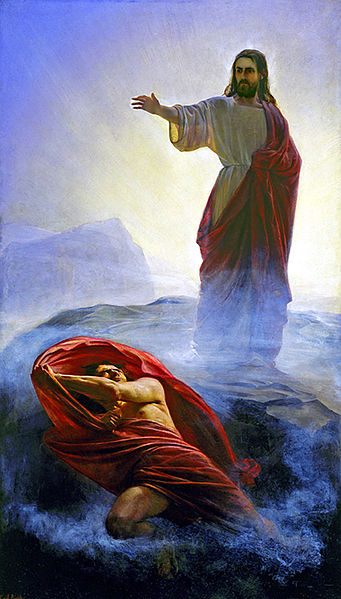
II Corinthians 6:1-10  *  Matthew 4:1-11
Pelagius was Britain's first- sadly not last- heretic, and he taught that man was not really dead in trespasses and sins by Adam's transgression. His doctrine was that one could pull himself up by his own bootstraps, and become holy by sheer will power. Never mind everything St. Paul wrote about the weakness of the flesh. Never mind the words of Jesus: "Ye are from beneath; I am from above: ye are of this world; I am not of this world."1 Well, in my lifetime a new kind of Pelagianism captured the imagination of some twentieth century clergy. Because they had embraced, essentially, a quasi-Unitarian view of God, they were unable to accept the Gospel.
          To accept the Gospel you must come to a very simple recognition of fact: Life is not a test. Those who teach, in the name of religion, that life is a test, and at the end you get a passing or failing grade, will never understand the portion of the Gospel according to Matthew that we read this first Sunday in Lent. Like Pelagius of old, his modern followers cannot see that Christ came in the fullness of his divine nature, taking our finite and mortal human nature into his uncreated eternal life. They cannot see that He reached down and saved us from sin and death, that His cross and passion were the sacrifice by which we receive forgiveness of sins, and that He was raised again for our justification; that only by His cross and passion, and glorious resurrection and ascension, are we given life and immortality. They cannot see that He did for us what we could not do for ourselves. Life is not a test; it is a shipwreck. Christ did not come to prepare us for a test; He came to rescue us, to pull us out of the sea of sin and death and place our feet on solid ground. If life were a test we would all get an "f" and be cast into Hell. But, the Gospel is this: "For God sent not his Son into the world to condemn the world; but that the world through him might be saved."2     
So, the message of today's Gospel is not, "imitate Jesus: if he could do it so can you." Yes, try to imitate Jesus the best you can by doing always what pleases the Father. But, when, not “if” but when, you fail, confess your sins and be forgiven. This is one area in which you cannot imitate Jesus, for he had no sins to repent of. We have no power in ourselves, of ourselves, to save ourselves. The temptations of Jesus in this passage from Matthew are strange to us. They exist on a higher level than the carnality we must wrestle with. I have never been tempted to use divine power to turn stones into bread. Have any of you? I have been tempted to eat when I was fasting, and tempted to satisfy the body in ways that are outside of God's will; but, never to turn stones into bread.  We need to examine these temptations in light of what they were for Christ, and in light of what they mean for us. Two things that come to our aid are from St. Paul. One is the line, "There hath no temptation taken you but such as is common to man: but God is faithful, who will not suffer you to be tempted above that ye are able; but will with the temptation also make a way to escape, that ye may be able to bear it." 3 The other is, "But not as the offence, so also is the free gift. For if through the offence of one many be dead, much more the grace of God, and the gift by grace, which is by one man, Jesus Christ, hath abounded unto many."4          
With these passages in mind, let us think of the temptations Christ endured, first in terms of their meaning in his life, and then what they mean for us. Always remember this; Christ being holy and sinless was not a fallen creature. Modern English usage gives us the mistaken idea that temptation implies something in us that is weak encountering what is alluring to us. But, it simply means, as used here in scripture in its original Greek, that the devil tried to put Christ to the test. Now Jesus was the Word made flesh, the fullness of the Godhead dwelling bodily among us, fully God and fully man. It was not the fullness of His divine nature shrunken down into humanity, but the raising of human nature into His infinite Divine Person. For us, the temptations that come are common to man. To the holy, righteous savior, born of a virgin by the Holy Spirit instead of the seed of a fallen man, He is the pure and perfect man. These temptations we read about in this chapter of Matthew were not common to man, in one sense, but were common to man in another sense.
The first temptation was this: "If thou be the Son of God, command that these stones be made bread." The temptation was to use His Divine power in a way that was foreign to his very character as God. In everything we see from creation, God always used his power to make, that is, to give. Everything is grace, including life itself. The creation of life, including human life, met no need of God, for God has need of nothing.5 All of God's creative work was because of His love, by which love He gives, seeking nothing for Himself.6 The Son of God came into the world because of God's immeasurable love, with the intention of sharing the humility of a creature, and suffering the death of the cross as the Atonement, that which no sinner could make either for himself or as a ransom for his brother. The will of God foretold by the Prophets, that Christ rose again on third day, was for our sakes; by His resurrection He meets our greatest need, the gift of eternal life to save us from the full power of the grave. With mighty signs and wonders He went about "doing good, healing all who were oppressed by the Devil."7 But, here, in the desert wilderness after forty days of fasting, He was tempted by the Devil to use miraculous power strictly for Himself. But, that creative power had only been used in charity, that is, agape- the love of God.         
The second temptation was to throw Himself down from the temple, that is, to put the truth itself on trial. It is this temptation that demonstrates the cunning of Satan in his misuse of the very scriptures themselves. Notice how he misquotes the Psalm, taking it out of its context that teaches us not to fear death as an ultimate power, so that its meaning is reduced to something no bigger than this mortal life. Notice too the addition of three words not in the real Psalm: "lest thou strike thy foot against a stone" becomes, in the Devil's mouth, "lest at any time thou strike thy foot against a stone." At any time?  The condition is taken away, and the promise mis-stated. This temptation was to place the word of God on trial, and to do so by using an arbitrary and false measure, one forbidden by the Law itself, namely, testing God. 
The final temptation is subtle indeed. "The devil taketh Him up into an exceeding high mountain, and sheweth Him all the kingdoms of the world, and the glory of them; and saith unto Him, All these things will I give thee, if thou wilt fall down and worship me." It is the plan of God that all nations serve and obey Christ when he comes in His kingdom 8. When He comes again in glory, this will happen, and will happen in a way far beyond our present ability to perceive. Understand the nature of this temptation for what it was: This temptation was to avoid the cross. Remember one day, as we read later on in the Gospel According to St. Matthew, when the Lord predicted his coming suffering and death, that Peter, "…took Him, and began to rebuke Him, saying, 'Be it far from thee, Lord: this shall not be unto thee.' But He turned, and said unto Peter, 'Get thee behind me, Satan: thou art an offence unto me: for thou savourest not the things that be of God, but those that be of men.'"9      
The temptation was to arrive early at the goal by abandoning the Father's will, by avoiding the suffering and death which alone could reconcile man to God without any compromise of His holiness, and which in making sacrifice also shows the seriousness of our sins to change us morally. Retire early, avoid the suffering, do not take up the cross. Such a decision would have been to turn away from the Father indeed.      

In fact, there was no danger that Christ would yield to this. But we see important things for our own edification. The book of Genesis describes the Fall this way:


"And the serpent said unto the woman, Ye shall not surely die: For God doth know that in the day ye eat thereof, then your eyes shall be opened, and ye shall be as gods, knowing good and evil. And when the woman saw that the tree was good for food, and that it was pleasant to the eyes, and a tree to be desired to make one wise, she took of the fruit thereof, and did eat, and gave also unto her husband with her; and he did eat."10 


Look at these three things: 1) Good for food. 2) Pleasant to the eyes. 3) Desired to make one wise. Compare this to the words of St. John:


"Love not the world, neither the things that are in the world. If any man love the world, the love of the Father is not in him. For all that is in the world, the lust of the flesh, and the lust of the eyes, and the pride of life, is not of the Father, but is of the world. And the world passeth away, and the lust thereof: but he that doeth the will of God abideth for ever."11  


Compare the two lists: "Good for food" to "the lust of the flesh." We forget that the lust of the flesh is not only sexual lusts and passions, but also all other things that drag us away from God because of their direct effect on the desires of the body. This includes abuse of sex and of food, but also, for example, the abuse of drugs and alcohol that destroys lives and families. Beyond the obvious, read the fifth chapter of St. Paul's Epistle to the Galatians about "the works of the flesh" that are the opposite of "the fruit of the Spirit."
          Compare "Pleasant to the eyes" with "the lust of the eyes." Remember the words of St. Paul: "For I had not known lust, except the law had said, Thou shalt not covet."12 The lust of the eyes is what Jesus spoke of when He said that it is the sin of adultery to look on a woman to lust after her. He was simply driving home the point already in the Law of Moses, in the tenth Commandment: "Thou shalt not covet thy neighbor's wife, etc."13 The lust of the eyes is never content with the gifts that God has given, and is the opposite of that love that "seeketh not her own." It wants more, even if your neighbor is deprived or diminished. The lust of the eyes does not give thanks to God for what He has given, but finds fault with Him for not trying to spoil us to our seemingly infinite satisfaction – that bottomless pit of increasing desire. As the writer to the Hebrews put it, "Let your conversation be without covetousness; and be content  with such things as ye have: for He hath said, I will never leave thee, nor forsake thee."14 Giving in to the lust of the eyes is like drinking seawater. It never satisfies, and indeed, each drink of the seawater (that is, saltwater) only makes one thirstier and thirstier, leading to death by dehydration, and only after madness.


Compare "it was desired to make one wise" to "the pride of life." Pride requires an illusion. The truth makes a man humble. The truth is the very opposite of Pelagianism; for the fact is, you cannot go one day without committing sins if only in your thoughts. The truth is, you cannot keep your own soul alive. The truth is contrary to "Motivational Seminars," which teach the sin of pride a thousand different ways. Every day, in every way, it is not getting better and better; no not at all. You are aging, and as your eyes fail, and your hair gets gray or falls out, and your skin wrinkles, you are reminded that, however long you live, the body is subject to the dying process 15. This is part of the Fall. Pride says life must be a test, and we can pass it. Humility says, "God I have earned no better than an a failing grade. Save me from sin and death." A man trying to stay afloat in a shipwreck has no time to impress anybody; he must, with the humility that realism brings, accept salvation from his rescuer.   Christ overcame the things that are in the world. "The world" in this sense, that has only these three sinful categories: The lust of the flesh, the lust of the eyes and the pride of life. The world, in that sense, is best described in the first chapter of John's Gospel: "He was in the world, and the world was made by him, and the world knew him not." The world is fallen into the state of not knowing its Creator, even in His Incarnation.16  This season of Lent, learn the humility to take seriously these three enemies: The world, the Flesh and the Devil. Learn to fight the temptations that come through "the things that are in the world." Jesus used the scriptures, the sword of the Spirit; so, you need to know the word of God, to read, mark, learn and inwardly digest it.17 The disciplines of Lent are useful indeed. Fasting is a way to humble our souls before God,18 and giving is away to show gratitude to the Lord.


Let us have a holy Lent, knowing that without Him, we can do nothing.19


1) John 8:23

2) John 3:17

3) I Corinthians 10:13

4) Romans 5:15
5) Acts 17:25
6) I Corinthians 13:5
7) Acts 10:38
8) Psalm 2
9) Matthew 16:22, 23
10) Genesis 3:4-6
11) I John 2:15-17
12) Romans 7:7
13) Cp. Exodus 20:17 to Matthew 5:28
14) Hebrews 13:5
15) See my sermon for Trinity XVI.
16) John 1:10
17) Ephesians 6:17, in context.
18) Psalm 35:18
19) John 15:5