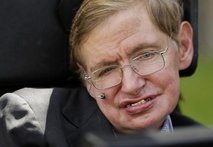
God did not create the universe, says Hawking
By Michael Holden Michael Holden – Thu Sep 2, 9:08 am ET
LONDON (Reuters) – God did not create the universe and the "Big Bang" was an inevitable consequence of the laws of physics, the eminent British theoretical physicist Stephen Hawking argues in a new book.
In "The Grand Design," (Continuum editorial comment: Design? Does he really mean to use that word?) co-authored with U.S. physicist Leonard Mlodinow, Hawking says a new series of theories made a creator of the universe redundant, according to the Times newspaper which published extracts on Thursday.
"Because there is a law such as gravity, the universe can and will create itself from nothing (A law which just happens to exist without any origin or design?). Spontaneous creation is the reason there is something rather than nothing, why the universe exists, why we exist," Hawking writes.
"It is not necessary to invoke God to light the blue touch paper and set the universe going."
Hawking, 68, who won global recognition with his 1988 book "A Brief History of Time," an account of the origins of the universe, is renowned for his work on black holes, cosmology and quantum gravity.
Since 1974, the scientist has worked on marrying the two cornerstones of modern physics -- Albert Einstein's General Theory of Relativity, which concerns gravity and large-scale phenomena, and quantum theory, which covers subatomic particles.
His latest comments suggest he has broken away from previous views he has expressed on religion. Previously, he wrote that the laws of physics meant it was simply not necessary to believe that God had intervened in the Big Bang.
He wrote in A Brief History ... "If we discover a complete theory, it would be the ultimate triumph of human reason -- for then we should know the mind of God."
In his latest book, he said the 1992 discovery of a planet orbiting another star other than the Sun helped deconstruct the view of the father of physics Isaac Newton that the universe could not have arisen out of chaos but was created by God.
"That makes the coincidences of our planetary conditions -- the single Sun, the lucky combination of Earth-Sun distance and solar mass, far less remarkable, and far less compelling evidence that the Earth was carefully designed just to please us human beings," he writes. ("Coincidence" was never the argument made by believers. Yet he uses the simple fact that the universe makes sense to argue random chance. All he has proved is that a giant intellect really can inhabit a tiny mind after all.)
Last year he announced he was stepping down as Cambridge University's Lucasian Professor of Mathematics, a position once held by Newton and one he had held since 1979.
"The Grand Design" is due to go on sale next week.
__________
It is all too easy to refute-like shooting fish in a barrel. let us extend his argument about the universe to particular details within it.
We could argue, using the same logic:
"There was no J.S. Bach. The perfectly logical but random design of tones and timing explains why the sounds we hear as music make sense to our minds. But, in fact, they are not really music, but merely vibrations interacting with our ears and our brains, randomly designed by no one. The existence of our ears and brains makes the coincidence of apparent order in the arrangement of vibrations (appearing to be tones and rhythm) less remarkable. We don't need any longer to believe in some Being we call a composer."
And, we could argue, also using Hawking's brand of logic:
"There was no Frank Lloyd Wright. Research has uncovered foundations resting beneath all of the buildings previously credited to Wright, proving that they were not the design of some Being we call an architect, but the design of the same random chance that placed foundations on those spots. It was inevitable that buildings would be the result of those foundations, all of which just happened to be there anyway. The foundations make the coincidence of the buildings less remarkable"
My brother, David Bentley Hart, is so right about the disappointing intellectual state of contemporary atheists. They present no intellectual challenge whatsoever.
