As Sunday approaches, and as I have a long quiet afternoon, I have begun reading George Herbert's Countrey Parson, courtesy of Project Canterbury. The following is Chapter 8, The Parson Preaching.
"The Countrey Parson preacheth constantly, the pulpit is his joy and his throne: if he at any time intermit, it is either for want of health, or against some great Festivall, that he may the better celebrate it, or for the variety of the hearers, that he may be heard at his returne more attentively. When he intermits, he is ever very well supplyed by some able man who treads in his steps, and will not throw down what he hath built; whom also he intreats to press some point, that he himself hath often urged with no great success, that so in the mouth of two or three witnesses the truth may be more established. When he preacheth, he procures attention by all possible art, both by earnestnesse of speech, it being naturall to men to think, that where is much earnestness, there is somewhat worth hearing; and by a diligent, and busy cast of his eye on his auditors, with letting them know, that he observes who marks, and who not; and with particularizing of his speech now to the younger sort, then to the elder, now to the poor, and now to the rich. This is for you, and This is for you; for particulars ever touch, and awake more then generalls. Herein also he serves himselfe of the judgements of God, as of those of antient times, so especially of the late ones; and those most, which are nearest to his Parish; for people are very attentive at such discourses, and think it behoves them to be so, when God is so neer them, and even over their heads. Sometimes he tells them stories, and sayings of others, according as his text invites him; for them also men heed, and remember better then exhortations; which though earnest, yet often dy with the Sermon, especially with Countrey people; which are thick, and heavy, and hard to raise to a poynt of Zeal, and fervency, and need a mountaine of fire to kindle them; but stories and sayings they will well remember. He often tels them, that Sermons are dangerous things, that none goes out of Church as he came in, but either better, or worse; that none is careless before his Judg, and that the word of God shal judge us. By these and other means the Parson procures attention; but the character of his Sermon is Holiness; he is not witty, or learned, or eloquent, but Holy. A Character, that Hermogenes never dream'd of, and therefore he could give no precepts thereof. But it is gained, first, by choosing texts of Devotion, not Controversie, moving and ravishing texts, whereof the Scriptures are full. Secondly, by dipping, and seasoning all our words and sentences in our hearts, before they come into our mouths, truly affecting, and cordially expressing all that we say; so that the auditors may plainly perceive that every word is hart-deep. Thirdly, by turning often, and making many Apostrophes to God, as, Oh Lord blesse my people, and teach them this point; or, Oh my Master, on whose errand I come, let me hold my peace, and do thou speak thy selfe; for thou art Love, and when thou teachest, all are Scholers. Some such irradiations scatteringly in the Sermon, carry great holiness in them. The Prophets are admirable in this. So Isa. 64 [:1]. Oh that thou would' st rent the Heavens, that thou wouldst come down, &c. And Jeremy Chapt. 10 [:23]. after he had complained of the desolation of Israel, turnes to God suddenly, Oh Lord, I know that the way of man is not in himself, &c. Fourthly, by frequent wishes of the peoples good, and joying therein, though he himself were with Saint Paul even sacrificed upon the service of their faith. For there is no greater sign of holinesse, then the procuring, and rejoycing in anothers good. And herein St Paul excelled in all his Epistles. How did he put the Romans in all his prayers? Rom.1.9. And ceased not to give thanks for the Ephesians, Eph. 1.16. And for the [II] Corinthians, chap. 1.4. And for the Philippians made request with joy, ch.1.4. And is in contention for them whither to live, or dy; be with them, or Christ, verse 23. which, setting aside his care of his Flock, were a madnesse to doubt of. What an admirable Epistle is the second to the Corinthians? how full of affections? he joyes, and he is sorry, he grieves, and he gloryes, never was there such care of a flock expressed, save in the great shepherd of the fold, who first shed teares over Jerusalem, and afterwards blood. Therefore this care may be learn'd there, and then woven into Sermons, which will make them appear exceeding reverend, and holy. Lastly, by an often urging of the presence, and majesty of God, by these, or such like speeches. Oh let us all take heed what we do, God sees us, he sees whether I speak as I ought, or you hear as you ought, he sees hearts, as we see faces: he is among us; for if we be here, hee must be here, since we are here by him, and without him could not be here. Then turning the discourse to his Majesty, And he is a great God, and terrible, as great in mercy, so great in judgement: There are but two devouring elements, fire, and water, he hath both in him; His voyce is as the sound of many waters. Revelations 1 [:15]. And he himselfe is a consuming fire, Hebrews 12 [:29]. Such discourses shew very Holy. The Parsons Method in handling of a text consists of two parts; first, a plain and evident declaration of the meaning of the text; and secondly, some choyce Observations drawn out of the whole text, as it lyes entire, and unbroken in the Scripture it self. This he thinks naturall, and sweet, and grave. Whereas the other way of crumbling a text into small parts, as, the Person speaking, or spoken to, the subject, and object, and the like, hath neither in it sweetnesse, nor gravity, nor variety, since the words apart are not Scripture, but a dictionary, and may be considered alike in all the Scripture. The Parson exceeds not an hour in preaching, because all ages have thought that a competency, and he that profits not in that time, will lesse afterwards, the same affection which made him not profit before, making him then weary, and so he grows from not relishing, to loathing."
Full text of book here
Saturday, October 14, 2006

In All Things, Charity
I would like to draw readers' attention to a pastoral letter here,
jointly signed by the bishops of the Anglican Province of America and the Reformed Episcopal Church in which they plea for greater unity among traditional Anglicans.
In particular, it draws attention to the Federation of Anglican Churches in the Americas here, which it says "has been created to allow separate organizational structures.
The letter says that, "through FACA we want to forge a deeper union between us. It will facilitate growing into the unity that we possess."
In addition to the APA and the REC, the federation also encompasses the Anglican Church in America and the Anglican Mission in America.
I am not nearly the theological expert that are Fathers Hart and Kirby, but it would seem to me that the FACA might provide the vehicle for the unity we so desperately need within the continuing movement, at least in terms of full inter-communion and cooperation in evangelistic and charitable works, if not full structural unity. In short, that it might prove to be the haven to which those now preparing to flee the apostate Episcopal Church might flee.
In that respect, I direct your attention to a recent speech">details here to the Forward in Faith synod in London by the Rt Revd Keith Ackerman, Bishop of Quincy.
This piece says, in part, "outlining the difficulties Anglo-Catholics face in North America, Ackerman said there were 53 separate denominations of continuing churches, with some wanting to be in communion with Canterbury, but not all. 'It is difficult for us to know the path we are to take.' (my emphasis)
"The Anglo-Catholic bishop said that half of his class from Nashotah House is now with the Roman Catholic, Antiochian and numerous continuing churches. "There is not a place for the Anglo-Catholic."(my emphasis)
Bishop Ackerman's lament is not the first such comment I have heard, particularly within the Church of England, where there seems to be little awareness even of the existence of the continuing movement. But I have also heard it from America. A very orthodox TEC priest I know there recently commented that he saw his only options as Rome and Constaninople, because there was "nowhere else" for him to go.
I am raising two questions here, the first in two parts. Could the FACA serve as a prototype for a sort of Alternative Anglican Communion, and are the Anglican Catholic Church and the Anglican Province of Christ the King giving thought to joining it? Secondly, as I so often ask, without ever getting much response, why is it that the continuing movement is so poorly known, and so often belittled when it is known?
jointly signed by the bishops of the Anglican Province of America and the Reformed Episcopal Church in which they plea for greater unity among traditional Anglicans.
In particular, it draws attention to the Federation of Anglican Churches in the Americas here, which it says "has been created to allow separate organizational structures.
The letter says that, "through FACA we want to forge a deeper union between us. It will facilitate growing into the unity that we possess."
In addition to the APA and the REC, the federation also encompasses the Anglican Church in America and the Anglican Mission in America.
I am not nearly the theological expert that are Fathers Hart and Kirby, but it would seem to me that the FACA might provide the vehicle for the unity we so desperately need within the continuing movement, at least in terms of full inter-communion and cooperation in evangelistic and charitable works, if not full structural unity. In short, that it might prove to be the haven to which those now preparing to flee the apostate Episcopal Church might flee.
In that respect, I direct your attention to a recent speech">details here to the Forward in Faith synod in London by the Rt Revd Keith Ackerman, Bishop of Quincy.
This piece says, in part, "outlining the difficulties Anglo-Catholics face in North America, Ackerman said there were 53 separate denominations of continuing churches, with some wanting to be in communion with Canterbury, but not all. 'It is difficult for us to know the path we are to take.' (my emphasis)
"The Anglo-Catholic bishop said that half of his class from Nashotah House is now with the Roman Catholic, Antiochian and numerous continuing churches. "There is not a place for the Anglo-Catholic."(my emphasis)
Bishop Ackerman's lament is not the first such comment I have heard, particularly within the Church of England, where there seems to be little awareness even of the existence of the continuing movement. But I have also heard it from America. A very orthodox TEC priest I know there recently commented that he saw his only options as Rome and Constaninople, because there was "nowhere else" for him to go.
I am raising two questions here, the first in two parts. Could the FACA serve as a prototype for a sort of Alternative Anglican Communion, and are the Anglican Catholic Church and the Anglican Province of Christ the King giving thought to joining it? Secondly, as I so often ask, without ever getting much response, why is it that the continuing movement is so poorly known, and so often belittled when it is known?
British Airways ... Repent!
I was tempted to head this post "Boycott BA!", but that would have been unfair.
Instead, perhaps justice might be better served by expressing profound disapproval of what the company has done and calling on BA to publicly announce a reversal of its policies.
I refer here to a story in the Daily Mail entitled Christian BA employee suspended for wearing cross necklace. Read it all here
The story reads, in part:
"The airline's uniform code states that staff must not wear visible jewellery or other 'adornments' while on duty without permission from management.
"It makes exceptions for Muslim and Sikh minorities by allowing them to wear hijabs and turbans.
"Under rules drawn up by BA's 'diversity team' and 'uniform committee', Sikh employees can even wear the traditional iron bangle - even though this would usually be classed as jewellery - while Muslim workers are also allowed prayer breaks during work time.
"But Miss Eweida, 55, from Twickenham, insisted her cross, which is smaller than a ten pence piece, was not jewellery but an expression of her deep Christian faith.
"She questioned why she was being forced to hide her religion when BA's Muslim and Sikh workers could express theirs.
"Miss Eweida said last night: "I will not hide my belief in the Lord Jesus. British Airways permits Muslims to wear a headscarf, Sikhs to wear a turban and other faiths religious apparel.
"Only Christians are forbidden to express their faith. I am a loyal and conscientious employee of British Airways, but I stand up for the rights of all citizens..."
"Miss Eweida is suing BA under the Employment Equality (Religion or Belief) Regulations 2003.
"Her case is being supported by her union, the TGWU, and she has hired Paul Diamond, a barrister specialising in religious affairs and an adviser for the Keep Sunday Special campaign, to represent her at her employment tribunal.
"And a petition of support has been signed by more than 200 fellow workers."
Instead, perhaps justice might be better served by expressing profound disapproval of what the company has done and calling on BA to publicly announce a reversal of its policies.
I refer here to a story in the Daily Mail entitled Christian BA employee suspended for wearing cross necklace. Read it all here
The story reads, in part:
"The airline's uniform code states that staff must not wear visible jewellery or other 'adornments' while on duty without permission from management.
"It makes exceptions for Muslim and Sikh minorities by allowing them to wear hijabs and turbans.
"Under rules drawn up by BA's 'diversity team' and 'uniform committee', Sikh employees can even wear the traditional iron bangle - even though this would usually be classed as jewellery - while Muslim workers are also allowed prayer breaks during work time.
"But Miss Eweida, 55, from Twickenham, insisted her cross, which is smaller than a ten pence piece, was not jewellery but an expression of her deep Christian faith.
"She questioned why she was being forced to hide her religion when BA's Muslim and Sikh workers could express theirs.
"Miss Eweida said last night: "I will not hide my belief in the Lord Jesus. British Airways permits Muslims to wear a headscarf, Sikhs to wear a turban and other faiths religious apparel.
"Only Christians are forbidden to express their faith. I am a loyal and conscientious employee of British Airways, but I stand up for the rights of all citizens..."
"Miss Eweida is suing BA under the Employment Equality (Religion or Belief) Regulations 2003.
"Her case is being supported by her union, the TGWU, and she has hired Paul Diamond, a barrister specialising in religious affairs and an adviser for the Keep Sunday Special campaign, to represent her at her employment tribunal.
"And a petition of support has been signed by more than 200 fellow workers."
Monday, October 02, 2006
Trinity XVI and more on the clash of civilizations
Having returned late on Saturday night from Fond du Lac Wisconsin, my Sunday sermon was ad libbed. But, as I read my 2005 sermon for the same Sunday, I saw its relevance to a topic that is of very immediate concern. The date of the Sixteenth Sunday after Trinity in 2005 just happened to be September 11th, and my thoughts were very much on the contrast between Christ's compassion, and the madness of Islamic mass murder. Relevant to this are words from the introduction to the first encyclical of Pope Benedict XVI (now available in book form, and adding to the Ratzinger theological corpus), Deus Caritas Est (God is Love). I quote: "In a world where the name of God is sometimes associated with vengeance or even a duty of hatred and violence, this message [of God's love] is both timely and significant." Amen to that. The compassion of Christ that moved Him to overturn the death of a young man in order to relieve the grief of one widow teaches us the nature of our faith. And, it stands in contrast to the spirit of evil, the teaching of antichrist.
We need to know why the first commandment is against worshiping any god other than the true God. In the long history of false religion, everything from paganism to pseudo-Christian cults, the terrible reality is that cruelty has been quite the normal thing. The ancient idols, spoken of in the Bible, were served through such things as human sacrifice, especially the sacrifice of children. When people shun the story of Abraham offering Isaac, and speak about how terrible the story is, they miss the whole point. Aside from the obvious theological truth in which Isaac carries the wood up the hill, and represents the Lord Jesus Who offered Himself for our sins on the cross, is a practical point as well. When God put Abraham through that ordeal, and then told him not to harm Isaac, the point was made to the people of Israel that the true God does not want the blood of children to be offered to Him; that such tragic sacrifices as were made to Molech of the people’s infants, and that are made today whenever children are murdered by abortion, are an abomination to God. It never entered His mind. He has never wanted any such thing to be done. And, since suicide and mass murder are a kind of sacrifice offered by Muslim terrorists to their god, these violent acts belong to the same category of religious abomination.
False religion brings death. And, contrary to the spirit of error and violence, in today’s Gospel Christ acts out of compassion to give life. The difference between true religion and false religion is the difference between revelation and error. The ultimate revelation is the Incarnation; the Person of the Son of God among us as a human being; someone we can see, hear and touch. If I may digress, the entire message of Mohamed was a rejection of the Gospel of Jesus Christ. Mohamed came along in the 7th Century and created a religion in which God has no Son, and in which the word “Antichrist” achieved its most appropriate usage. For Islam really is Antichrist in the most accurate sense of that word. It rejects the truth that Jesus Christ is come in the flesh, that is, that He is both fully God of one substance with His Father, and fully man, taking human nature from His blessed Virgin Mother (I John 4:1-3).
They call us idolaters, because we worship Christ. But, the difference between true religion and false religion is the difference of revelation- that is, what God has revealed. And, the greatest revelation is Jesus Christ, God with us, the Word made flesh. So, you see, now that Jesus Christ has come in the flesh, and we have come to know the truth of His two natures in one Person, what we embrace in Jesus Christ is the revelation of God. Once we know that Jesus Christ is come in the flesh, it would be idolatry to worship only a god that cannot be seen, heard and touched. Let me quote to you the opening of Saint John’s First Epistle:
“1: That which was from the beginning, which we have heard, which we have seen with our eyes, which we have looked upon, and our hands have handled, of the Word of life;
2: (For the life was manifested, and we have seen it, and bear witness, and shew unto you that eternal life, which was with the Father, and was manifested unto us;)
3: That which we have seen and heard declare we unto you, that ye also may have fellowship with us: and truly our fellowship is with the Father, and with his Son Jesus Christ.
4: And these things write we unto you, that your joy may be full.”
When God took Abraham up the mountain and taught against human sacrifice (while foreshadowing the crucifixion of His own Son), and later, when He told the people, through His prophet Moses, that they were to worship no other god, these things were done out of compassion for mankind. That compassion reached its highest expression when God the Son appeared in human form. It continues to this day through the Church, which continues the same mission given to Saint Paul, the mission to bring people out of darkness and ignorance into the light of the Gospel. That is your mission and mine. When the Lord Jesus appeared to Saul on the road to Damascus, and began to transform him into Saint Paul the Apostle, He called him to take his part in this mission of compassion. The Lord spoke to him about “…the Gentiles, unto whom now I send thee, to open their eyes, and to turn them from darkness to light, and from the power of Satan unto God, that they may receive forgiveness of sins, and inheritance among them which are sanctified by faith that is in me (Acts 26: 17, 18).”
Because Jesus showed His compassion for a grieving mother by restoring her dead son to life, we see in this story what the Incarnation means. It means that Christ is, as the Orthodox Church has always put it, “the Lover of mankind.” God is among us in His love and compassion, if we will but free our minds of petty things that reduce our religion into something small. This very day, when you come to the altar rail for the sacrament, you will be touching and tasting Jesus Christ. This is not idolatry; it is the revelation of God. He is among us to give life, as the One Who has the power to give life when others can give only death. He gives us His own life, for His flesh is food indeed, and His blood is drink indeed. The Word, the Life manifested who our eyes will see, and our hands will handle, has come and will come to do what only God can do. He gives life to the dead.
Trinity XVI (2005)
Eph. 3:13-21 Luke 7:11-17
Anyone can speak death, and anyone can inflict death; but, only the word of God has the power to give life. Among the many things we see in today’s Gospel, we see life being given to the dead, and we see compassion. What a stark contrast we see between true and false religion. In Christ we see compassion and the giving of life. We see the opposite, the spirit of Antichrist, in Islamist terrorists who think that by killing us, they do God service. It is fitting to remember that today, only the fourth anniversary of that painful day when over three thousand people were killed in New York, and several more at the Pentagon; and more died heroically by making sure their plane crashed in Pennsylvania instead of hitting its target. It is fitting to remember them in our prayers on this day, September 11th.
We need to know that a false understanding about God has terrible consequences. No wonder, in the first chapter of his Epistle to the Galatians, Saint Paul told his children in the faith that anyone who would preach to them a false gospel is under a curse. That is, such a one has no true power. For true power is not the ability to curse, to inflict death and suffering; and we need not fear those who can do these things. Neither is true power the ability to deceive. If we grant power to such people, we are joining them in a cursed and barren existence. False ideas about God can be fatal. Just ask anyone who has seen a Jehovah’s Witness die an unnecessary death rather than receive something as simple and available as a blood transfusion.
Eph. 3:13-21 Luke 7:11-17
Anyone can speak death, and anyone can inflict death; but, only the word of God has the power to give life. Among the many things we see in today’s Gospel, we see life being given to the dead, and we see compassion. What a stark contrast we see between true and false religion. In Christ we see compassion and the giving of life. We see the opposite, the spirit of Antichrist, in Islamist terrorists who think that by killing us, they do God service. It is fitting to remember that today, only the fourth anniversary of that painful day when over three thousand people were killed in New York, and several more at the Pentagon; and more died heroically by making sure their plane crashed in Pennsylvania instead of hitting its target. It is fitting to remember them in our prayers on this day, September 11th.
We need to know that a false understanding about God has terrible consequences. No wonder, in the first chapter of his Epistle to the Galatians, Saint Paul told his children in the faith that anyone who would preach to them a false gospel is under a curse. That is, such a one has no true power. For true power is not the ability to curse, to inflict death and suffering; and we need not fear those who can do these things. Neither is true power the ability to deceive. If we grant power to such people, we are joining them in a cursed and barren existence. False ideas about God can be fatal. Just ask anyone who has seen a Jehovah’s Witness die an unnecessary death rather than receive something as simple and available as a blood transfusion.
We need to know why the first commandment is against worshiping any god other than the true God. In the long history of false religion, everything from paganism to pseudo-Christian cults, the terrible reality is that cruelty has been quite the normal thing. The ancient idols, spoken of in the Bible, were served through such things as human sacrifice, especially the sacrifice of children. When people shun the story of Abraham offering Isaac, and speak about how terrible the story is, they miss the whole point. Aside from the obvious theological truth in which Isaac carries the wood up the hill, and represents the Lord Jesus Who offered Himself for our sins on the cross, is a practical point as well. When God put Abraham through that ordeal, and then told him not to harm Isaac, the point was made to the people of Israel that the true God does not want the blood of children to be offered to Him; that such tragic sacrifices as were made to Molech of the people’s infants, and that are made today whenever children are murdered by abortion, are an abomination to God. It never entered His mind. He has never wanted any such thing to be done. And, since suicide and mass murder are a kind of sacrifice offered by Muslim terrorists to their god, these violent acts belong to the same category of religious abomination.
False religion brings death. And, contrary to the spirit of error and violence, in today’s Gospel Christ acts out of compassion to give life. The difference between true religion and false religion is the difference between revelation and error. The ultimate revelation is the Incarnation; the Person of the Son of God among us as a human being; someone we can see, hear and touch. If I may digress, the entire message of Mohamed was a rejection of the Gospel of Jesus Christ. Mohamed came along in the 7th Century and created a religion in which God has no Son, and in which the word “Antichrist” achieved its most appropriate usage. For Islam really is Antichrist in the most accurate sense of that word. It rejects the truth that Jesus Christ is come in the flesh, that is, that He is both fully God of one substance with His Father, and fully man, taking human nature from His blessed Virgin Mother (I John 4:1-3).
They call us idolaters, because we worship Christ. But, the difference between true religion and false religion is the difference of revelation- that is, what God has revealed. And, the greatest revelation is Jesus Christ, God with us, the Word made flesh. So, you see, now that Jesus Christ has come in the flesh, and we have come to know the truth of His two natures in one Person, what we embrace in Jesus Christ is the revelation of God. Once we know that Jesus Christ is come in the flesh, it would be idolatry to worship only a god that cannot be seen, heard and touched. Let me quote to you the opening of Saint John’s First Epistle:
“1: That which was from the beginning, which we have heard, which we have seen with our eyes, which we have looked upon, and our hands have handled, of the Word of life;
2: (For the life was manifested, and we have seen it, and bear witness, and shew unto you that eternal life, which was with the Father, and was manifested unto us;)
3: That which we have seen and heard declare we unto you, that ye also may have fellowship with us: and truly our fellowship is with the Father, and with his Son Jesus Christ.
4: And these things write we unto you, that your joy may be full.”
When God took Abraham up the mountain and taught against human sacrifice (while foreshadowing the crucifixion of His own Son), and later, when He told the people, through His prophet Moses, that they were to worship no other god, these things were done out of compassion for mankind. That compassion reached its highest expression when God the Son appeared in human form. It continues to this day through the Church, which continues the same mission given to Saint Paul, the mission to bring people out of darkness and ignorance into the light of the Gospel. That is your mission and mine. When the Lord Jesus appeared to Saul on the road to Damascus, and began to transform him into Saint Paul the Apostle, He called him to take his part in this mission of compassion. The Lord spoke to him about “…the Gentiles, unto whom now I send thee, to open their eyes, and to turn them from darkness to light, and from the power of Satan unto God, that they may receive forgiveness of sins, and inheritance among them which are sanctified by faith that is in me (Acts 26: 17, 18).”
Because Jesus showed His compassion for a grieving mother by restoring her dead son to life, we see in this story what the Incarnation means. It means that Christ is, as the Orthodox Church has always put it, “the Lover of mankind.” God is among us in His love and compassion, if we will but free our minds of petty things that reduce our religion into something small. This very day, when you come to the altar rail for the sacrament, you will be touching and tasting Jesus Christ. This is not idolatry; it is the revelation of God. He is among us to give life, as the One Who has the power to give life when others can give only death. He gives us His own life, for His flesh is food indeed, and His blood is drink indeed. The Word, the Life manifested who our eyes will see, and our hands will handle, has come and will come to do what only God can do. He gives life to the dead.
Sunday, September 24, 2006
The "Clash of Civilisations"
This article is a modified and shortened version of a sermon given by me on Trinity 13 2006 at St Hilda's Mission, Maitland, NSW, Australia.
Sin, like virtue, has many manifestations. And so, when sinners fight, it is often possible to see fault on each side, as one type of selfishness battles another. Unfortunately, the sins and errors of men, though often incompatible with each other, will unite against their common enemy: Christ and the Church. A modern example of this is the so-called “clash of civilizations” between Islam and the post-Christian West.
Sin, like virtue, has many manifestations. And so, when sinners fight, it is often possible to see fault on each side, as one type of selfishness battles another. Unfortunately, the sins and errors of men, though often incompatible with each other, will unite against their common enemy: Christ and the Church. A modern example of this is the so-called “clash of civilizations” between Islam and the post-Christian West.
The modern West, as it sees itself, stands for individual freedoms and human rights, equality, democracy, and for freedom of inquiry and technological advance. Whereas, from the West's perspective, Islamic fundamentalism stands for oppression, tyranny and ignorance.
But the Islamist sees things differently. He sees politically active Islam, at least potentially, as the means to harmony with God and between people through submission to God’s will. And human reason is one of the things that must also submit. He sees respect within families and orderly authority as guarantees of a successful society when in conjunction with Sharia law enforcing moral health. On the other hand, the West is perceived as devoted to sexual corruption, social disorder, impiety, and thus hypocrisy when it claims superiority.
But what does the Church say? Or, more to the point, what does Christ say through the Scriptures? With Islam and against the secular West we reject the idea that freedom means freedom from responsibility or freedom to sin (Gal. 5.13-15). And we also reject putting individual above the community (1 Cor. 5.1-6), ignoring or artificially undermining traditional gender roles (1 Cor. 11.2-16, 14.34-38), and allowing science or industry carte blanche (1 Cor. 6.12) in their manipulations of nature.
But against the Islamism, and with the West that we helped create, we reject the view that virtue can be coerced by all-encompassing law (Mt. 5.5, Rom. 8.3a, Gal. 3.21) and that women's lives must be utterly submerged as inferiors beneath an overwhelming and self-serving exercise of raw male power (Pr. 31.10-31). Similarly, we do not accept that the egalitarianism, liberty and respect for others consciences which underlie democracy are too risky to allow (cf. Gal. 3.28, 1 Co. 7.23, 8.7-13).
Instead, what the church is for is both liberty and moral order within society (Lev. 25.10, Mic. 4.4, Rom. 13.1-7), and both submission and sacrificial chivalry within the family (Eph. 5.22-29). And so we must be willing to criticise both the West's devotion to lust and the Islamist's devotion to coercive violence, while appealing to both sides to abandon their common illusion: that, with enough moral effort or the right social, economic or technological programme, humanity can solve its fundamental problems and establish near Utopian conditions on Earth. In other words, we must preach the Gospel, including the doctrine of Original Sin, and place our trust in God's grace, not human works.
Ironically, as we do this, even if we “speak the truth in love” (Eph. 4.15), both the secular West and radical Islam will probably still join in despising us. The Islamists pretend to blame us for the sins of the West, while the secular West often pretends to equate devout Christians with Islamic suicide bombers! And it is pretence or self deception. We should not be surprised. The World hates us, just as Jesus predicted. But “greater is he that is in you than he that is in the world” (1 Jn 4.4). So, let us take courage and remember to pray for all those who are deceived.
Update: I wrote the first version of this more than a fortnight ago. Since then, events have perhaps made it seem to some that the "Clash" is primarily between Islam and the Church, rather than Islam and the West. But it is still worth remembeing that many of those in the West criticising Islam (and its recent reactions) are hungering for a showdown with "Islamofascists" out of unChristian hate and a deeply committed libertarianism, whether of the left or the right. It is dangerous for Christians to think "the enemy of my enemy is my friend". We must be careful with whose rhetoric we ally ourselves. I am sure the Pope understands this, judging from what he has said and how he has handled himself. He knows that some of the Muslim criticisms of the modern West are valid and that Islam retains much of value from its Judeo-Christian background. Indeed, this correlates with the point that the Byzantine quoted by the Pope was making: that it was what was new in Islam that was distorted. He was willing to grant there was good in it, but only insofar as it drew on the true Revelation both Christians and Muslims accepted.
TRINITY XV 2006
GALATIANS 6:11-18 MATTHEW 6:24-34
Years ago Diane and I were subjected the spectacle of clergymen who could not think of what to say in their sermons, because the scriptures seemed to them something much too strong for the likes of ordinary people, and they assumed that everyone is afraid of that thing called theology. On a couple of occasions, several years ago, back when I still sat in a pew with my wife, we were treated to exegesis and in depth commentary on a text that appealed to these clergymen more than the passages of scripture that were read in church. And, so it was that they proceeded to expound upon the meaning of a children’s story called The Velveteen Rabbit. Their sermons could be summarized as follows: “hey, like get real, man.” After being tortured by these homilies two or three times, I resolved that, if ever I meet this velveteen rabbit chap I would kill it, and put myself out of its misery. With all of the writers of the Bible, Moses, David, Isaiah, Matthew, Mark, Luke, John and Paul- to name only a few- why is it that anyone would have trouble thinking of something to say?
The problem that some clergymen have with preaching is that they know they are handling dynamite, and it scares them. “The word of God is quick and powerful, sharper than any two edged sword,” says the writer to the Hebrews. When you and I are facing the real life traumas and struggles that threaten to shake either our lives or our faith, or that seem to challenge the very idea that God is good, merciful and kind, it is that objective thing called doctrine, that unchanging Creed, yes, our theology, that provides an anchor in the storm. When the world presents the illusion that our faith can be threatened by some sophisticated and trendy new “final blow to Christianity” (as opposed to last month’s “final blow to Christianity” which died away as soon as the clear light of reason shone upon it), it is theology that keeps us rooted and unshaken. What the teaching of the word of God does for you is by no means some irrelevant academic exercise divorced from the real world. No indeed. It is, rather, the armor and weaponry by which you advance in the knowledge of God and of His Son Jesus Christ, by which you overcome the world through your faith by the power of the Holy Spirit Who is in you. In times of sorrow, in times of joy, in times of suffering, and in times of merriment, the word of God is our daily bread for the mind and for the spirit; it is the lamp for our feet. It does not divorce us from reality because it keeps us rooted and grounded in the truth.
The scriptures today warn us of two kinds of deception, namely the deception of false religion and the deception of the cares of this world. And, what we see connecting these passages of scripture is summed up perfectly by our Lord when He tells us to seek first the kingdom of God and His righteousness. In that seeking we are not escaping reality, rather we are facing it in its fullest. We can face good news and bad, even the fact of our own mortality, with a brand of courage unknown except by faith.
Saint Paul, as I pointed out last week when we read from this same Epistle to the churches in Galatia, saw the need to correct the heresy of self appointed teachers who proclaimed a new and different “gospel.” In the first chapter he told them: “I marvel that ye are so soon removed from him that called you into the grace of Christ unto another gospel: Which is not another; but there be some that trouble you, and would pervert the gospel of Christ. But though we, or an angel from heaven, preach any other gospel unto you than that which we have preached unto you, let him be accursed. As we said before, so say I now again, If any man preach any other gospel unto you than that ye have received, let him be accursed.” These words may sound harsh to people who imagine that all religion is good: But every genuine pastor, every sincere bishop, priest, or deacon, cannot help but agree fully and empathize with the burden that Saint Paul expressed. We cannot simply smile and accept what is taught in cults, or even in churches that are turning away from a clear and faithful adherence to ‘that which has been believed in all times, everywhere and by all” of the true teachers and saints in God’s Holy Catholic Church.
As we learned last week, this heresy was the new teaching that all of the gentiles who had converted to Christ could not be saved unless they were circumcised and kept the Six Hundred and Thirteen Commandments of the Torah as interpreted by the early Talmudic Rabbis of the time. Today we have false teaching of every sort all around us, and it has terrible consequences spiritually, and sometimes physically. For example, the Jehovah’s Witnesses not only teach the Arian and Pneumatimachian heresies by denying the Trinity, by denying the existence of the Holy Spirit, and denying the bodily resurrection of Christ (who appeared to witnesses). They also cause their people to die, and at times have caused the deaths of their own children, by forbidding blood transfusions. It is tragic. For many years my father worked side by side with a good friend, a man we all liked very much, who died at the age of sixty from heart disease. A very simple medicine could have kept him alive to this day; but he was a member of Mary Baker Eddy’s so called “Christian Science Church,” and so he would not take medicine. As a result of his religious beliefs he died before he could retire, before he could meet his grandchildren. The picture we are given of God, by these kinds of doctrines, is very much like the picture given by the teaching that we have to keep the rules of the early Talmudic Rabbis in order to be saved: that is, the picture of God is one of a very unreasonable and harsh taskmaster who demands the impossible without providing grace.
To avoid false gospels we need sound doctrine, and true theology.
In the Gospel Jesus lifts our eyes heavenward. The Book of Common Prayer does something unusual in this passage. It does not use the exact words of the King James Bible, which tells us “give no thought for the morrow.” Instead, this one passage is changed from the King James to translate the words as “be not anxious for the morrow.” Anxiety can take your mind off of the Lord; it can disturb your peace and ruin your whole life. Anxiety is the opposite of faith. Isaiah the prophet tells us: “Thou wilt keep him in perfect peace, whose mind is stayed on thee: because he trusteth in thee. Trust ye in the LORD for ever: for in the LORD, the LORD, is everlasting strength (Isa. 26:3,4).” This strength is real and effective for us here and now in this life, and it is the only strength that lasts forever. No matter what evils come in this life, as people face the death of loved ones, as they face betrayal, economic hardship, illness, and the hostility of an unbelieving world, in the Lord is everlasting strength.
“Look for an example to the suffering of Job” we are told. Let us look as well to the suffering of the Apostles. One of the most moving passages in all of Saint Paul’s Epistles, at least for me, is a personal plea that he wrote near the end of his life to his son in the Faith, Timothy. It is not a deeply theological passage, at least not in an academic sense. It is not a passage that we can use to illuminate our minds with doctrine- and yet is a very useful passage for theology and doctrine if you reflect upon it. In the last chapter of Second Timothy we find two requests. First he wrote: “The cloke that I left at Troas with Carpus, when thou comest, bring with thee, and the books, but especially the parchments.”
Then he wrote, “Do thy diligence to come before winter.” Think about that. When the Romans locked up a prisoner they did not feed him, or tend to his needs. That had to be arranged by family and friends. At the end of his many years of service, which he once described as involving constant persecutions, and other troubles such as shipwrecks, hunger and cold, he had come to this. The Saint, the former Rabbi who was the father of the Gentile Christians, the man who wrote about charity in words more meaningful than any other passage ever written about love, the man who gave us most of the words of the New Testament, bearing in his body the marks of Christ, glorying only and ever in the cross of Christ, had instead of retirement and a nice pension, a cell in a dungeon and a sentence of death. He was going to face Nero’s executioner. To get through his last Winter on this earth he asked Timothy to bring the cloak, and to hurry up and get it to him before the cold winds of Winter could blow through his dungeon cell.
Well, that may not seem like a very deep theological passage. But it is. We see the faith of this saint who looked above the things of this world, this last witness of Christ’s resurrection facing death without fear, suffering the loss of all things with joy. His needs were real. He needed the cloak. Also, he wanted his books, no doubt hand written copies of the Old Testament scriptures. What good were “the books, especially the parchments,” to a man on death row? The answer is, he wanted to keep his mind fed with the word of God, because he knew, living in prison and facing death, that the truth of the word of God was his anchor.
“Seek ye first the Kingdom of God and His righteousness, and all these things shall be added unto you.” Everything you need for this life will be added. You have no cause for anxiety as unbelievers do. But more than that, more than food and drink, clothing and a place to lay your head, in the Lord is everlasting strength, the gift of sharing immortality with the Risen Christ, and the hope of partaking of the Divine nature through grace. You need not fear that the one who died to take away your sins, and who has promised in His resurrection to be with us forever, will change His mind and break His promises. What you need in this life will be provided as you seek first His kingdom and righteousness. But, even more so, “in the Lord is everlasting strength.” The pledge is eternal life through the risen Christ who has overcome death.
This is the faith that takes you through a life of real struggles and temptations. To feed and strengthen this faith you need to know what to rest your hope upon. For that you need the teaching that God has given by the revelation of His word. Dare I say it, you need theology and sound doctrine, because that alone- and no where else- is where you discover the truth of God’s love.
Years ago Diane and I were subjected the spectacle of clergymen who could not think of what to say in their sermons, because the scriptures seemed to them something much too strong for the likes of ordinary people, and they assumed that everyone is afraid of that thing called theology. On a couple of occasions, several years ago, back when I still sat in a pew with my wife, we were treated to exegesis and in depth commentary on a text that appealed to these clergymen more than the passages of scripture that were read in church. And, so it was that they proceeded to expound upon the meaning of a children’s story called The Velveteen Rabbit. Their sermons could be summarized as follows: “hey, like get real, man.” After being tortured by these homilies two or three times, I resolved that, if ever I meet this velveteen rabbit chap I would kill it, and put myself out of its misery. With all of the writers of the Bible, Moses, David, Isaiah, Matthew, Mark, Luke, John and Paul- to name only a few- why is it that anyone would have trouble thinking of something to say?
The problem that some clergymen have with preaching is that they know they are handling dynamite, and it scares them. “The word of God is quick and powerful, sharper than any two edged sword,” says the writer to the Hebrews. When you and I are facing the real life traumas and struggles that threaten to shake either our lives or our faith, or that seem to challenge the very idea that God is good, merciful and kind, it is that objective thing called doctrine, that unchanging Creed, yes, our theology, that provides an anchor in the storm. When the world presents the illusion that our faith can be threatened by some sophisticated and trendy new “final blow to Christianity” (as opposed to last month’s “final blow to Christianity” which died away as soon as the clear light of reason shone upon it), it is theology that keeps us rooted and unshaken. What the teaching of the word of God does for you is by no means some irrelevant academic exercise divorced from the real world. No indeed. It is, rather, the armor and weaponry by which you advance in the knowledge of God and of His Son Jesus Christ, by which you overcome the world through your faith by the power of the Holy Spirit Who is in you. In times of sorrow, in times of joy, in times of suffering, and in times of merriment, the word of God is our daily bread for the mind and for the spirit; it is the lamp for our feet. It does not divorce us from reality because it keeps us rooted and grounded in the truth.
The scriptures today warn us of two kinds of deception, namely the deception of false religion and the deception of the cares of this world. And, what we see connecting these passages of scripture is summed up perfectly by our Lord when He tells us to seek first the kingdom of God and His righteousness. In that seeking we are not escaping reality, rather we are facing it in its fullest. We can face good news and bad, even the fact of our own mortality, with a brand of courage unknown except by faith.
Saint Paul, as I pointed out last week when we read from this same Epistle to the churches in Galatia, saw the need to correct the heresy of self appointed teachers who proclaimed a new and different “gospel.” In the first chapter he told them: “I marvel that ye are so soon removed from him that called you into the grace of Christ unto another gospel: Which is not another; but there be some that trouble you, and would pervert the gospel of Christ. But though we, or an angel from heaven, preach any other gospel unto you than that which we have preached unto you, let him be accursed. As we said before, so say I now again, If any man preach any other gospel unto you than that ye have received, let him be accursed.” These words may sound harsh to people who imagine that all religion is good: But every genuine pastor, every sincere bishop, priest, or deacon, cannot help but agree fully and empathize with the burden that Saint Paul expressed. We cannot simply smile and accept what is taught in cults, or even in churches that are turning away from a clear and faithful adherence to ‘that which has been believed in all times, everywhere and by all” of the true teachers and saints in God’s Holy Catholic Church.
As we learned last week, this heresy was the new teaching that all of the gentiles who had converted to Christ could not be saved unless they were circumcised and kept the Six Hundred and Thirteen Commandments of the Torah as interpreted by the early Talmudic Rabbis of the time. Today we have false teaching of every sort all around us, and it has terrible consequences spiritually, and sometimes physically. For example, the Jehovah’s Witnesses not only teach the Arian and Pneumatimachian heresies by denying the Trinity, by denying the existence of the Holy Spirit, and denying the bodily resurrection of Christ (who appeared to witnesses). They also cause their people to die, and at times have caused the deaths of their own children, by forbidding blood transfusions. It is tragic. For many years my father worked side by side with a good friend, a man we all liked very much, who died at the age of sixty from heart disease. A very simple medicine could have kept him alive to this day; but he was a member of Mary Baker Eddy’s so called “Christian Science Church,” and so he would not take medicine. As a result of his religious beliefs he died before he could retire, before he could meet his grandchildren. The picture we are given of God, by these kinds of doctrines, is very much like the picture given by the teaching that we have to keep the rules of the early Talmudic Rabbis in order to be saved: that is, the picture of God is one of a very unreasonable and harsh taskmaster who demands the impossible without providing grace.
To avoid false gospels we need sound doctrine, and true theology.
In the Gospel Jesus lifts our eyes heavenward. The Book of Common Prayer does something unusual in this passage. It does not use the exact words of the King James Bible, which tells us “give no thought for the morrow.” Instead, this one passage is changed from the King James to translate the words as “be not anxious for the morrow.” Anxiety can take your mind off of the Lord; it can disturb your peace and ruin your whole life. Anxiety is the opposite of faith. Isaiah the prophet tells us: “Thou wilt keep him in perfect peace, whose mind is stayed on thee: because he trusteth in thee. Trust ye in the LORD for ever: for in the LORD, the LORD, is everlasting strength (Isa. 26:3,4).” This strength is real and effective for us here and now in this life, and it is the only strength that lasts forever. No matter what evils come in this life, as people face the death of loved ones, as they face betrayal, economic hardship, illness, and the hostility of an unbelieving world, in the Lord is everlasting strength.
“Look for an example to the suffering of Job” we are told. Let us look as well to the suffering of the Apostles. One of the most moving passages in all of Saint Paul’s Epistles, at least for me, is a personal plea that he wrote near the end of his life to his son in the Faith, Timothy. It is not a deeply theological passage, at least not in an academic sense. It is not a passage that we can use to illuminate our minds with doctrine- and yet is a very useful passage for theology and doctrine if you reflect upon it. In the last chapter of Second Timothy we find two requests. First he wrote: “The cloke that I left at Troas with Carpus, when thou comest, bring with thee, and the books, but especially the parchments.”
Then he wrote, “Do thy diligence to come before winter.” Think about that. When the Romans locked up a prisoner they did not feed him, or tend to his needs. That had to be arranged by family and friends. At the end of his many years of service, which he once described as involving constant persecutions, and other troubles such as shipwrecks, hunger and cold, he had come to this. The Saint, the former Rabbi who was the father of the Gentile Christians, the man who wrote about charity in words more meaningful than any other passage ever written about love, the man who gave us most of the words of the New Testament, bearing in his body the marks of Christ, glorying only and ever in the cross of Christ, had instead of retirement and a nice pension, a cell in a dungeon and a sentence of death. He was going to face Nero’s executioner. To get through his last Winter on this earth he asked Timothy to bring the cloak, and to hurry up and get it to him before the cold winds of Winter could blow through his dungeon cell.
Well, that may not seem like a very deep theological passage. But it is. We see the faith of this saint who looked above the things of this world, this last witness of Christ’s resurrection facing death without fear, suffering the loss of all things with joy. His needs were real. He needed the cloak. Also, he wanted his books, no doubt hand written copies of the Old Testament scriptures. What good were “the books, especially the parchments,” to a man on death row? The answer is, he wanted to keep his mind fed with the word of God, because he knew, living in prison and facing death, that the truth of the word of God was his anchor.
“Seek ye first the Kingdom of God and His righteousness, and all these things shall be added unto you.” Everything you need for this life will be added. You have no cause for anxiety as unbelievers do. But more than that, more than food and drink, clothing and a place to lay your head, in the Lord is everlasting strength, the gift of sharing immortality with the Risen Christ, and the hope of partaking of the Divine nature through grace. You need not fear that the one who died to take away your sins, and who has promised in His resurrection to be with us forever, will change His mind and break His promises. What you need in this life will be provided as you seek first His kingdom and righteousness. But, even more so, “in the Lord is everlasting strength.” The pledge is eternal life through the risen Christ who has overcome death.
This is the faith that takes you through a life of real struggles and temptations. To feed and strengthen this faith you need to know what to rest your hope upon. For that you need the teaching that God has given by the revelation of His word. Dare I say it, you need theology and sound doctrine, because that alone- and no where else- is where you discover the truth of God’s love.
Thursday, September 21, 2006
Read It and Grin
Being American, I have a weakness for bumper stickers. Here is one I read about today, found on the car of a member of the ACC:
Episcopalians are keeping the buildings.
We are keeping the faith.
Episcopalians are keeping the buildings.
We are keeping the faith.
Wednesday, September 20, 2006
Weak gods
I had posted this thought as a comment (Misty Battlefields...), but now think that it ought to be a separate piece, so as to be more visible. All of the killing to defend Allah shows that he must be a very weak god who needs people.
"Then the men of the city said unto Joash, Bring out thy son, that he may die: because he hath cast down the altar of Baal, and because he hath cut down the grove that was by it. And Joash said unto all that stood against him, Will ye plead for Baal? will ye save him? he that will plead for him, let him be put to death whilst it is yet morning: if he be a god, let him plead for himself, because one hath cast down his altar. Therefore on that day he called him Jerubbaal, saying, Let Baal plead against him, because he hath thrown down his altar."-Judges 6:30-32
Baal and Allah are both of them very weak gods who need people to kill in their defense.
7:58 PM
"Then the men of the city said unto Joash, Bring out thy son, that he may die: because he hath cast down the altar of Baal, and because he hath cut down the grove that was by it. And Joash said unto all that stood against him, Will ye plead for Baal? will ye save him? he that will plead for him, let him be put to death whilst it is yet morning: if he be a god, let him plead for himself, because one hath cast down his altar. Therefore on that day he called him Jerubbaal, saying, Let Baal plead against him, because he hath thrown down his altar."-Judges 6:30-32
Baal and Allah are both of them very weak gods who need people to kill in their defense.
7:58 PM
To All Continuing Hierarchs
In case this has not reached you directly, I am posting it here. This could be an opportunity to take another step toward unity among ourselves and to help shape the future nature and structure of the emerging new Anglican Communion.
Continuers, Covenant and Co-operation
A proposal from two editors – Auburn Traycik of The Christian Challenge and Peter Toon of The Mandate – addressed to orthodox, continuing Anglicans in North America.
We sent this message primarily to those whom we know as the real Continuing Anglicans, who trace their origins via the St Louis Gathering in 1977 to the orthodox Anglican Way, as that had been known in the Anglican Church of Canada and in the Protestant Episcopal Church of the USA. However, we hope that others who have left these two Churches also to become Continuing Anglicans will prayerfully consider what we suggest.
On September 16, 2006, Dr Rowan Williams, the Archbishop of Canterbury, sent out a pastoral letter to the Archbishops and Presiding Bishops of the Anglican Communion of Churches. In it he stated that, as request by the Primates themselves, he had asked Archbishop Drexel Gomez of The Bahamas to chair a committee to draft a Covenant. The purpose of the Covenant is to bring together in basic doctrine, liturgy, morals and polity those Provinces, which will be, in the future, members of the “renewed” Anglican Communion ( and which may or may not be the same as those 38 Provinces which are the current members). [For the origins of the need for a Covenant see The Windsor Report of 2004.]
We believe that in the process of creating this Covenant, there is a unique opportunity for the genuine, orthodox Continuing Anglicans to make a solid and serious contribution to debate and dialogue within the Anglican Family worldwide and also in the present Anglican Communion (some of whose provinces and dioceses still confess the Anglican Way in the same traditional style as do the Continuing Anglicans).
Our suggestion is simple but we believe profound:
• that each of the several jurisdictions, which traces its ancestry back to the exodus of 1977 via St Louis, nominate a couple of persons, one clergy one laity;
• that the two from each jurisdiction join together to form a working party to draft a Covenant for submission to the committee headed by Archbishop Gomez;
• that the initial meeting be under the good auspices of The Christian Challenge in Washington D.C., where a chairman and secretary can be appointed and the work begin;
• that in order to get this started that each jurisdiction contact Auburn Traycik at Christian Challenge (ATraycik@aol.com) and that she uses her knowledge of Washington,the Continuing Churches and persons therein to facilitate the first meeting.
• That Peter Toon be used as a contact person to advise what kind of shape, style and size of document [not content!] is required, and is likely to gain the best reading/hearing.
We see this suggestion as in the providence of God achieving good ends – e.g., the provision on The Table at the centre of the Anglican Family of a fully orthodox, traditional Anglican statement of what truly is the basis, content and genius of the Anglican Way; greater cooperation between orthodox groups that have, through varied circumstances, walked apart in recent decades; and a renewal of mind and purpose for those who engage in this enterprise and which they can share with others in their churches. We cannot see anything negative arising from this way forward; rather, we believe, it is an open door being provided for Continuing Anglicans to share what God has given them with others around the globe.
To discuss this further, please call Mrs Traycik at the Office of Christian Challenge in Washington, DC.
Also, please commend this proposal to the Lord in prayer for his guidance.
Continuers, Covenant and Co-operation
A proposal from two editors – Auburn Traycik of The Christian Challenge and Peter Toon of The Mandate – addressed to orthodox, continuing Anglicans in North America.
We sent this message primarily to those whom we know as the real Continuing Anglicans, who trace their origins via the St Louis Gathering in 1977 to the orthodox Anglican Way, as that had been known in the Anglican Church of Canada and in the Protestant Episcopal Church of the USA. However, we hope that others who have left these two Churches also to become Continuing Anglicans will prayerfully consider what we suggest.
On September 16, 2006, Dr Rowan Williams, the Archbishop of Canterbury, sent out a pastoral letter to the Archbishops and Presiding Bishops of the Anglican Communion of Churches. In it he stated that, as request by the Primates themselves, he had asked Archbishop Drexel Gomez of The Bahamas to chair a committee to draft a Covenant. The purpose of the Covenant is to bring together in basic doctrine, liturgy, morals and polity those Provinces, which will be, in the future, members of the “renewed” Anglican Communion ( and which may or may not be the same as those 38 Provinces which are the current members). [For the origins of the need for a Covenant see The Windsor Report of 2004.]
We believe that in the process of creating this Covenant, there is a unique opportunity for the genuine, orthodox Continuing Anglicans to make a solid and serious contribution to debate and dialogue within the Anglican Family worldwide and also in the present Anglican Communion (some of whose provinces and dioceses still confess the Anglican Way in the same traditional style as do the Continuing Anglicans).
Our suggestion is simple but we believe profound:
• that each of the several jurisdictions, which traces its ancestry back to the exodus of 1977 via St Louis, nominate a couple of persons, one clergy one laity;
• that the two from each jurisdiction join together to form a working party to draft a Covenant for submission to the committee headed by Archbishop Gomez;
• that the initial meeting be under the good auspices of The Christian Challenge in Washington D.C., where a chairman and secretary can be appointed and the work begin;
• that in order to get this started that each jurisdiction contact Auburn Traycik at Christian Challenge (ATraycik@aol.com) and that she uses her knowledge of Washington,the Continuing Churches and persons therein to facilitate the first meeting.
• That Peter Toon be used as a contact person to advise what kind of shape, style and size of document [not content!] is required, and is likely to gain the best reading/hearing.
We see this suggestion as in the providence of God achieving good ends – e.g., the provision on The Table at the centre of the Anglican Family of a fully orthodox, traditional Anglican statement of what truly is the basis, content and genius of the Anglican Way; greater cooperation between orthodox groups that have, through varied circumstances, walked apart in recent decades; and a renewal of mind and purpose for those who engage in this enterprise and which they can share with others in their churches. We cannot see anything negative arising from this way forward; rather, we believe, it is an open door being provided for Continuing Anglicans to share what God has given them with others around the globe.
To discuss this further, please call Mrs Traycik at the Office of Christian Challenge in Washington, DC.
Also, please commend this proposal to the Lord in prayer for his guidance.
I Will Not Submit
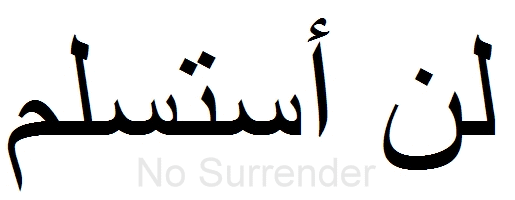
Various commentators on the reactions in the Muslim world to Pope Benedict's address last week have noted how increasingly media savvy the protestors are, at least in the West. Witness the impeccably printed signs in English proclaiming, for example, that "Jesus is Allah's Slave."
Okay, so they got it wrong. Jesus is the Son of God, Incarnate. He is the Lord of the Universe. And I am His slave, Christodoulos, as the Greeks would say.
I will never submit to the sub-Christian sect that is Islam, which denies the Trinity, the Incarnation, the passion and death of Christ on the Cross and His Resurrection. Deo volente, I will also not submit to the bullying carried out by the more extreme members of that sect nor be intimidated by the terror they seek to sow in an attempt to cow us into submission.
That is what the Arabic phrase above says: "I will not submit."
If you never learn any other Arabic, which would be a shame, learn this: "Lan estislam." I will not submit.
And notice that the root of the verb is "islam," which means submission.
So here, for all the Arabic-speaking world to see is my message to them, in their own language: I will not submit.
And now, unto God the Father, God the Son and God the Holy Ghost, be ascribed, as is most justly due, all might, majesty, dominion, glory and power, now and forever. Amen
Tuesday, September 19, 2006
Misty Battlefield at Dawn?
I would imagine that most readers here are also regular readers of CANN. If not, they should be. The following is CANN's latest "editorial" on the scandalous Muslim reaction to the Pope's address last week in Germany. I strongly urge you to read, mark, learn and inwardly digest what is said here.
Sober second thought, reasonable caution, and prudence are all good things. Perhaps if some media-sharks hadn’t dumped chum-bait all over the Pope, we’d not have to restate the obvious right now. If not this, it would be something else.
The fact is (pace, Mark Shea, et al.) we are already in a religious and civilizational war that will not go away by our being more reasonable, self-effacing, or scruplulously even-handed in our analysis. The current Pope is pretty much the most reasonable and educated religious leader on the planet.
The Pope quoted somebody. Get over it. He’s allowed: we don’t have to abide by your Islamist rules. THAT’S THE POINT. This is yet another attempt to make us construct our own inner borders and fences on their behalf.. forbidden thoughts & words.. fear.. self-destruction. It’s the habit inculcated by any tyranny: Communism, Nazism, Islamism, and by the various flavours of secularist Westernism. The bully wants the victim to worry and act always in terms of the will of the bully.
Islamist ideology is an opportunistic infection; unholy ebola. Disproportionate drama-queen controversy, deliberate outrage, sympathetic media attention, staged protests are all good for the cause. Any excuse in a storm, for the bullying scumbags, soundrels and rabble-rousers– however sincere– who want Western Civilization on the eternal defensive, then enslaved.
Militant Islamists want to finish the Big Jihad, paused in the 1600s at the gates of Vienna. It will involve erasing and defacing everything in accord with their views. All shall submit: history, nations, churches, secularity, literature, art, philosophy, archaeology, music. Yes, it’s even worse than an infestation of liberal Christian liturgists and clergy. Europe stand on the verge of implosion, having lost the native population and the civilizational nerve to know what to do, in the face of massive internal Islamist threats.
Oh, and the nuclear sword may already be at our necks. Got Caliphate?
That Emperor-guy had more than enough reason, and 700 years of Byzantine bumbling and Islamic predation (and the destruction of Christian North Africa, much of what is now Israel, Syria, Jordan, Egypt, and chunks of modern-day Turkey) over which to make his comment to the muslim Persian professor with whom he was talking– and that final collapse was aided and abetted by the Catholic West, over and over again. The ruins of cities and blood of Christians and the loss of most of the Eastern Roman Empire were testament enough to his view. History may repeat itself in the next century.
The Pope (a witness and survivor of Hitlerism) does not need to be reminded that the world is a dangerous place. Despite the idea that John Paul II was more of a “Peace, peace! Where there is no peace” kind of soul, one need only remember that he lit the spark that imploded the satanic secularity of the USSR. Assassin’s bullets showed that the Kremlin recognized the dangerous power of Christianity, and of JP2’s papacy.
Benedict laid down a gauntlet before both the irrationalism of modern secularity, and a resurgent pre-modern heresy with Jewish and Christian roots, and a violent past and present. Political correctness and jihad are twins, of a sort. Both refuse rationality and religion, and insist on their own absolute autonomy, and the submission of all else to their particular claim. Western cultural skirmishes over Islam, and many social-cultural issues like abortion or homosexuality are all signs of the bigger battle– not to mention that in the end, it’s not flesh and blood we’re fighting, but powers & principalities and spiritual darkness that seeks to eat up everything: Christian, secularist, and Islam alike, and make Hell on earth in whatever form. Our enemy Satan is not picky.
And once again.. our eyes are off very nearly nuclear Iran. Anybody notice that?
Nobody likes such a time as this. Hearts quake, knees shake, all are tested beyond their skill, wit, or desire. We want to turn our eyes away, we long for comfort and peace. But this is our time, and like it or not, this burden is ours. As Christians, we need to step up. If we are secularists (as B-16 recently said to someone), the we ought to live and act as if God existed. If moderate muslims, as if the best of our religion and heritage is not going to be stolen and defaced, and our own names and faces dishonoured by the radicals– even if they are, worldwide, a majority.
And even if the battle is a long retreat– well, there are far worse things than dying well, into the arms of God. As for the rest? God rules.
CaNN News Editor
Sober second thought, reasonable caution, and prudence are all good things. Perhaps if some media-sharks hadn’t dumped chum-bait all over the Pope, we’d not have to restate the obvious right now. If not this, it would be something else.
The fact is (pace, Mark Shea, et al.) we are already in a religious and civilizational war that will not go away by our being more reasonable, self-effacing, or scruplulously even-handed in our analysis. The current Pope is pretty much the most reasonable and educated religious leader on the planet.
The Pope quoted somebody. Get over it. He’s allowed: we don’t have to abide by your Islamist rules. THAT’S THE POINT. This is yet another attempt to make us construct our own inner borders and fences on their behalf.. forbidden thoughts & words.. fear.. self-destruction. It’s the habit inculcated by any tyranny: Communism, Nazism, Islamism, and by the various flavours of secularist Westernism. The bully wants the victim to worry and act always in terms of the will of the bully.
Islamist ideology is an opportunistic infection; unholy ebola. Disproportionate drama-queen controversy, deliberate outrage, sympathetic media attention, staged protests are all good for the cause. Any excuse in a storm, for the bullying scumbags, soundrels and rabble-rousers– however sincere– who want Western Civilization on the eternal defensive, then enslaved.
Militant Islamists want to finish the Big Jihad, paused in the 1600s at the gates of Vienna. It will involve erasing and defacing everything in accord with their views. All shall submit: history, nations, churches, secularity, literature, art, philosophy, archaeology, music. Yes, it’s even worse than an infestation of liberal Christian liturgists and clergy. Europe stand on the verge of implosion, having lost the native population and the civilizational nerve to know what to do, in the face of massive internal Islamist threats.
Oh, and the nuclear sword may already be at our necks. Got Caliphate?
That Emperor-guy had more than enough reason, and 700 years of Byzantine bumbling and Islamic predation (and the destruction of Christian North Africa, much of what is now Israel, Syria, Jordan, Egypt, and chunks of modern-day Turkey) over which to make his comment to the muslim Persian professor with whom he was talking– and that final collapse was aided and abetted by the Catholic West, over and over again. The ruins of cities and blood of Christians and the loss of most of the Eastern Roman Empire were testament enough to his view. History may repeat itself in the next century.
The Pope (a witness and survivor of Hitlerism) does not need to be reminded that the world is a dangerous place. Despite the idea that John Paul II was more of a “Peace, peace! Where there is no peace” kind of soul, one need only remember that he lit the spark that imploded the satanic secularity of the USSR. Assassin’s bullets showed that the Kremlin recognized the dangerous power of Christianity, and of JP2’s papacy.
Benedict laid down a gauntlet before both the irrationalism of modern secularity, and a resurgent pre-modern heresy with Jewish and Christian roots, and a violent past and present. Political correctness and jihad are twins, of a sort. Both refuse rationality and religion, and insist on their own absolute autonomy, and the submission of all else to their particular claim. Western cultural skirmishes over Islam, and many social-cultural issues like abortion or homosexuality are all signs of the bigger battle– not to mention that in the end, it’s not flesh and blood we’re fighting, but powers & principalities and spiritual darkness that seeks to eat up everything: Christian, secularist, and Islam alike, and make Hell on earth in whatever form. Our enemy Satan is not picky.
And once again.. our eyes are off very nearly nuclear Iran. Anybody notice that?
Nobody likes such a time as this. Hearts quake, knees shake, all are tested beyond their skill, wit, or desire. We want to turn our eyes away, we long for comfort and peace. But this is our time, and like it or not, this burden is ours. As Christians, we need to step up. If we are secularists (as B-16 recently said to someone), the we ought to live and act as if God existed. If moderate muslims, as if the best of our religion and heritage is not going to be stolen and defaced, and our own names and faces dishonoured by the radicals– even if they are, worldwide, a majority.
And even if the battle is a long retreat– well, there are far worse things than dying well, into the arms of God. As for the rest? God rules.
CaNN News Editor
Sunday, September 17, 2006
The Latest from Fr Zeppo Hart
Back in August, I introduced Fr Zeppo Hart Is There a Fourth Hart Brother?
Today I came across the following, from the Press Trust of India, in which Fr Zeppo assures us that "practising Hinduism is in no way incompatible with my faith in Christ."
Read it here
(Thanks to Titusonenine)
Today I came across the following, from the Press Trust of India, in which Fr Zeppo assures us that "practising Hinduism is in no way incompatible with my faith in Christ."
Read it here
(Thanks to Titusonenine)
Friday, September 15, 2006
Here We Go Again?
No sooner do certain Muslims perceive that they are being accused of belonging to a violent religion than they react, well, by resorting to violence.
On a day when voices around the Muslim world were denouncing Pope Benedict XVI for linking Islam with violence, someone threw a hand grenade into the compound housing the oldest church in the Gaza Strip. Mercifully there were no casualties.
Should we now expect another wave of violence, as witnessed following the publication of cartoons of Mohammed, to demonstrate how peaceful Islam is?
Watch this space.
Kyrie eleison.
On a day when voices around the Muslim world were denouncing Pope Benedict XVI for linking Islam with violence, someone threw a hand grenade into the compound housing the oldest church in the Gaza Strip. Mercifully there were no casualties.
Should we now expect another wave of violence, as witnessed following the publication of cartoons of Mohammed, to demonstrate how peaceful Islam is?
Watch this space.
Kyrie eleison.
Thursday, September 14, 2006
All Ye Holy Martyrs, Pray For Us
Taking advantage of a quiet day here in Beirut last Saturday, I was surveying the blogosphere, only to find something that left my head spinning.
Regular readers will recall that, on August 27, I posted an item entitled Fox Journalists 'Convert' to Islam. In it, I raised some questions about the moral implications of 'conversion' at gunpoint, and received some very enlightening answers.
The bottom line was that, as Christians, we are commanded to stand firm in our faith, even to the point of death. But we are also assured that if we crack in the moment of testing, we can count on God's forgiveness.
But it appears that for Canon Andrew White, forced 'conversion' is not a matter of faith but one of political expediency.
An Anglican priest, Fr White is one of the leaders of the Foundation for Reconciliation in the Middle East. He has been accused of actually suggesting to the kidnappers that the release of American Steve Centanni and New Zealander Olaf Wiig might be granted in exchange for their forced conversion.
Over at Get Religion, I found the following, which purports to be a letter written by Canon White and included in an August 27 press release by the FRME. I could not find a link to the press release on the FRME web site, and contacted the organization to enquire. My email was addressed to Canon White, or to anyone at the FRME authorized to speak on his behalf. Having received no reply from anyone, I have decided to publish this post.
Here is the text of the letter, as provided to Get Religion by a commenter:
Dear Friends,
It has been an exhausting few days working flat out on getting hostages released from Gaza. These kinds of things always come at the wrong time. Last Christmas and now the very days we had chosen to have our holiday. Last week I was contacted by Roger Wiig. A Methodist minister from New Zealand who just happens to be working in Bromley. He is in New Zealand at the moment but his son was one of the people taken in Gaza.
I felt we had to become involved after this news.... We eventually made contact with the hostage takers. We then managed to form links between Hamas and the Hostage takers. We had to then find a way out and advising to convert at gunpoint to Islam was the only option. (My emphasis) As in all these cases we must have no publicity. Our work is always behind the scenes.
So my holiday in Disney Land Paris has been mainly hostages but that is part of our life. With the help of Mickey Mouse we succeeded and will return to the Middle East soon.
Blessings,
Andrew
I truly hope that the letter is bogus, and that the accusations against Canon White are therefore unjustified.
It the letter is genuine, and Canon White indeed did propose to the kidnappers a forced conversion, I still welcome him to argue his case here.
Regular readers will recall that, on August 27, I posted an item entitled Fox Journalists 'Convert' to Islam. In it, I raised some questions about the moral implications of 'conversion' at gunpoint, and received some very enlightening answers.
The bottom line was that, as Christians, we are commanded to stand firm in our faith, even to the point of death. But we are also assured that if we crack in the moment of testing, we can count on God's forgiveness.
But it appears that for Canon Andrew White, forced 'conversion' is not a matter of faith but one of political expediency.
An Anglican priest, Fr White is one of the leaders of the Foundation for Reconciliation in the Middle East. He has been accused of actually suggesting to the kidnappers that the release of American Steve Centanni and New Zealander Olaf Wiig might be granted in exchange for their forced conversion.
Over at Get Religion, I found the following, which purports to be a letter written by Canon White and included in an August 27 press release by the FRME. I could not find a link to the press release on the FRME web site, and contacted the organization to enquire. My email was addressed to Canon White, or to anyone at the FRME authorized to speak on his behalf. Having received no reply from anyone, I have decided to publish this post.
Here is the text of the letter, as provided to Get Religion by a commenter:
Dear Friends,
It has been an exhausting few days working flat out on getting hostages released from Gaza. These kinds of things always come at the wrong time. Last Christmas and now the very days we had chosen to have our holiday. Last week I was contacted by Roger Wiig. A Methodist minister from New Zealand who just happens to be working in Bromley. He is in New Zealand at the moment but his son was one of the people taken in Gaza.
I felt we had to become involved after this news.... We eventually made contact with the hostage takers. We then managed to form links between Hamas and the Hostage takers. We had to then find a way out and advising to convert at gunpoint to Islam was the only option. (My emphasis) As in all these cases we must have no publicity. Our work is always behind the scenes.
So my holiday in Disney Land Paris has been mainly hostages but that is part of our life. With the help of Mickey Mouse we succeeded and will return to the Middle East soon.
Blessings,
Andrew
I truly hope that the letter is bogus, and that the accusations against Canon White are therefore unjustified.
It the letter is genuine, and Canon White indeed did propose to the kidnappers a forced conversion, I still welcome him to argue his case here.
Monday, September 11, 2006
What can we learn from Fr. Thomas Hopko?
In all that follows of these selected excerpts from a talk by Fr. Thomas Hopko, substitute in your mind "Continuing Anglican" (for lack of a better phrase) when Fr. Hopko says "Orthodox." The same scandal of disunity over issues that often are trivial, political and no more essential than a simple "who struck John?" scenerio, needs to become a thing of the past. I firmly believe that many jurisdictions have sprung up all over the place for no more valid a reason than that somebody wants to wear a purple shirt and a mitre, and simply won't submit himself to the wisdom and Canon Law of established Anglican churches. That is, because somebody wants power. Read these remarks by Father Hopko, and think about our own house (or houses). I have included the editor's note to introduce our own readers to Fr. Hopko.
Father Thomas Hopko is an Orthodox theologian and the dean emeritus of St. Vladimir’s Orthodox Seminary in Crestwood, N.Y. He is a retired professor of dogmatic theology who lives in Ellwood City, Pa. Recently, he spoke to the St. John Chrysostom Society at a meeting held at St. John Orthodox Church in Campbell on the topic of what the Orthodox would have to do, despite our shared common heritage, before there could be unity with Catholicism. The topic seems of such importance to ecumenism that we include here, edited for length, his remarks that evening. The St. John Chrysostom Society works to foster unity and understanding between Roman Catholics and members of eastern-rite churches.
They don’t even want unity. So I am extremely pessimistic about that point. Why? Because the Orthodox leaders don’t even want unity among the Orthodox, let alone with Roman Catholics or Protestants. It’s obvious. The record is clear. I’m not making this up. This is not my opinion. The Orthodox leadership, and most of the Orthodox people, don’t want unity with others, and they are not ready to give up anything… even the smallest little thing that is clearly not essential to the faith. I feel very strongly that this is true.
When people ask me, for example, why the Orthodox jurisdictions in America are not united, the answer is very clear: because our leaders don’t want it. If they wanted it, we would have had it yesterday. There is nothing stopping them… you may have to suffer a lot. You may have to give up some things: power, pre-eminence, prominence, property, possessions, prestige, positions, privilege and pleasure. We’re not ready to give up those things because of pride, passion and prejudice. Forget it. There’s not going to be any unity. That’s what divides people generally, and it is certainly what divides churches…
Another point for the Orthodox is that we not only have to desire unity, be ready to sacrifice everything essential to have it, to be able to distinguish what is essential from what is not, be able to forgive the past and admit our own sins and concentrate on ourselves, to do practical acts of charity and mercy – but also never, ever to say or do anything that would offend another person unnecessarily…There are so many ways we can charitably go out of our way to not hurt others… our churches speak about unity, and then every day attack each other in missionary work and so on. Even among the Orthodox, one of our jurisdictions starts a mission and three days later, another jurisdiction starts another mission on the same street. That’s just offensive.
They don’t even want unity. So I am extremely pessimistic about that point. Why? Because the Orthodox leaders don’t even want unity among the Orthodox, let alone with Roman Catholics or Protestants. It’s obvious. The record is clear. I’m not making this up. This is not my opinion. The Orthodox leadership, and most of the Orthodox people, don’t want unity with others, and they are not ready to give up anything… even the smallest little thing that is clearly not essential to the faith. I feel very strongly that this is true.
When people ask me, for example, why the Orthodox jurisdictions in America are not united, the answer is very clear: because our leaders don’t want it. If they wanted it, we would have had it yesterday. There is nothing stopping them… you may have to suffer a lot. You may have to give up some things: power, pre-eminence, prominence, property, possessions, prestige, positions, privilege and pleasure. We’re not ready to give up those things because of pride, passion and prejudice. Forget it. There’s not going to be any unity. That’s what divides people generally, and it is certainly what divides churches…
Another point for the Orthodox is that we not only have to desire unity, be ready to sacrifice everything essential to have it, to be able to distinguish what is essential from what is not, be able to forgive the past and admit our own sins and concentrate on ourselves, to do practical acts of charity and mercy – but also never, ever to say or do anything that would offend another person unnecessarily…There are so many ways we can charitably go out of our way to not hurt others… our churches speak about unity, and then every day attack each other in missionary work and so on. Even among the Orthodox, one of our jurisdictions starts a mission and three days later, another jurisdiction starts another mission on the same street. That’s just offensive.
… You all know the story of the Orthodox man who was shipwrecked on an island. When they came to rescue him, they found two churches there. The rescuer said, “Why are there two churches here? You’re all alone.” The Orthodox man said, “Yeah… that’s the one I go to and that’s the one I don’t.” That’s a deeply ingrained mentality among eastern Christians because of their history, their culture, their politics. But if that is not purged out somehow by the grace of God, forget about talking unity with Catholics. Orthodox need to first have unity among themselves, even culturally and nationally in regions where they live.
… So Orthodox need to be ready to go the extra mile. Jesus said, “If they ask for your coat, give them your shirt. If they ask you to go one mile, go two.” So our attitude has to be always toward bending over backwards, so to speak, to do the thing that will build up unity rather than give offense or cause hard feelings.
People always point out that they fear greater unity because it will cause greater schisms… some of our people won’t go along. But we have schisms anyway. Let’s have them for the right reason. Suppose we had unity and half the [Orthodox] people didn’t come along. I think we should be ready to say goodbye to them if the unity is in God. We have to be people of unity, not because we will have more power in society, or be more popular, or George Bush will invite us to the White House. We have to have unity because God wants it, but it has to be unity in God, not unity in Ukrainianism or whatever… If the unity is not in God, in Christ, in the Spirit, who wants it anyway?
But history shows that the people who worked for unity in the Faith were usually persecuted, while the masses just went about their business.
Saturday, September 09, 2006
Trinity XIII
Galatians 3:16-22, Luke 10:23-37
The Epistle and Gospel for today help to bring balance to a subject that has been confusing to Christians in the Western world for five centuries. Ever since the days of Martin Luther the question of Faith and Works, and the role they may or may not play in the salvation and justification of sinners, has dominated a great deal of theological discourse. As you may know, Luther built his German based Reformation on sola fide, which translates as “faith alone.” This view, taken to an extreme, can take all of the statements by Saint Paul about faith, and make it the only factor in the Christian life. And, indeed Saint Paul does speak often about faith that justifies and saves us. But, Saint Paul never added the word “alone.” The only verse in the whole Bible that contains these words, faith and alone, in close proximity is James 2: 17: “Even so faith, if it hath not works, is dead, being alone.” Because of Saint James’ teaching in his Epistle, Martin Luther wanted to have the whole Epistle cut out of the Bible. He called it “an Epistle of straw, compared to” most of the New Testament. What is the balance? What is the truth about faith and works, and the role of faith in our salvation?
Saint Paul never exactly said that by faith we are saved. Rather, he took it along a specific route that begins with grace. In Ephesians, the second chapter he wrote these words: “For by grace are ye saved through faith; and that not of yourselves: it is the gift of God: Not of works, lest any man should boast.” In the very next verse he adds, “For we are his workmanship, created in Christ Jesus unto good works, which God hath before ordained that we should walk in them.” (This ought to remind you of the words in our prayer of thanksgiving after receiving Communion, about good works that God hath prepared for us to walk in.) So, if Saint James was full of straw for teaching that “faith without works is dead, being alone,” then Saint Paul was full of the exact same straw, because he taught the exact same thing.
In fact, today’s Epistle is speaking more directly to the problem of faith and works then either Paul’s Epistle to the Ephesians, or the Epistle of James. This is for two reasons. First of all, Paul never conceived of faith existing all by itself, cut off from the rest of the Christian life. In the most famous passage he ever wrote, the chapter about the love of God, the thirteenth chapter of First Corinthians, he lists the three most important virtues together: “And now abideth faith, hope, charity, these three; but the greatest of these is charity.” It is always at least somewhat misleading to speak of “faith alone” because faith never is alone. True faith that is planted in us by the Holy Spirit always has two other virtues at its side: hope and charity. It simply does not exist alone.
But, in today’s Epistle, Paul tells us of the distinction between the Law and the promise, specifically this promise that Abraham believed. And, Paul builds a lot of teaching on this promise and the faith of Abraham, basing it on these words from Genesis. “And He [God, that is] brought him [Abram] forth abroad, and said, Look now toward heaven, and tell the stars, if thou be able to number them: and he said unto him, So shall thy seed be. And he believed in the LORD; and he counted it to him for righteousness.” The Hebrew word for believed is the word “amen.” Amen (אמן) is a form of emet. Emet (אמת) means “truth” and so “amen” means true. Jesus, when He said “verily, verily” actually said, “Amen, amen, (ἀμήν ἀμήν) I say unto you.” When you say “amen” you are stating that you believe the words spoken to be true. When Abram (as his name was at that stage) believed God, what he believed, very specifically, was that God’s word is true. That is how Abram amened God, and so was accounted righteous. From this Paul teaches two things. First, believing in God’s revealed truth is essential to our being accounted as righteous, namely, that by God’s mercy our sins are not taken into account. He also taught that Abram, as yet uncircumcised, became the father not only of the Jewish people, but of all people who have faith, that is all who believe God’s word to be true, even Gentiles. All of this shows the absolute necessity of faith. The writer to the Hebrews teaches us that this faith in God’s promise was manifest when Abraham was ready to offer Isaac on the mountain. James, however, uses the same story to teach the importance of works. Again, this should not surprise us, because the issue never was faith versus works.
We are saved by grace through faith, not by our works. But, faith lives with hope and charity. You can separate faith from works only if you can separate it from charity. Your own good works cannot earn for you the forgiveness of your sins; but the faith that calls and empowers you to enter the whole sacramental life as a Christian is a faith that God’s word is true, and it is faith that lives with hope and charity. And, because it lives with charity, good works will be present in the life of faith. However, like the Samaritan in today’s Gospe, this charity can be quite spontaneous. The Samaritan saw a man who may very well have despised him were he not in dire straits. The Jews looked down on Samaritans as being a group of Gentiles pretending to be Jews. They were seen as being second class at best. This did not matter to the Samaritan in this parable, and why? The answer is that he was, as the Lord said, “moved with compassion.” He was not trying to balance out his sins with good works (which is impossible). The idea of trying to appease God by doing a good work is not indicated at all. Instead, the Samaritan simply has compassion, and acts without resentment against a Jewish man who, under other circumstances, he may have avoided. His charity is natural and spontaneous, not forced and contrived.
The other thing we learn from the Epistle is the true context of faith and works as a theological question. In the Western world, ever since the Reformation, the whole treatment of this subject has been misunderstood, recast as a difference between people within Christianity. But, this is not right. Paul was not teaching that God’s grace saves us through just any faith, rather through faith in something very specific. The faith that God’s word is true, the promise we must say our own “amen” to, is the Gospel of Jesus Christ as it is now revealed through the Word made flesh as proclaimed by his Apostles. Any effort to be saved by works meant, as used by Paul in his Epistles, the effort to be saved by the works, specifically, of the Law. The Law of commandments that came four hundred and thirty years after Abram believed God’s promise, does not make you righteous. It reveals that you are a sinner. It reveals that you need the Savior from sin and death, the One who has died as the Lamb of God that takes away the sin of the world, and rose again the third day to destroy death. Before his conversion, when he was Saul of Tarsus, he believed himself to be righteous, and his zeal to persecute the Church to have been the seal of his righteousness. But, when he saw the Risen Christ, and was blinded as he drew close to Damascus, he learned that this great crowning act of his own righteousness was actually the sin of persecuting the Messiah by persecuting His Church. At once he learned of his sin, and of God’s mercy in forgiving that sin. We was converted, and began to see only in his blindness.
So, the issue at the time Saint Paul was writing was never some quality called faith versus good works. These terms are used, rather, to speak of the difference between religion when it is without a specific faith in Jesus Christ, even the best religion- the truth of the Jewish religion based on the revelation of God to Patriarchs and Prophets- and a belief that God’s word is true as revealed in Jesus Christ. It is the difference between trying to be saved by the Law of Commandments, through efforts of self-deception that you are somehow a good person, and the faith that embraces the entire new life of a Christian. I could say that it is the difference between Judaism and Christianity; however, I would say that only with respect. As Christians we do believe in Judaism, the Law and the Prophets. It is simply that we also believe in the promise, and we say the “amen” of faith that God’s word is true, specifically the word of the Gospel as preached by the apostles of the New Covenant, the word that is the foundation of the Church in every age and place about Jesus Christ.
Then, we must recall the words of James: “Even so faith, if it hath not works, is dead, being alone. Yea, a man may say, Thou hast faith, and I have works: shew me thy faith without thy works, and I will shew thee my faith by my works.” That is, this faith will grow in us by the work of the Holy Spirit within our hearts, and it will abide with hope and charity as we press on into the sacramental life by the grace of God, pursuing the goal and end of our belief, knowing God and His Son Jesus Christ whom He has sent (John 17:3).
Wednesday, September 06, 2006
Interview from 2004
I just found this paper from home (Maryland) that I had brought to Arizona with me. That year the Western and Eastern Calendars had the same dates for Holy Week. I believe that this two year old interview best exemplifies the thinking of people who see a wide gulf fixed between "East" and "West"- so wide that any attempt to acheive unity must be resisted at all costs. Wouldn't want that now would we. - Fr. Hart
Interview with Fr.Vladimir Dimitrios
Eastern Shore Press
April 10, 2004
Interview with Fr. Vladimir Dimitrios, priest of the One and Only Orthodox Church, located in Weston (West of Easton).
Eastern Shore Press: Fr. Vladimir, thank you for allowing this interview, and congratulations for the ground breaking of the Orthodox Church your new congregation is building here in Weston.
Vladimir Dimitrios: Thank you.
ESP: Father, my paper wanted me to interview you because, as you are the only Orthodox priest we can find anywhere around here, you have been elected to be our paper’s expert on all matters Orthodox. I am sure you can see how practical that is.
VD: Yes, and I applaud your sense of practicality.
ESP: As you know, this year, the Western and Eastern Churches are holding Easter on the same day, something that has not occurred in living memory.
VD: Properly speaking, there are no Western churches, not really.
ESP: Well, let’s get back to that thought later. Father Vladimir, on this special holiday do you have a message to give to the people who read this paper? Something about the true meaning of Easter? A message about Christ and the Gospel?
VD: That’s not what matters.
ESP: What? Well, Father Vladimir, in your own words, can you tell us what it is that matters?
VD: Yes. We’re not Western. That’s what matters.
ESP: But, don’t you and the Western churches, the Catholic Church for example, preach the same Gospel?
VD: No.
ESP: Don’t you believe in the same God?
VD: Belief in God has never been a central doctrine of the Orthodox Church.
ESP: Wait a minute! I know you- why just six months ago you were an Episcopal priest at St. Cuthbert’s. You were called the Rev. Mr. Roger Brown!
VD: We never speak of those days.
ESP: But, you’re a recent convert. Who made you an expert?
VD: The newspaper did.
ESP: Oh, that’s right. But, are you sure you speak for the Orthodox Church? Are you really a proper representative of the Orthodox Tradition?
VD: Look, I’m wearing a black Cassock, aren’t I?
ESP: Well, yes.
VD: And look at this beard- not a goatee, or even a silly little beard like Errol Flynn wore in Robin Hood. This is a big bushy beard. How can you be more Orthodox than that?
ESP: We wouldn’t know.
__________________________________________
Eastern Shore Press
April 10, 2004
Interview with Fr. Vladimir Dimitrios, priest of the One and Only Orthodox Church, located in Weston (West of Easton).
Eastern Shore Press: Fr. Vladimir, thank you for allowing this interview, and congratulations for the ground breaking of the Orthodox Church your new congregation is building here in Weston.
Vladimir Dimitrios: Thank you.
ESP: Father, my paper wanted me to interview you because, as you are the only Orthodox priest we can find anywhere around here, you have been elected to be our paper’s expert on all matters Orthodox. I am sure you can see how practical that is.
VD: Yes, and I applaud your sense of practicality.
ESP: As you know, this year, the Western and Eastern Churches are holding Easter on the same day, something that has not occurred in living memory.
VD: Properly speaking, there are no Western churches, not really.
ESP: Well, let’s get back to that thought later. Father Vladimir, on this special holiday do you have a message to give to the people who read this paper? Something about the true meaning of Easter? A message about Christ and the Gospel?
VD: That’s not what matters.
ESP: What? Well, Father Vladimir, in your own words, can you tell us what it is that matters?
VD: Yes. We’re not Western. That’s what matters.
ESP: But, don’t you and the Western churches, the Catholic Church for example, preach the same Gospel?
VD: No.
ESP: Don’t you believe in the same God?
VD: Belief in God has never been a central doctrine of the Orthodox Church.
ESP: Wait a minute! I know you- why just six months ago you were an Episcopal priest at St. Cuthbert’s. You were called the Rev. Mr. Roger Brown!
VD: We never speak of those days.
ESP: But, you’re a recent convert. Who made you an expert?
VD: The newspaper did.
ESP: Oh, that’s right. But, are you sure you speak for the Orthodox Church? Are you really a proper representative of the Orthodox Tradition?
VD: Look, I’m wearing a black Cassock, aren’t I?
ESP: Well, yes.
VD: And look at this beard- not a goatee, or even a silly little beard like Errol Flynn wore in Robin Hood. This is a big bushy beard. How can you be more Orthodox than that?
ESP: We wouldn’t know.
__________________________________________
Stem Cells and Cloning
Recently the issue of whether Australia should allow therapeutic cloning for embryonic stem cell research has been much in the news. The Federal Health Minister, Tony Abbott, is an orthodox Roman Catholic who strongly opposes such legal permission. Prime Minister John Howard, while probably personally opposed, has decided to allow a “conscience vote” on this issue rather than continuing to make opposition to the research the official policy of his Government. In all likelihood this will lead to the “green light” being given to therapeutic cloning and associated embryonic stem cell research, despite the vehement objections of the Health Minister.
Those of us opposed to this research point out that creating human beings to use as research material for the benefit of others is immoral because it is opposed to human dignity and the right to life. The response of those who support harvesting cloned embryos for medical research is that these embryos are simply not human beings, any more than a sperm or an egg. They are just a lump of cells that could theoretically, but not in practice, become a human being.
What are the arguments for using embryos in this way and against our objections based on the right-to-life? I will give the arguments in quotation marks as summaries, without implying they are in fact direct quotations, and then respond to each.
“Many diseases could be cured using embryonic stem cells.” Maybe, maybe not. Nobody can be certain either way, but it is true that embryonic stem cells have greater “potential” than non-embryonic stem cells, precisely because they are what biologists call “totipotent” rather than merely “pluripotent”. That is, they can become any and all other sorts of cell. Nevertheless, if we cannot get them without creating and destroying human lives, then the fact that other lives would be lengthened cannot justify the action, as we will see below. One human should never be made to be an expendable source of healthy flesh for another.
“This is a conflict between religion and science. In such a conflict, religion must always give way to the facts. Anyway, you have no right to impose your religious beliefs on society. If you think that such research is murder, you can just choose not to take advantage of it and leave the rest of us to do so!” Actually, this is not a conflict between religion and science. Firstly, all science can do is tell us what physical processes would be involved in the procedure and then predict possible or probable applications and insights. Science, properly speaking, cannot tell us whether the means to those ends is moral (see below) or even what “value” the ends have. Secondly, not all those opposing the research are religious, and even those who are religious do not believe the problems with therapeutic cloning are something esoteric or merely “impious”, they believe the problems with it extend to issues of human life and death and that the arguments against it are based on universally applicable moral principles, not simply divine revelation. It is not a matter of imposing religious beliefs, but of standing up for basic human decency and what philosophers used to call Natural Law. Nor is it a matter of trying to eliminate in others offences to our sensibilities, but of trying to defend the most vulnerable human beings from being harvested and killed.
“Once the benefits were known and fully understood, all opposition would cease, as it has to previous medical advances once distrusted.” There are three errors here, one a moral idiocy, one historical misrepresentation, and the other false analogy. The idea that knowledge of the benefits of a particular action must inevitably lead to reasonable people accepting that action as undeniably morally licit is absurd. It ignores the fact that there may be costs as well as benefits that are relevant to ethical judgement, and it rides roughshod over the fundamental question of whether the ends must always justify the means. As for the supposed precedents for once-opposed medical treatments eventually overcoming that opposition by their very success, they do not prove what they are purported to. The example of anaesthetic, which was opposed at first by a number of church-goers (and many physicians!) is not analogous to the present situation. There was no official or binding Church teaching on that matter, only the musings of individuals, as the sanctity of life itself was not at stake. In addition, other medical procedures which have had some success, such as In Vitro Fertilisation, have had the Church’s and others’ opposition remain consistent, precisely because the right to life was involved, given the regular creation and destruction of “surplus” embryos in this treatment.
“Whatever the status of the embryo or blastocyte in narrowly scientific terms, its moral significance is minimal because it cannot perform any of the mental or physical functions or consciously experience any of the sensations or feelings of a properly developed human being. It is human only in a technical sense, it is not a human person.” Here we come to the crux of the matter. The only way we can justify using incipient humans as experimental material is by understanding “true humanity” purely and solely in terms of present functionality and awareness. Intertwined with this justification is the belief that the only real evil is pain and the only real good conscious pleasure. Thus, it is asserted, the fact that killing the embryo causes it no pain and harvesting its cells may reduce suffering in others is amply sufficient reason to do it.
But this is to misunderstand what human life is and what killing a human being involves morally. Human life cannot be understood or appreciated except diachronically, as a process of development. The instantaneous snapshot tells us nothing since, even if we limit ourselves to addressing conscious awareness, we are dealing with something intrinsically temporal and dynamic. Consider some of the characteristics of human consciousness when it is fully operative: memory, expectation, step-by-step ratiocination, and learning. All these are tied inextricably to the passage of time. A human being is not merely what they appear to be at any one moment, but an accumulation of past human existence and an open potential for future experience. The older the person, the more the former “accumulation” should invest them with significance for others and themselves. The younger the person, the more the latter potentiality should invest them with rich significance. When we kill an innocent human being, we steal that person’s future. This “theft”‑aspect of killing is actually increasingly evil the younger the victim.
One of the most amazing blind-spots of those who say one is not a person if one is not aware and is unable to perform distinctively human mental acts is that they forget that this would render even adult humans “non-persons” whenever they were in a deep sleep, under anaesthetic or in a coma. In fact, if the avoidance of pain and maximisation of pleasure are the only morally worthwhile actions and the present functioning of higher mental processes the only guarantee of human identity, then the following scenario becomes morally reasonable: A man who gains great and lasting satisfaction from killing women (but not from inflicting pain) shoots a woman in the head while she is in non-REM sleep or after surreptitiously drugging her, in the knowledge that the chosen victim will feel no pain and has no close friends or family at present whose pain of mourning might otherwise outweigh the happiness he will receive from the deed and the treasured memory of it. If we can see that this scenario is patently and undeniably evil, then we have no alternative but to reject the utilitarian and consequentialist philosophy which “vindicates” it. And it is this very philosophy which underlies the advocacy of embryonic stem cell research.
Yet, there is an even more basic bedrock that ensures the dignity and rights of every human, even if we happen to know that they will not live long. Everything we have done and everything we could do as humans is dependent on what we are. External circumstances may prevent our human essence unfolding its full potential, but they are exactly that, external circumstances. They cannot therefore reflect back on our intrinsic worth. What gives a human being rights and dignity and makes their life sacred is their being human! That is why murder is more than theft of future. It is sacrilege.
It is this differentiation between intrinsic nature and extrinsic circumstances that undermines perhaps the most devious and shameful argument against considering the rights of the cloned embryo. I refer to the claim that since therapeutically cloned embryos would be created without any intention of ever implanting them in utero, they should not be even considered potential persons. What makes this so disgraceful is that a deliberate intention and arrangement to prevent these children from developing is used as an excuse not to consider them children in the first place. It is rather like saying that if I grew a fruit tree on somebody else’s land (and using their water supply) without their permission and without ever intending to either inform them or let them have any of the fruit, when I take the fruit for myself I have committed no theft. It should also be noted that if it ever became possible to create and develop babies to full term (or beyond?) outside the womb, the same “logic” would allow such children to be grown and farmed as spare parts for others, as long as there was a secure system for preventing their ever reaching any level of consciousness. It is not inconceivable that, with the correct use of drugs and physico-chemical suppression of “grey matter” brain development, such a thing could be achieved. Again, no pain is caused and proponents could claim that extending human rights to such beings would be unnecessary since they are created without any intention of allowing them to develop fully or normally. Please note, the fact that this is not presently on the horizon is irrelevant to the point I am making. I am not claiming that such a research programme is being or will be promoted. What I am saying is that the principles said to justify therapeutic cloning are perfectly consistent with such a programme. If we recognise the latter as palpably vile and wicked, we must reject the moral principles underlying both it and therapeutic cloning. In other words, once the embryo exists as an intrinsically viable and identifiable entity with all the human potential that is encoded in the genome, it has rights. Those rights cannot be taken away by our pre-emptive decision to avert such potential.
Fundamentally, the philosophical error we are encountering here is a refusal to perceive three things: the implications of the fact of a human's very existence, the necessity of considering potential properties as well as actual ones in assessing the value of human life, and the priority of essence over function or action. The specifically moral error is a refusal to see human life as anything other than a succession of evanescent sensations and mental acts, so that humans too young to think and humans too old and senile to think effectively become nothing at all, while those favoured with recognition of their personhood have their greatest fulfilment reduced to minimisation of pain and maximisation of pleasure. In other words, mankind’s summum bonum has become epitomised in pain-killers and orgasms.
Update: I have changed the first sentence of the last paragraph above, as its earlier version was grammatically incorrect, partly tautological and rather obscure. Apart from that it was fine!
Saturday, September 02, 2006
Roman Catholic Ecclesiology (as commonly understood) and Christian Apologetics
One of the important jobs of Christian apologists is to defend the Church against accusations that it has been, overall, an influence for bad in the world, or generally guilty of evil activity and teaching. This is particularly important for apologists who are Catholics, who believe in the holiness, infallibility and indefectibility of the Church. Now, this latter belief does not mean we must deny sins or errors by individual Christians or even by particular Churches (segments of the Church). It only means that we do not accept that the Church ever committed itself as a whole to any such wrongs.
But actions, if pursued throughout the Church and with little or no official censure or, contrariwise, with official approval, constitute a teaching that such actions are morally correct by the Ordinary Magisterium, that is, by the consistent and consensual belief, lived and taught, of the hierarchy. (They thus reflect on both the Church’s holiness and doctrinal trustworthiness.) Therefore, if it could be shown that a particular evil activity had been generally accepted and approved throughout the Catholic Church, that would constitute a falsification of the Catholic truth-claims.
Now, there is no doubt that many of the popular characterisations of “sins” or “mistakes” of the Church are based on exaggeration, selective history or misunderstanding. Nevertheless, not all accusations can be dismissed this way. When someone points to the fact that the Roman Catholic Church (RCC) of the middle ages justified the use of torture and burning at the stake to “protect the true Faith” and achieve religious ends, they are speaking the truth. To reply that the actual applications of violent force were often left to the civil authorities makes no moral difference, as the RCC condoned these acts and in some cases had religious or clergy directly participate in them, as, for example, in the Inquisition’s torture chambers.
My response to this has always been to note that these extreme evils (for so they must be accounted in the context of the Saviour’s teaching) were not universally practiced or accepted as legitimate in the Church of that time. The Eastern Orthodox Church (EOC), for example, never taught that the use of torture by the Church was justified, even with the occasional compromises by some of its jurisdictions with civil governments in other areas. (One can take a similar approach regarding other excesses involving widespread abuses of ecclesial power within certain regions or jurisdictions.) Since, as an Anglican Catholic, I believe that both the RCC and EOC are part of the Catholic Church, this makes perfect sense from my point of view.
The problem is this. If most orthodox Roman Catholics are correct, and those Churches visibly outside their communion are not properly part of the One (Visible) Catholic Church, then this line of defence is unavailable and plausible alternatives seem to disappear completely. That is why it appears to me incontestable that the RCC’s ecclesiological claims (as normally presented), even in their post-Vatican II, “gentler” version of exclusivity, are implicitly inconsistent with belief in the infallibility of the Church, and so are radically un-Catholic.
To make my position clear, here is the argument:
- If a Church or communion of Churches authorises, condones and engages in an activity with virtual unanimity through its official organs of authority over an extended period of time, this constitutes a definitive teaching affirming the moral goodness of that activity.
- It is not possible for the Catholic Church as a whole to be in error in a definitive teaching on moral matters, any more than in matters of Faith.
- Therefore, a definitive teaching established by the process outlined in (1) cannot be in error if the said “Church or communion of Churches” is equivalent to “the Catholic Church as a whole”. [1 + 2]
- The RCC officially and generally authorised, condoned or practised torturous examinations and executions for religious ends over an extended period of time.
- Therefore, the RCC definitively taught that such torture was morally right. [1 + 4]
- Such torture is, in fact, morally repugnant.
- Therefore, the RCC definitively taught error on an important moral matter. [5 + 6]
- Therefore, the RCC is not the whole Catholic Church. [3 + 7]
I will take it as a given that 2 and 6 are uncontested by all identifying as Catholics. And that 3, 5, 7 and 8 do follow logically from their identified premises. That only leaves 1 and 4. 1 is a theological statement that appears synonymous with the RCC’s teaching on the infallibility of the consensus of the ordinary magisterium. 4 is a historical statement. Is it seriously questioned, even by revisionist historians?
Please note, I am not trying to attack the RCC or deny its Catholic identity. Indeed, if the exclusivist ecclesiology normally held in that Church is abandoned, the apparent scandal of proposition 7 above is seriously qualified. That is, once the RCC accepts that the Ordinary Magisterium of the Catholic Church is and was bigger than they have been wont to admit, apparent contradictions between the consensual Magisterial teaching past and present on this matter will disappear. In other words, a more inclusive ecclesiology will also mean a strengthened ecclesiology, with the historical infallibility of the Church protected.
Trinity XII
Ears to Hear, a Tongue to Speak
Mark 7:31-37
“He hath done all things well: He maketh both the deaf to hear and the dumb to speak.”
We come to Christ completely deaf and dumb, unable to hear and to speak. Before He healed this man, Jesus looked up to heaven and sighed. This detail which Mark records, His having looked up to heaven and having sighed, is mysterious, but it could have to do with His desire for us not only to have ears, but ears to hear. He was about to heal this man’s ears so that he could hear natural sounds; yet how often our Lord said, concerning the truth of the Word of God, “Who hath ears to hear, let him hear.” Isaiah the Prophet was called to speak to a generation which did not have eyes to see, ears to hear and a heart to understand; they could not turn and be healed. Jesus said that the generation to which Isaiah spoke was not of that prophet’s own time, but the generation who, in the presence of the Word made flesh, could not see, could not hear, could not understand.
Many times I have heard people say that Christ spoke in parables so that the people could understand His teaching. Did He now? Did He not rather say that He spoke to the crowd in parables because it was not given to them to know the mysteries of the Kingdom of Heaven? To His disciples was it given to know these mysteries, but to those who were outside of the Kingdom it was not given. He went on to say to His disciples, “But blessed are your eyes, for they see: and your ears for they hear (Matt 13: 16).” The mysteries of God’s Kingdom cannot be known except by the work of the Holy Ghost; nor can they be uttered unless He gives us speech. If our ears hear the word of God it is the gift of the Holy Ghost; if our speech is seasoned with grace, it is the gift of the Holy Ghost.
By now I hope that you understand that I speak of two sacraments which are bound together: Baptism and Confirmation. “Except a man be born of water and of the Spirit he cannot see the Kingdom of God.” By one we are given life by the Holy Spirit regenerating us, and by the other wisdom and power from the Holy Spirit residing within us. Christ does indeed touch our ears and our tongue, giving the gifts of hearing and of speech. We can hear the Word of God, and then, like the man who was also healed of the impediment in his speech- and as our King James Bible puts it, “spake plain”- so can we speak clearly, and our words can impart life. But without His Holy Spirit we would remain deaf and dumb.
How important this is in a world which is at its best confused, at its worst simply evil. Many sounds are blaring around us, competing for our attention; and many of the words which appear to be the wisest and best are words which impart only death, selling ideas which lead only into sin and error. People seem to catch their beliefs and opinions, or as they often say today, their “feelings” about important matters of life and death, as they catch a virus. Few opinions are thought through; almost none are what can be called conclusions, for no thought is evident in them. But, even the best thinking cannot, by itself, reveal the truth Christ teaches, because it still lacks the element of grace, the supernatural gift of the Holy Spirit. The light that is in them is darkness; how great is that darkness.
Nonetheless, for us there is this sober warning: Simply having received the sacraments of Baptism and Confirmation does not guarantee that we will hear as we ought, or that we will have speech seasoned with grace. For, simply having ears that can hear is not enough; what Jesus said was “Who hath ears to hear, let him hear.” That is, we must learn the discipline of hearing; and until we have heard we have nothing to say.
What did Jesus mean by His clear implication that some ears cannot hear the Word of God? What is hearing then? As a reader of the Hebrew language, let me begin to answer by pointing out that the Hebrew word for “hear” is the same word as the word “obey.” The word is sh’mai- as in “sh’mai Israel” or “Hear O’ Israel.” In ancient Jewish understanding, to hear is to obey- and to obey is to hear. “He that turneth away his ear from hearing the Law, even his prayer shall be an abomination,” says the Book of Proverbs; what is the warning to us? That drawing near to God without a heart to obey Him is like the unacceptable sacrifice of the murderer Cain. It is not enough simply to be able to hear; we must hear, we must have an obedient heart.
So then, how do we hear, how do we learn, what do we obey?
As we have seen, we cannot hear the Word of God unless our attitude of heart is that we are willing to be obedient to that Word. All around us today is the spectacle of clergymen speaking false doctrine intended for consumption by that group of people who are described in the First Epistle of St. Peter as having “itching ears”- itching ears instead of ears to hear. There always will be a demand for false teachers. My friend, the Editor of Touchstone Magazine, David Mills, keeps a computer file which he calls “the voice of the demonic.” As I understand it, the voice of the demonic is no ordinary deception, but a very crafty sort of trickery which begins, continues and ends with the assumption that evil is good, and good is evil, with subtlety and yet brazen shamelessness. I would say that many of the recent attempts to justify the latest twists and turns of the new modern religion is the voice of the demonic, especially their interpretation- so called- of scripture. The whole point is to create a teaching for those who do not wish to be obedient to God, but who desire, nonetheless, the illusion of being religious and spiritual people.
If we do wish to obey God, however, how do we know the voice of Christ from the other voices, even from the voice of the demonic?
The Anglican answer is best summed up by the great Richard Hooker, and the three part method we use: Scripture, Right Reason and Tradition. I would say, however, that this was no new idea; it is what we see the ancient Church practicing in the early centuries, the time of what we call “the undivided Church.”
Why do we not simply rely upon “the Bible alone?” Let me answer this way: Yes, the whole truth is in scripture, and anything that cannot be proved from it is to be rejected, for it fails to meet the standard of “most certain warrant of Holy Scripture.” But, the Church is needed as our guide to understand scripture correctly. The Bible says so, for it calls the Church “the Pillar and ground of the truth.” And, the Bible tells us that the scriptures are not to be subjected to “any private interpretation.”
Unfortunately, “the Bible Alone” method is all too often a free for all of private interpretation, the subjective opinions and even the feelings of would be teachers, such as the kind that the Apostle Paul warned of, “who desire to be teachers.” It is, in fact, the basis for non-Christian Arian cults, such as those most unfortunate and deceived people who knock on your door on Saturday mornings to feed you their indoctrination. Such as are so misled by their false ideas about the Bible that they would offer their children to their cruel notion of God through the sacrifice of denying something as good and useful as a blood transfusion- all because they have bought an interpretation of scripture which rejects and defies the Tradition of the Church. Look, the Church existed before the Bible was complete; the Bible is the Book of the Holy, Catholic and Apostolic Church, not of the cults.
So, we need Scripture interpreted by the Tradition, and a mind that possesses Right Reason to understand. Let me point out, however, what this is not. First of all, it is not a system of checks and balances. Second, it is not scripture, reason and experience. What the false teachers who use our Anglican label, or the Episcopal label, have come to practice in the last few years is a complete perversion of the whole idea.
The Reason we use is not our own cleverness; it is not the wit of a lawyer’s brief in making an absurd case. The phrase is not simply “reason”, but “Right Reason.” Put simply, an interpretation that is based upon madness or fanaticism, the old “Enthusiasms” as they were called, is obviously not what St. Paul calls “the mind of Christ.” When Jesus speaks of casting out our eye to avoid sin, it is an unreasonable interpretation to think that He meant it literally. We all have heard of snake handlers, and their interpretation of scripture defies the reason of every sane person. So does the reasoning of Mary Baker Eddy and the “Christian Scientists” who invite death or bad health to themselves and their children by refusing the use of all medical knowledge. The same problem exists among those who refuse medicine in the name of “Faith healing.” “Right Reason” saves us from lunacy. As G.K Chesterton said, “when religion could make men mad, theology keeps them sane.”
And what do we mean by Tradition? We do not mean experience. The cute little trend these days is to replace the word Tradition with “experience.” Then they say, well the Bible says thus and so, but our experience teaches the opposite, and so we must adjust our reading of the Bible to our experience. The Bible says that a man shall not lie with a man, but our experience- or so they presume to say- teaches that it is okay. Then they turn it around, and put back the word Tradition, a word they infuse with all sorts of negative emotion to evoke an irrational prejudice, and come to the silly conclusion that the Bible justifies the “ordination” of women- and I can prove that it does not- but tradition is against it, so we must throw out the tradition.
More often than not, however, they prefer to say “experience” instead of “Tradition.” Why do they do this? Remember what I said, Scripture, Right Reason and Tradition is not a system of checks and balances. We do not separate these three things and compare them against each other. We do not say, for example, the Bible says this, but Tradition balances it out by saying that, and so we come to the truth by weighing them. This would be all wrong. Think of these three as we do the Trinity- these three are one. What the Bible says is taught in the Tradition of the Church, and only by that Tradition can someone with Right Reason come to a true understanding. Experience is subjective, especially if it is filled with emotion; but the Tradition is objective, and it is, quite frankly, inflexible- thank God. Without it, we can make the Bible mean whatever we please, and without it many people are actually being harmed by those who subject the Bible to their own warped interpretations, using it to do harm, both physical and spiritual harm.
Dynamite and surgical tools in the right hands can do good; in the wrong hands they kill and maim people. I have news for you- without the Tradition of the Church, as St. Vincent of Lerins put it- “that which has been believed everywhere, always and by all”-and without the sanity of Right Reason, the Bible is dangerous. Sorry if that bothers anyone, but it is obviously, and I do mean obviously, true.
But, Jesus Christ provides for us this gift by His healing hand: if we are willing and obedient to submit to Scripture, Right Reason and Tradition, and if the Holy Spirit of God resides within us, we will have ears to hear, and also will have the string of our tongue loosed to speak the words of life without impediment.
And now unto God the Father, God the Son and God the Holy Ghost be ascribed, as is most justly due, all might, majesty, power, dominion and glory, now and forever.
Amen
Mark 7:31-37
“He hath done all things well: He maketh both the deaf to hear and the dumb to speak.”
We come to Christ completely deaf and dumb, unable to hear and to speak. Before He healed this man, Jesus looked up to heaven and sighed. This detail which Mark records, His having looked up to heaven and having sighed, is mysterious, but it could have to do with His desire for us not only to have ears, but ears to hear. He was about to heal this man’s ears so that he could hear natural sounds; yet how often our Lord said, concerning the truth of the Word of God, “Who hath ears to hear, let him hear.” Isaiah the Prophet was called to speak to a generation which did not have eyes to see, ears to hear and a heart to understand; they could not turn and be healed. Jesus said that the generation to which Isaiah spoke was not of that prophet’s own time, but the generation who, in the presence of the Word made flesh, could not see, could not hear, could not understand.
Many times I have heard people say that Christ spoke in parables so that the people could understand His teaching. Did He now? Did He not rather say that He spoke to the crowd in parables because it was not given to them to know the mysteries of the Kingdom of Heaven? To His disciples was it given to know these mysteries, but to those who were outside of the Kingdom it was not given. He went on to say to His disciples, “But blessed are your eyes, for they see: and your ears for they hear (Matt 13: 16).” The mysteries of God’s Kingdom cannot be known except by the work of the Holy Ghost; nor can they be uttered unless He gives us speech. If our ears hear the word of God it is the gift of the Holy Ghost; if our speech is seasoned with grace, it is the gift of the Holy Ghost.
By now I hope that you understand that I speak of two sacraments which are bound together: Baptism and Confirmation. “Except a man be born of water and of the Spirit he cannot see the Kingdom of God.” By one we are given life by the Holy Spirit regenerating us, and by the other wisdom and power from the Holy Spirit residing within us. Christ does indeed touch our ears and our tongue, giving the gifts of hearing and of speech. We can hear the Word of God, and then, like the man who was also healed of the impediment in his speech- and as our King James Bible puts it, “spake plain”- so can we speak clearly, and our words can impart life. But without His Holy Spirit we would remain deaf and dumb.
How important this is in a world which is at its best confused, at its worst simply evil. Many sounds are blaring around us, competing for our attention; and many of the words which appear to be the wisest and best are words which impart only death, selling ideas which lead only into sin and error. People seem to catch their beliefs and opinions, or as they often say today, their “feelings” about important matters of life and death, as they catch a virus. Few opinions are thought through; almost none are what can be called conclusions, for no thought is evident in them. But, even the best thinking cannot, by itself, reveal the truth Christ teaches, because it still lacks the element of grace, the supernatural gift of the Holy Spirit. The light that is in them is darkness; how great is that darkness.
Nonetheless, for us there is this sober warning: Simply having received the sacraments of Baptism and Confirmation does not guarantee that we will hear as we ought, or that we will have speech seasoned with grace. For, simply having ears that can hear is not enough; what Jesus said was “Who hath ears to hear, let him hear.” That is, we must learn the discipline of hearing; and until we have heard we have nothing to say.
What did Jesus mean by His clear implication that some ears cannot hear the Word of God? What is hearing then? As a reader of the Hebrew language, let me begin to answer by pointing out that the Hebrew word for “hear” is the same word as the word “obey.” The word is sh’mai- as in “sh’mai Israel” or “Hear O’ Israel.” In ancient Jewish understanding, to hear is to obey- and to obey is to hear. “He that turneth away his ear from hearing the Law, even his prayer shall be an abomination,” says the Book of Proverbs; what is the warning to us? That drawing near to God without a heart to obey Him is like the unacceptable sacrifice of the murderer Cain. It is not enough simply to be able to hear; we must hear, we must have an obedient heart.
So then, how do we hear, how do we learn, what do we obey?
As we have seen, we cannot hear the Word of God unless our attitude of heart is that we are willing to be obedient to that Word. All around us today is the spectacle of clergymen speaking false doctrine intended for consumption by that group of people who are described in the First Epistle of St. Peter as having “itching ears”- itching ears instead of ears to hear. There always will be a demand for false teachers. My friend, the Editor of Touchstone Magazine, David Mills, keeps a computer file which he calls “the voice of the demonic.” As I understand it, the voice of the demonic is no ordinary deception, but a very crafty sort of trickery which begins, continues and ends with the assumption that evil is good, and good is evil, with subtlety and yet brazen shamelessness. I would say that many of the recent attempts to justify the latest twists and turns of the new modern religion is the voice of the demonic, especially their interpretation- so called- of scripture. The whole point is to create a teaching for those who do not wish to be obedient to God, but who desire, nonetheless, the illusion of being religious and spiritual people.
If we do wish to obey God, however, how do we know the voice of Christ from the other voices, even from the voice of the demonic?
The Anglican answer is best summed up by the great Richard Hooker, and the three part method we use: Scripture, Right Reason and Tradition. I would say, however, that this was no new idea; it is what we see the ancient Church practicing in the early centuries, the time of what we call “the undivided Church.”
Why do we not simply rely upon “the Bible alone?” Let me answer this way: Yes, the whole truth is in scripture, and anything that cannot be proved from it is to be rejected, for it fails to meet the standard of “most certain warrant of Holy Scripture.” But, the Church is needed as our guide to understand scripture correctly. The Bible says so, for it calls the Church “the Pillar and ground of the truth.” And, the Bible tells us that the scriptures are not to be subjected to “any private interpretation.”
Unfortunately, “the Bible Alone” method is all too often a free for all of private interpretation, the subjective opinions and even the feelings of would be teachers, such as the kind that the Apostle Paul warned of, “who desire to be teachers.” It is, in fact, the basis for non-Christian Arian cults, such as those most unfortunate and deceived people who knock on your door on Saturday mornings to feed you their indoctrination. Such as are so misled by their false ideas about the Bible that they would offer their children to their cruel notion of God through the sacrifice of denying something as good and useful as a blood transfusion- all because they have bought an interpretation of scripture which rejects and defies the Tradition of the Church. Look, the Church existed before the Bible was complete; the Bible is the Book of the Holy, Catholic and Apostolic Church, not of the cults.
So, we need Scripture interpreted by the Tradition, and a mind that possesses Right Reason to understand. Let me point out, however, what this is not. First of all, it is not a system of checks and balances. Second, it is not scripture, reason and experience. What the false teachers who use our Anglican label, or the Episcopal label, have come to practice in the last few years is a complete perversion of the whole idea.
The Reason we use is not our own cleverness; it is not the wit of a lawyer’s brief in making an absurd case. The phrase is not simply “reason”, but “Right Reason.” Put simply, an interpretation that is based upon madness or fanaticism, the old “Enthusiasms” as they were called, is obviously not what St. Paul calls “the mind of Christ.” When Jesus speaks of casting out our eye to avoid sin, it is an unreasonable interpretation to think that He meant it literally. We all have heard of snake handlers, and their interpretation of scripture defies the reason of every sane person. So does the reasoning of Mary Baker Eddy and the “Christian Scientists” who invite death or bad health to themselves and their children by refusing the use of all medical knowledge. The same problem exists among those who refuse medicine in the name of “Faith healing.” “Right Reason” saves us from lunacy. As G.K Chesterton said, “when religion could make men mad, theology keeps them sane.”
And what do we mean by Tradition? We do not mean experience. The cute little trend these days is to replace the word Tradition with “experience.” Then they say, well the Bible says thus and so, but our experience teaches the opposite, and so we must adjust our reading of the Bible to our experience. The Bible says that a man shall not lie with a man, but our experience- or so they presume to say- teaches that it is okay. Then they turn it around, and put back the word Tradition, a word they infuse with all sorts of negative emotion to evoke an irrational prejudice, and come to the silly conclusion that the Bible justifies the “ordination” of women- and I can prove that it does not- but tradition is against it, so we must throw out the tradition.
More often than not, however, they prefer to say “experience” instead of “Tradition.” Why do they do this? Remember what I said, Scripture, Right Reason and Tradition is not a system of checks and balances. We do not separate these three things and compare them against each other. We do not say, for example, the Bible says this, but Tradition balances it out by saying that, and so we come to the truth by weighing them. This would be all wrong. Think of these three as we do the Trinity- these three are one. What the Bible says is taught in the Tradition of the Church, and only by that Tradition can someone with Right Reason come to a true understanding. Experience is subjective, especially if it is filled with emotion; but the Tradition is objective, and it is, quite frankly, inflexible- thank God. Without it, we can make the Bible mean whatever we please, and without it many people are actually being harmed by those who subject the Bible to their own warped interpretations, using it to do harm, both physical and spiritual harm.
Dynamite and surgical tools in the right hands can do good; in the wrong hands they kill and maim people. I have news for you- without the Tradition of the Church, as St. Vincent of Lerins put it- “that which has been believed everywhere, always and by all”-and without the sanity of Right Reason, the Bible is dangerous. Sorry if that bothers anyone, but it is obviously, and I do mean obviously, true.
But, Jesus Christ provides for us this gift by His healing hand: if we are willing and obedient to submit to Scripture, Right Reason and Tradition, and if the Holy Spirit of God resides within us, we will have ears to hear, and also will have the string of our tongue loosed to speak the words of life without impediment.
And now unto God the Father, God the Son and God the Holy Ghost be ascribed, as is most justly due, all might, majesty, power, dominion and glory, now and forever.
Amen
Friday, September 01, 2006
"I'm Spiritual, But Not Religious"
For those of you who wrestle with the nuts and bolts of Christian apologetics, or with the nature of your own faith, I heartily commend the post of the same title over at O Cuniculi!.
Subscribe to:
Posts (Atom)