Showing posts with label Unity. Show all posts

Thursday, March 01, 2012

St. David's Day (of Wales)

By Fr. David Marriott


St. David can be used as a forerunner, a predecessor of all the challenges and tribulations that we encounter in the church world today: his generation is of the time when the church was one: or was it?

St. David lived in the time of the founding of the Benedictine order by St. Benedict at Monte Cassino; he is thought to have travelled to Jerusalem, and to have learned from his visit of the lives of the desert fathers: the hermit monastic life, on which all future monastic orders were based. The order he founded when back home in Wales followed this early pattern rather then the corporate life of the Benedictines: and once more, we see in this pattern a link to the earlier Christian and Celtic church in Britain, where the hermit life was well understood, alongside the monastic life developing in Ireland, Scotland, especially at Lindisfarne, and Wales.

So this really looks quite peaceful: for sure, the Roman empire was in decline, as we now know, and there were periodic troubles caused by barbarian invasions: especially where the faith had not yet penetrated: We might think of the abduction and slavery of St. Patrick, taken as a young lad from his home, and transported to work as a shepherd in slavery in Ireland. But apart from that the faith had become better defined, the early heresies had been largely resolved: so why do I say that this time reflects the challenges of today?

One word: and that is the word ‘Unity’. 

Because whereas the Benedictines were clearly under the authority of the Roman church, and this latter church with its clergy were present in England at the same time, gradually developing a presence along the south eastern coasts, the rest of the church was still under the influence and control, if one might say, of the Celtic tradition: and it is this tradition that we see in the way of life established by David in the monastery of his see at Menevia, now known as St. David’s. Indeed, the very location of this see, so hard to get to even today, remote and cut off from the world, is in itself an acute reminder of the difference between Celtic, individual faith, and the more corporate expression of the same faith in the Church of Rome.

The key to this enigma of unity in the church is revealed by St. Thomas Aquinas: he considers the role of intellect, that gift which we can use, which we do use, to make decisions, work things out, and manage our lives. And in the gift of that intellect, being the same gift for every human being, there is unity: we are all united by the gift of God of an intellectual capacity, the same intellectual capacity for each one of us. In that way, we are united, we are of the oneness as given us by God: but we are not all the same: We are not united numerically, where we would be all clones one of the other, and each of God. No, we are united in the gift of intellect, but separated by the way in which this intellect is expressed and developed as we each in our own ways, in our own cultures, mature through this earthly life. (Light of Faith - Compendium of Theology #85)

So how can we say that we are united? Because, as St. Paul describes it so very well, we are all members of one body, which is the Church of Christ, but each having different functions. And if this illustration is relevant for man the individual, so it is valid for man, the group, the organisation, the Church; and it is this that St.Thomas Aquinas calls an organic unity. We do not all have to belong to the one, and we can each appreciate the strengths of the other, the friend with whom  we have cordial links, but from whom we differ in habits, in customs, in the food we eat, in every which way. But we are united in the faith we express in God the Father, His Son, Jesus Christ, and we have all been blessed with the gift of the Holy Spirit – our belief being an organic unity, the type of unity spoken of by St. Paul: we do not have to say we are one with Paul, or one with Peter, or one with Apollos: we just have to say we are one with Christ.

And it is this that brings me back to St. David, who, whilst expressing his Celtic faith, was still able to see that faith and its expression as being in union, in unity with the expression of faith of the Church of Rome. It was only some 60 years after his death that we read of the synod of Whitby, where the two churches met, so that they could negotiate a common date for the commemoration of the Easter feast. This synod, the first resolution of differences between equals, was the unifying factor between the Celtic Northumbrian church and the Church of Rome, leading to the establishment of York as a Province of the Church, and the gradual incorporation of a common worship across the country; a common worship established between members united organically, that they may be one organically. But each retained that which was specific to their own organic function, as a member, an organ of the whole: they never had need to become one numerically. And it is in this that there is the link between St. David and ourselves, that we might learn.


Wednesday, November 23, 2011

We are not a mission field

On implications of wider unity

One of the priorities we must have is real unity among Continuing Anglicans, and that for the sake of our portion of the overall mission of the Church as Christ authorized and commanded it. This keeps the priorities of unity, evangelism and Anglican identity closely related. Having survived the recent storm, it is useful to learn from the dangerous misapplication of the whole subject of unity as it often was related to the Two One True Churches, or as it was during the controversy that enveloped Anglicanorum Coetibus, to the Church of Rome. 

It was fashionable among the contingent advocating and misrepresenting that Roman constitution, to quote part of John 17:21, "That they all may be one," in a thoroughly confusing and misleading manner. This practice belonged to the modern "soundbite" culture in which words and phrases are used to prevent rather than aid the art of thinking. The misapplied words of Christ were used to appeal to sentiment, to impart guilt, and in every way simply to manipulate adults. Inasmuch as I have already given my defense of the true meaning of Christ's words (in The Theology of Unity) I will not restate it here. Suffice to say, for now, that even a number of people simply transferring from one denomination to another, say from the Traditional Anglican Communion (TAC) to the Roman Catholic Church (RCC), would not bring the Universal Church even so much as one step closer to outward and political unity; it would not end divisions that date back to the sixteenth century, or to 1054 AD. 

Does this mean we should not hope for eventual outward and political unity? Anglican writers as early as Richard Hooker have always held out that hope. We would not seek to close the door to it. We do, however, see it as more practical to work on unity among our own people as a realizable goal; and it is happening anyway. 

More to the point, at this time it is terribly obvious that both Rome and Orthodoxy see unity only in terms of joining them, losing our own identity and ceasing to be Anglican, submitting to them and putting ourselves completely in their hands. To them we are not a real church in any sense (indeed, in reality they still rule out each other as the true Church, though idealistic and misinformed, indeed misinforming, individuals have convinced themselves it isn't so). Whether we deal with the Orthodox or the Roman Catholics, when we talk of unity, they think of evangelism as they see it, regarding us as a mission field. 

We are not a mission field, and our place in the One, Holy, Catholic and Apostolic Church is certainly no less secure than theirs; and to the degree that true doctrine is part of the Apostolic Succession, we would argue that our place is more secure. And, it is high time for all Continuing Anglicans, especially Anglo-Catholics, to acquire that security. True doctrine is the issue that divides us still, at this time, from both of the Two One True Churches, because each of them remains muddled and unclear about important elements essential to the very Gospel of Jesus Christ. It is not we who need their claims about history to somehow give us perfect validity. It is they who need clarity of doctrine that goes back to "the most ancient catholic doctors and bishops" of the Church; and that clarity is more readily at hand to us.

Some will be fooled by arguments based on unverifiable claims about history, such as the entire basis for the Papal claims, mixed with just plain impossible interpretations of scripture. You may be very sure that polemicists have already lost the real argument when they come back with derisive and silly attempts to dismiss us as "merely five hundred years old." Aside form being incorrect history, it means they have no Biblical or theological point in mind. Of course, that non-argument fits a perverted kind of logic that does not recognize their own divided state, nor the fact that we have maintained the Catholic Tradition that goes all the way back to the beginning. We have merely removed the dross.

If we want real unity, we must begin with our own people. If we hold out a hope for wider unity, it cannot be by accepting the lie that we are a mission filed for either One True Church to harvest. Sadly, that was what the recent storm was all about, Anglican bishops trying to accept the status imposed by Rome on behalf of those who intended loyalty to the truth of the Gospel, faith in the Anglican way, and the understanding Affirmed in St. Louis. Those who believe they need one or other of the Two One True Churches to be valid, or have "the fullness," or whatever, may go with our prayers and charity. But, we already belong to the Church; we are not a mission field. 

Wednesday, October 26, 2011

The theology of unity

On July 28, I posted the following:

Unity and Salvation


"Neither pray I for these alone, but for them also which shall believe on me through their word; That they all may be one; as thou, Father, art in me, and I in thee, that they also may be one in us: that the world may believe that thou hast sent me." John 17:20,21


We hear this quoted often, and alluded to even more often. Almost never do we actually hear the full quotation. This should not be surprising in an age that thinks in sound bites, and that places greater emphasis on how people feel about issues, than on what they think about them. When we are treated to these allusions and partial quotations, the message seems to be this: Jesus really wants us to become one, and we have to make it happen. Put another way, God is praying to us, and we ought to hear his prayer.And, if that seems wrong to you, good; well it should.The emphasis of the Gospel according to St. John is twofold: It is the Trinity and the Incarnation. As it opens, John takes us behind the scenes of Genesis. The Hebrew name of the first book of the Bible means, "In the beginning." ( B'Rasheet, בְּרֵאשִׁית). John opens with this same phrase recognized by readers of the Septuagint(LXX), the standard Greek translation of the Old Testament; He too opens with, "In the beginning," (En Arche, ἐν ἀρχῇ ). In the Book of B'Rasheet, or Genesis, we are told what God did, the word "created" (bora, בָּרָא) following as the second word ("In the beginning" is all one word). 


If translated into English words, but retaining Hebrew syntax, it would say, "In the beginning created God the heavens and the earth." The emphasis is not on God himself, but on his work of creation. John, using the expression known to Greek readers of the LXX (ἐν ἀρχῇ ) alludes to the opening of Genesis in a very obvious way, but does not immediatley speak of God's work. First he lingers on God as God, and presents God as the Trinity."In the beginning was the Word (Logos, Λόγος), and the Word was with God, and the Word was God. The same was in the beginning with God." (1:1,2)Verse 2 is not superflous; it mentions God the third time because, as this Gospel unfolds, we see the Son and we hear him speak of the other Comforter, that is the Spirit of Truth. The theme of God as Trinity is presented immediately. Then, with a bow to the Genesis narrative, John speaks of creation (בָּרָא): "All things were made by him; and without him was not any thing made that was made. " He speaks of the Logos as the One in whom there is life, that is, life that gives life, suggesting most strongly the creation of Man: "In him was life; and the life was the light of men." 


When we keep reading, and get to verse 14, the second great theme of John's Gospel is introduced. "And the Word was made flesh, and dwelt among us, (and we beheld his glory, the glory as of the only begotten of the Father,) full of grace and truth."It is only in the context of these two great themes that dominate this Gospel, the Trinity and the Incarnation of the Word, that we have any business interpreting the meaning of the High Priestly prayer of chapter 17. The first Unity that we must consider in the words of this prayer is the Unity of the Trinity. 


So, it opens: "These words spake Jesus, and lifted up his eyes to heaven, and said, Father, the hour is come; glorify thy Son, that thy Son also may glorify thee: As thou hast given him power over all flesh, that he should give eternal life to as many as thou hast given him. And this is life eternal, that they might know thee the only true God, and Jesus Christ, whom thou hast sent. " (17:1-3) 


Our salvation is knowing God, and because whoever sees the Son sees the Father, and no man comes to the Father but by the Son (14:6-10), because God cannot be separated from God (for each Person is distinct, but inseparable), to know the Father requires that we know Jesus Christ. The only true God is known truly only by revelation, namely, Jesus Christ Whom he has sent; that is, the Word Incarnate.By the time we get to the place where Jesus says, "Holy Father, keep through thine own name those whom thou hast given me, that they may be one, as we are" (v.11), it ought to be clear that he is speaking to the Father, one Divine Person to another Divine Person, about our common salvation in himself. The meaning is eternal and salvific. 


It means, in effect, keep them in me. For, "this is life eternal, that they might know thee the only true God, and Jesus Christ, whom thou hast sent. "Understood correctly, "that may all be one" gives greater motivation to be unified among ourselves in common faith and thought, with charity; because we are one whether we live like it or not. A prayer spoken within the Godhead, which we are privileged to overhear, the Son addressing the Father, is as much a declaration as "Let there be light," or "Let us make man in our image." God has pronounced that his people are one, that is, that the Church is, as St. Paul says many times, "in Christ." 


The Church as a whole is "in Christ," and each member of the Church is "in Christ."We know that a married couple is no longer two, but one flesh. This is clear in Genesis, in the Gospels where Jesus explains that divorce is a mere fiction, and in the Epistles of Paul when he warns us to live within the boundaries of God's moral laws. To suggest that the eternal unity of the Church in Christ can really be broken, is akin to believing that human courts can undo the work of God in a valid sacramental marriage. The Church's various divorces, whether in 1054 or in the 16th century, do not annul its unity in Christ; for if it did, members would be cut off and die simply because of human failing. Where true faith is present, we are in Christ; and, unless one can rob a Christian of his faith, he cannot cut him off from Christ (Romans 4:16).


Our unity is both a present and eternal fact, because we are in Christ. We should make efforts to understand each other, to be very clear in communication, to work for the resolution of theological and political separation, and to cultivate charity by the grace of the Holy Spirit who is within us all. But, we must not let this become mere sentimentality, and neither must we feel anxiety or pressure to leap forward faster than honest and clear communication allow. We already are one in Christ, and can proceed toward a resolution of differences in polity only with theological clarity and respect for everyone's conscience.
****
At the time I was writing to respond to false ideas about unity being pushed on people by urgent demands that they convert to Roman Catholicism. That was a false appeal to unity. What is happening at the present time is that the leading bishops of the older and larger jurisdictions are working on a realistic unity that can be achieved fairly soon. That is, unity among us; to have no more Continuing movement, but the Continuing Anglican Church. 

Friday, October 21, 2011

A new day

I have only just arrived home in Chapel Hill, North Carolina after spending most of this week at the Provincial Synod of the Original Province of the Anglican Catholic Church (ACC), presided over by Archbishop Mark D. Haverland, Metropolitan. Among the visiting bishops were Archbishop John Augustine, Primate of the Second Province of the ACC in India, and other Indian bishops. Also, and of great interest to readers in the Continuing Anglican jurisdictions, seat and voice were given to Archbishop Peter Robinson of the United Episcopal Church in North America (UECNA),  the Rt. Rev. Brian Marsh Presiding Bishop of the Anglican Church in America (ACA), and the Rt. Rev. Walter Grundorf of the Anglican Province in America (APA). Also present were bishops from Africa and clergy from Haiti; and I plan to report more details in the coming week here on The Continuum. News about what is happening on those fronts will be included.

The importance of having the Presiding Bishops of the ACA and the APA at this Provincial Synod of the ACC-OP cannot be overstated. One result of the Roman Catholic constitution Anglicanorum Coetibus, is clearer communication and shared desire for unity among these chief bishops. Each has a firm commitment to remaining Anglican and to adhering to the principles established for the Continuing Church in 1977 at St. Louis. It is time for everyone to pray and work for and to expect the emergence, in real time, of one and only one recognized Continuing Anglican Church, with all present.

Saturday, October 15, 2011

The Urgency of Unity

One of the frustrations of my life as Archbishop of the United Episcopal Church is the lack of progress that I see being made by the Anglican Continuum here in America. Progress, as I define it, consists of two thing - growth and unity. Apart from some transfers of parishes from the Traditional Anglican Communion, the three jurisdictions with a straight line back to the St Louis Congress, all remain stubbornly about the same size as they have been for the last dozen or so years with a total of about 170 parishes, sixty percent of which belong to the Anglican Catholic Church. On the unity front, apart from the "Prague Spring" of the ACC-UECNA Concordat of a few years ago, nothing much has happened though a sort of shuttle diplomacy has developed with leaders from the ACC, APCK, UECNA and other jurisdictions meeting periodically at various conferences. Whilst this represents an improvement on the sort of deep frozen attitudes between sister jurisdictions that prevailed a ten years ago, it is still a major hinderence to the further unity, and therefore greater growth, in the Anglican Continuum.

I had hoped that the appearence of the new Anglican Church of North America would provide a sort of catalyst for the "real" continuers to bite the bullet and begin the process of reunification. However, it seems that that optimism was misplaced. Instead, the Episcopalian realignment in the USA is very largely leaving the 1977 Continuum out in the cold, with most new conservative/traditional parishes going to ACNA, apart from a few Anglo-Papalist congregations, which, often at huge cost in terms of membership, are committing themselves to the extended Roman Catholic Pastoral Provision.

Whilst I do not wish the ACNA harm, I think even their leadership realizes that they are a church divided. Some dioceses accept women priests, some do not; others have a positive view of the Charismatic movement; others are more skeptical; and then we have the thing about ACNA accepting 1662 as the standard BCP, but most parishes use something else... So far the leadership of ACNA has been pretty good at keeping everyone focussed, but sooner or later some decisions will have to be made about those contentious issues which ACNA has so far successfully ignored or put off. I am hoping that this process of gaining greater theological clarity will not be long delayed and will lead them back towards the mainstream of historic Christianity, but who knows. So far they are reaping the rewards of their outward unity in the form of rapid growth, and a favourable press from the few who are in any way favourable to tradition or conservative Anglicanism.

Now before those of us in the Continuing Churches dislocate our shoulders trying to pat ourselves on the back for our doctrinal purity, we have our own elephant in the living room with which to contend. The question of Unity. In my honest opinion, it is probably unprofitable to revisit what went wrong in 1978-83 that led to the original Anglican Church in North America (Episcopal) falling apart other than to say "OK, we all goofed. Sorry. Let's try again." In fact, most of us who are in positions of leadership today were not even around in the Continuing Church Movement as clergy when the thing began. In my own case, I was not even confirmed when this show got going! This should enable us to approach the situation without too much in the way of personal baggage, though I am sure we have all heard the various war stories from the perspective of our own particular jurisdiction.

I frankly do not see any major obstacles to the major Continuing Anglican groups achieving institutional unity over the next five to ten years other than a tradition of disunity, old wounds, and too many bishops. I think I should, as Archbishop of the UECNA, say that we are as guilty of those "crimes" as anyone else, but there is no use in our dwelling in the past. The crisis that led to the 1977 St Louis Congress necessarily led to a clarification of the Anglican position, as it needed to define itself against theological Liberalism. This neccessarily lead to a narrowing of the boundaries, and, as the Continuing Church Movement began in North America, that meant a move in the catholic direction. On the whole, this more Catholic Anglicanism has worked well, with the problems not being caused by the Affirmation of St Louis or any other specific document, but by occasional over zealous interpretors of our own tradition. This was not a new problem that we started just after the St Louis Congress, but an old one, that had been with us for years. However, the need for unity against the 'foes within' had tended to dampen down the internal tensions within the Anglo-Catholic and catholic-leaning parties in the Episcopal Church.

Perhaps one inevitable part of the Continuum maturing is that we need to realize that we need each other, and also that most folks cannot tell the difference between the various Continuing Churches. What puts them off is the fact that the next parish of your jurisdiction might be several hundred miles away, and you pass parishes of several other jurisdictions on the way there. This is an inhibiting factor to Church growth as we cannot pool clergy and resources to plant new congregations. Without greater unity the Continuing Church is condemning itself to a slow and lingering death, slowing achieving unity through decline.

Do we really want to go this route?

The answer that I get from the laity, time and again, is an unequivocable 'No.' This may be one of those occasions when, in the most literal sense sense 'vox populi' is indeed 'vox Dei.' Unity is no longer an issue we can safely leave on the back burner, but an urgent and insistent need in order to advance the kingdom of God.

Monday, June 20, 2011

A Modest Proposal

'A Modest Proposal" is the title of one of Dean Swift's more aggressive satires on the Engish government in Ireland, which, in satirizing Dublin Castle's inept administration makes the suggestion that Ireland's problems with over-population and hunger could be solved by the practice of cannibalism. Of course the Dean was not being serious, he was just trying to illustrate the fact that many of Dublin Castle's policies were just as ridiculous as his modest proposal. Unfortunately for the Dean, and for Ireland, his serious suggestions for reform did not get very far, and I rather suspect that what I am going to propose in this posting will suffer a very similar fate to the literary Dean's suggestion for the Reform of the 'Castle.'(1)

Over the last few months I have spending a certain amount of time recently cogitating on the peculiarities of the Affirmation of St Louis, the way in which they might have distorted the development of the Continuing Anglican movement, and whether our present divisions owe something to the Affirmation. Furthermore, I have been thinking about what could be done to reduce the amount of argument that goes on over its provisions, and reach a consensus sufficient to eventually bring about the reunion of the Continuum.

At the very outset I have to say that, in my researches over the years, I have not come across a complete and orderly account of how the Affirmation of St Louis was drafted, nor an explanation of the precise aims of its framers. In absence of such an account I need to take the Affirmation at face value, and let it speak for itself.

It seems to me that the basic intent was to maintain 'business as usual' as understood by orthodox churchmen in both the Episcopal Church, USA, and the Anglican Church of Canada. There was no intent to exclude any Churchmanship - Catholic, Broad, Low or Evangelical - from the original Anglican Church of North America (Episcopal), and lastly, there was no intent to depart from the faith received from the Church of England. On the other hand, there was an intent to close several loopholes, particularly those concerning the number of Ecumenical Councils accepted by the Anglican Church, and the character and method of selecting those to be ordained. There is also a protest in favour of traditional Christian morality, which, given the way society has moved on in the last 34 years, seems almost prophetic.

Unfortunately, like most documents drawn up in a hurry, and passed with very little debate(2) the Affirmation of St Louis has a couple of slip-ups in it, both of which look as though they are intended to allow the Continuum to morph into a narrowly Catholic - read quasi-Tridentine - body.

The first of these is the provision concerning the seven Sacraments. All Anglicans would agree that Baptism (including Baptism by desire) and the Eucharist were directly instituted by Our Lord, and are generally (that is, universally) necessary to salvation. Most would agree also agree that the other five - confirmation, penance, holy unction, marriage, and orders - are sacraments, though instituted by the Church rather than Christ himself. The real snag is that the Western Church left the number of sacraments undefined until the Fourth Lateran Council in 1214. This Council also defined Transubstantiation, and several other things generally (in the modern sense) unpalatable to Anglicans. It also gives the impression that the Affirmation tacitly accepts some parts of Lateran IV, which might lead to some folks seeking to repudiate the whole Affirmation, and might lead others into acceptng the whole of that Papally convened council.

Now you will note that in what I have written above I am not repudiating the idea that there are seven Sacraments - an idea that has wide support in both the Eastern and Western traditions. However, I am expressing a certain nervousness as to the way in which it has been done in the Affirmation of St Louis, and a desire to make clear its basic theological thrust. Like the other sevens in catholic teaching - the works of corporal mercy, deadly sins, etc. - it is a very handy teaching tool, and is backed by a good deal of tradition, and even, in the case of seven Sacraments garnering some support from the Articles of Religion, but it is not a rigid dogmatic pronouncement. The Articles use the term 'commonly called' when referring to what I grew up calling the 'Lesser Sacraments' (or, if we were feeling facetious, Looser Sacraments), which is a simple statement that they are commonly accepted as sacraments, being the outward signs of inward spiritual grace. I assume that the framers of the Article simply wished to point out that, unlike Baptism and the Eucharist, they did not have direct Dominical authority in Scripture.

The other provision that has caused some difficulty is that allowing liturgical forms incorporating the Book of Common Prayer. This has led some to behave as though there is, in fact, a double standard, and that the BCP was retained only for sentimental reasons. I have often had to listen to clergymen justifying their use of the Missal on the basis of the BCP being in some undefined way 'uncatholic' that to some extent I now have an aversion to giving the Missals any sort of official status. However, that is an aversion I am prepared to set aside in the interests of unity, along with my title of Archbishop. However, it is clear from the way in which this provision of the Affirmation of St Louis that the Book of Common Prayer, and no other liturgy, is the standard in this Church. The Missals are allowed, but have no right to supercede the Book of Common Prayer except as a matter of parochial custom.

This brings me to my modest proposal that, as part of the on going process of reconciliation and reunion, the Houses of Bishops of the uniting jurisdictions authorize a statement which in essence states the following two positions:

Firstly, that after Holy Scripture and the three ancient Creeds, the Seven Ecumenical Councils constitute the doctrinal authority in this Church. The Articles of Religion (1571/1801) and the Affirmation of St Louis (1977) and are, in all respects, to be interpreted in accordance with the said seven Ecumenical Councils.

Secondly, that liturgical books incorporating the Book of Common Prayer, do not constitute a liturgical or doctrinal authority or standard, alternative, or supplementary, to the standard editions of the Book of Common Prayer. In certain circles there seems to be a certain tendancy to discount the Prayer Book in favour of the Missals even though the former is the official standard of liturgy in the Continuum.

To reference another one of Swift's satires, the disputes between the Catholic Anglican and Anglo-Catholic factions in the continuum often resemble the hostilities between the Big Enders and the Little Enders in Gulliver's Travels. Hopefully, a reaffirmation that the Seven Councils and the Prayer Book are the standards after Scripture and the Creeds would cut out a lot of that fractiousness, and reaffirm the clear intent of the Affirmation of St Louis to reaffirm the theological character of the Anglican Church as that of the Catholic Church before the disunion of East and West without Papal additions or Puritan subtractions.

(1) "The Castle" was common slang for the pre-1922 Irish government which was largely housed in Dublin Castle.
(2) The survivors of the St Louis Congress that I have had the opportunity to talk with have all suggested to me that the Affirmation was prepared before the Congress, and was passed with very little discussion and no amendments even though some Central and Low Churchmen had questions about the two provisions which I am discussing in this post. The fact it passed was a reflection of its fundamental soundness, and the desire of all present to maintain a united front against the bigger enemy - revisionism.

Wednesday, June 23, 2010

Whither Continuing Anglicanism

Continuing Anglicanism has always had a bit of an identity problem. Much of this is due to the fact that it incorporates a number of differing churchmanships as well as two differing schools of theology which I loosely refer to as the "Henrician" and the "Caroline."

The Henrician School tends to conceive Anglicanism as a mildly cleaned up version of 11th or 12th Century Catholicism without the Papacy, but with the Mass in English and married clergy. This is a rather crude description, but close enough for present purposes. The doctrinal Reformation of the reigns of Edward VI and Elizabeth I arouses, in varying degrees of hostility. Much of their rhetoric reminds me of the more vigorous Anglo-Catholics of the 1930s and their attempts to "undo the Reformation." As a result of this desire to modify the Anglican inheritance by using the Affirmation of St Louis against the BCP and Articles of Religion, a great deal of division and pain has been caused within the Continuum.

In contrast, the "Caroline" School take as their jumping off point the Caroline Divines and follow them to a variety of stopping off points usually Protestant High Churchmanship, Tractarianism, or Prayer Book Catholicism. This position accepts the English Reformation, but plays up the Catholic elements in the BCP, the Articles and the Anglican theological tradition. They also tend to be the ones who want to continue the "Old Church" but without the heresy and goofiness. The crankier members of this tendancy tend to see the more extreme "Henricians" as being just as "revisionist" as Katherine Jefferts-Schori and her cronies in their attempts to ignore, undo, or reject three hundred years of the Anglican Church's history.

Although the above represents a crude characterisation of both schools, it does make the point that Continuing Church Unity will probably remain a dream unless the gap between "Henricians" and "Carolines" can be bridged. Even relatively closely related bodies such as the ACC and the UECNA have some fairly serious differences of theology, culture and perception that need to be reconciled before any further progress towards organic unity can be made. Essentially, what I am saying is that so far as the "St Louis Churches" are concerned, the unity process has stalled, and is likely to remain stalled for the foreseeable future.

The reason for this is all too easy to identify. There has been an unwillingness to get down to brass tacks and talk openly about what divides the various jurisdictions. Unfortunately, until those issues are addressed, the chances of making unity "stick" are slim. When it comes down to it, the very issues that divided the Continuum - the status of the Affirmation of St Louis, the Articles, and the BCP, along with the varying approaches to Canon Law - are the very ones that are not being discussed. I can only assume that some folks are hoping that if we ignore them long enough the differences will go away. My fear is, however, that they will become only more and more entrenched.

Looking at it as a Catholic Anglican, albeit one with the typical Anglo-Irish distrust of elaborate ceremonial, I believe that it might just be possible, through the operation of the Holy Ghost, for both Henricians and Carolines to concede minor points in the interests of presenting a unified front. If Continuing Anglicanism is ever to be reunified, it will be necessary to put the "Centre" of the movement into the driving seat allowing Prayer Book Catholicism to serve as the bridge between Henricians and Carolines.

Tuesday, February 09, 2010

Rebuilding the bridge

or Hine Ma'Tov

Concerning the unity of the Holy Catholic Church, as the Creeds use the word "Catholic," the current hype over Anglicanorum Coetibus is misleading. The movement of some Anglicans into the Roman Catholic Church is as divisive as any other attempt to take "converts" from one denomination of the Church into another. Whatever realignment of parishes and individuals it may produce, it will not end the current outward and political division of Christ's Body. New "converts" will be won over to the faction that says, "I am of Cephas." But, in doing so they will leave behind divided dioceses and parishes, leaving one part for another, while the various Protestant bodies remain independent, and while the disunity of "east and west" due to the Great Schism of 1054 remains.

The true road to Unity lies now where it always did, through a strong Anglican presence that recognizes everyone in the One, Holy, Catholic and Apostolic Church with equal respect as part of the same Church. That cannot be accomplished by compromising the truth. In fact, it is by refusing to compromise the standards of Scripture in light of the Universal Consensus of Antiquity, or Quod ubique, quod semper, quod ab omnibus creditum est ("That faith which has been believed everywhere, always and by all"), that such a strong and flexible Anglican identity may help us to pick up the ball that the Canterbury Communion dropped. It was across the Anglican bridge that progress toward genuine unity appeared to be a real hope throughout much of the twentieth century. Those who urge Continuing Anglicans to mistake conversion to Rome for the hope of Reunion merely prolong the state of schism; for, the hope we could once again offer to the Church universal is a fire they can only extinguish by their rush to the Tiber.

The Lord saved Israel by the mere six hundred of Gideon, and we have no reason to despair that our numbers, so small compared to the Roman Catholic Church, the Orthodox Church, and small compared to the official Anglican Communion, are the real issue. On the basis of truth, we can hope to come to a place of recognition that allows us to call on the Patriarchs of the East, and the Patriarch of the West (if he will please reclaim his title) to open with us discussions as serious and as meaningful as the discussion they once had with Anglicans, and with each other through the See of Canterbury as it was then. If we are to pick up the ball that Canterbury dropped, with any hope of rebuilding the bridge they allowed our Enemy to destroy, it will require a new commitment to Anglican identity and principles. Conversion to Rome under the pretence of being Anglican and Roman Catholic at the same time, only stands in the way of fulfilling our true potential as the Continuing Anglican Church.

Below, see this re-posted from May 2006, to help give some historical perspective.
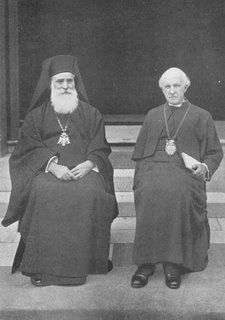
Orthodoxy and Anglicanism in a road block

It is the hope of myself and of all who have the unity of the Church of Christ at heart that the agreements already reached may lead to further progress along the road to that full intercommunion between the Church of England and the Orthodox Churches of the East, which is the burden of our prayers and the goal of all our efforts.

-Letter of the Archbishop of Canterbury to the Rumanian Patriarch, 1937

(Pictured, Archbishop Meletios of Alexandria and Archbishop of Canterbury Cosmo Lang in 1930)

In 1978, after it became clear that churches within the Anglican Communion were “ordaining” women and intent on spreading this untraditional practice, Orthodox Archbishop Athenagoras remarked: “…the theological dialogue [between the Orthodox and the Anglicans] will continue, although now simply as an academic and informative exercise, and no longer as an ecclesial endeavor aiming at the union of the two churches.”(1) Looking back at this, in the context of many theological discussions, what comes as a surprise to many is the fact that the leaders of the worldwide Anglican Communion and the Patriarchs and other chief Bishops of the Orthodox Church had been discussing the prospect of joining into one church at all. It would be an understatement to say that reference to this historical fact often meets with incredulity. Nonetheless, the serious discussion of combining the Orthodox Church and the Anglican Communion of Churches as one Church began in earnest at least as early as 1922. Just how much hope one should have had in that endeavor, either in how practical it was or how long it would have taken in the most promising of circumstances, seems less important than the fact of the effort itself. What does it tell us that for decades the hope of union between Orthodoxy and Anglicanism was pursued, not by well meaning people on the fringes, but by the highest levels of leadership in both communions? And, why did it take only one issue, women’s “ordination,” to bring it to an end, so that only a mere “academic exercise” could remain as a sort of fossil that testifies to this extinct animal?

This process began as Orthodox Patriarchs and other Orthodox Bishops recognized, one by one, the validity of Anglican Orders and sent letters to the Archbishop of Canterbury to that effect. The first came in 1922, from Constantinople (as it is called when referring to the Patriarchate- instead of Istanbul). Soon after in 1923 came letters from Jerusalem, and then from the Archbishop of Cyprus. Also in 1923, came a letter from the Patriarch of Alexandria. In 1936, the Orthodox Church of Romania sent a letter, also recognizng the validity of Anglican Orders. (2)

The Orthodox Church has in it many people who are now embarrassed, some to the point of denial. The Anglicans of today have, in many places, earned a bad reputation, winking at more than mere innovation; approving of what the Bible calls "abominations." How can the scandalized Orthodox accept the fact that their Church, "the One True Church," was ever considering real unity with people like the Episcopalians- a church with priestesses, bishopettes and at least one Ordinary living in a same sex union? Well, the fact is that they were never considering unity with such people. The Anglicans that they were talking with up until 1976, had at that time approved none of these errors. In fact, the Anglicans were so highly regarded that here, in Amercia, when Orthodox Christians lived very far away from an Orthodox Church, they received special letters from the Orthodox Hierarchy giving them permission to attend the Episcopal Church and to receive the sacraments- including the Holy Communion of Christ's Body and Blood (and so throughout the countries where the Anglican Churches could meet this need). Today, with Orthodox Churches in most major cities and towns, this situation does not exist (Orthodox people who remember this are still alive).

Was this because the Orthodox Patriarchs were a bit thick, and carelessly allowed themselves to be duped by deceitful Anglicans, "Protestants in Catholic clothing?" Having too much respect for their diligence and godly character to imagine such a thing, we must believe that they understood what Anglicanism really was. Furthermore, the kind of Anglicans who were at the highest levels of leadership, and who were in direct communication with the Orthodox Church, believed in the same Catholic Faith as we who Continue the Faith of our fathers. The irony is obvious. Thanks to the same heretics who drove us out, into Athanasian style exile, it may be a long time before the Orthodox Church, represented by any of its Patriarchates, will be willing to enter into serious discussions with any Anglicans. But, when the time comes, they ought to talk to us, not to the Canterbury Club.

In those decades the Church of England had begun an endeavor to seek Reunion with Rome (the ecumenical gesture of the infusion of Old Catholic orders), and to help make their Orders more acceptable to Rome in the hope of that eventual Reunion as a genuine possibility. If true unity could have been achieved, however long it took, think of the implications. No more Great Schism- talk about the Bridge Church was not empty rhetoric.

(1) As quoted in Anglican-Orthodox Dialogue: The Dublin Agreed Statement, (Crestwood, N.Y.: St. Vladimir’s Seminary Press, 1985), p.3

(2) Orthodox Statements on Anglican Orders

Encyclical on Anglican Orders from the Oecumenical Patriarch to the Presidents of the Particular Eastern Orthodox Churches, 1922

[The Holy Synod has studied the report of the Committee and notes:] 1. That the ordination of Matthew Parker as Archbishop of Canterbury by four bishops is a fact established by history. 2. That in this and subsequent ordinations there are found in their fullness those orthodox and indispensable, visible and sensible elements of valid episcopal ordination - viz. the laying on of hands, the Epiclesis of the All-Holy Spirit and also the purpose to transmit the charisma of the Episcopal ministry. 3. That the orthodox theologians who have scientifically examined the question have almost unanimously come to the same conclusions and have declared themselves as accepting the validity of Anglican Orders. 4. That the practice in the Church affords no indication that the Orthodox Church has ever officially treated the validity of Anglican Orders as in doubt, in such a way as would point to the re-ordination of the Anglican clergy as required in the case of the union of the two Churches. ================================================================

The Patriarch of JERUSALEM, 1923
The Patriarch of Jerusalem wrote to the Archbishop of Canterbury in the name of his Synod on March 12, 1923, as follows: To His Grace the Archbishop of Canterbury, First Hierarch of All England, our most beloved and dear brother in our Lord Jesus, Mgr. Randall. Greeting fraternally your beloved to us, Grace, we have the pleasure to address to you the following: Yesterday we dispatched to Your Grace the following telegram: ‘We have pleasure inform Your Grace that Holy Synod of our Patriarchate after studying in several meetings question Anglican Orders from Orthodox point view resolved their validity.' Today, explaining this telegram, we inform Your Grace that the Holy Synod, having as a motive the resolution passed some time ago by the Church of Constantinople, which is the church having the First Throne between the Orthodox Churches, resolved that the consecrations of bishops and ordinations of priests and deacons of the Anglican Episcopal Church are considered by the Orthodox Church as having the same validity which the Orders of the Roman Church have, because there exist all the elements which are considered necessary from an Orthodox point of view for the recognition of the grace of the Holy Orders from Apostolic Succession. We have great pleasure in communicating to Your Grace, as the First Hierarch of all the Anglican Churches, this resolution of our Church, which constitutes a progress in the pleasing-to-God work of the union of all Churches, and we pray God to grant to Your Grace many years full of health and salvation.
(Signed) DAMIANOS


February 27/March 12, 1923 Official translation published in The Christian East, vol. IV, 1923, pp. 121-122. The Archbishop of the autonomous Church of Sinai expressed for his Church adherence to the decisions of Constantinople and Jerusalem.
================================================================
The Archbishop of CYPRUS, 1923
The Archbishop of Cyprus wrote to the Patriarch of Constantinople in the name of his Synod on March 20, 1923, as follows: To His All-Holiness the Oecumenical Patriarch Mgr. Meletios we send brotherly greeting in Christ. Your Holiness – Responding readily to the suggestion made in your reverend Holiness' letter of August 8, 1922, that the autocephalous Church of Cyprus under our presidency should give its opinion as to the validity of Anglican Orders we have placed the matter before the Holy Synod in formal session. After full consideration thereof it has reached the following conclusion: It being understood that the Apostolic Succession in the Anglican Church by the Sacrament of Order was not broken at the Consecration of the first Archbishop of this Church, Matthew Parker, and the visible signs being present in Orders among the Anglicans by which the grace of the Holy Spirit is supplied, which enables the ordinand for the functions of his particular order, there is no obstacle to the recognition by the Orthodox Church of the validity of Anglican Ordinations in the same way that the validity of the ordinations of the Roman, Old Catholic, and Armenian Church are recognized by her. Since clerics coming from these Churches into the bosom of the Orthodox Church are received without reordination we express our judgment that this should also hold in the case of Anglicans – excluding intercommunio (sacramental union), by which one might receive the sacraments indiscriminately at the hands of an Anglican, even one holding the Orthodox dogma, until the dogmatic unity of the two Churches, Orthodox and Anglican, is attained. Submitting this opinion of our Church to Your All-Holiness, we remain, Affectionately, the least of your brethren in Christ,
Cyril of Cyprus


Archbishopric of Cyprus. March 7/20, 1923 Published in The Christian East, vol. IV, 1923, pp. 122-123.
====================================================
The Patriarch of ALEXANDRIA, 1930
After the Lambeth Conference of 1930, the Synod of the Patriarchate of Alexandria found itself able to join in the recognition of Anglican Orders. The decision was announced in a letter from the Patriarch to the Archbishop of Canterbury as follows: To the Most Reverend Dr. Cosmo Lang, Lord Archbishop of Canterbury and Primate of All England, Greetings in the New Born Christ The Feast of the Nativity, according to the Flesh, of the Redeemer of our Souls being a most suitable occasion for us, as it were, to visit your Beatitude, our friend, by means of a letter, we come to you hereby with a heart that is filled alike with joy, that "unto us is born a Savior, which is Christ the Lord," and with fervent prayers both for your health and for the peace and stability of the holy Churches of God over which you preside. At the same time, together with our greetings for the Feast, we send you as our gift the news, which we are sure will be good news, to you, that having derived the greatest gratification from the accounts which it has received, both of the marks of honor which were rendered in London, alike by your Grace and by the general body of your Church, to the office which is ours, and also of the happy results which by the favouring breath of the Holy Spirit have emerged from the contact of the Orthodox Delegation with the Lambeth Conference, our Holy Synod of the Metropolitans of the Apostolic and Patriarchal Throne of Alexandria has proceeded to adopt a resolution recognizing the validity, as from the Orthodox point of view, of the Anglican Ministry. The text of that resolution is as follows: "The Holy Synod recognizes that the declarations of the Orthodox, quoted in the Summary, were made according to the spirit of Orthodox teaching. Inasmuch as the Lambeth Conference approved the declarations of the Anglican Bishops as a genuine account [1] of the teaching and practice of the Church of England and the Churches in communion with it, it welcomes them as a notable step towards the Union of the two Churches. And since in these declarations, which were endorsed by the Lambeth Conference, complete and satisfying assurance is found as to the Apostolic Succession, as to a real reception of the Lord's Body and blood, as to the Eucharist being thusia hilasterios [2] (Sacrifice), and as to Ordination being a Mystery, the Church of Alexandria withdraws its precautionary negative to the acceptance of the validity of Anglican Ordinations, and, adhering to the decision of the Ecumenical Patriarchate, of July 28, 1922, pronounces that if priests, ordained by Anglican Bishops, accede to Orthodoxy, they should not be re-ordained, as persons baptized by Anglicans are not rebaptized." We rejoice to see the middle wall of partition being thrown down more and more, and we congratulate your Beatitude that under God you have had the felicity of taking the initiative in furthering that work. May the Lord Who was born in Bethlehem give to you and to us the happiness of its completion. In Alexandria upon the Feast of Christ's Nativity, 1930 Your Beatitude's Beloved Brother in Christ
Meletios of Alexandria

In reporting this decision to the Oecumenical Patriarch Meletios emphasized that his Synod was acting on the basis that the statements made at Lambeth had removed their former hesitation "as to the teaching of the Anglican Church upon the mysteries and Apostolic succession," and could be held to have met the desire expressed by the Romanian Patriarch in replying to Constantinople in 1925, when he wrote, But in order to make a definite pronouncement, we desire especially that the Anglican Church herself should precise her doctrine concerning the holy mysteries and particularly concerning orders: does she hold it to be a mystery or not? Since that requirement had now been satisfied, wrote Meletios, It is proper that the validity of Anglican Orders should now be recognized by all Orthodox Churches. For that which, according to the same letter, was "one of the most serious obstacles in the way of the Union of the two Churches," has been "removed." Letter published in The Christian East, vol. XII, 1931, pp. 1-6, with notes as above; the quotation in Note 2 is from No. 11 in the Resume of the Lambeth Discussions, reprinted below, p. 22.

FOOTNOTES
[1] The words in the Resolution of the Lambeth Conference are "sufficient account." [2] We transliterate the term, thusia hilasterios, and do not translate it by propitiatory sacrifice, or expiatory sacrifice, because, as generally used, these terms present conceptions which are not attached by the Orthodox to thusia hilasterios. The words used by the Anglican Bishops in their discussions with the Orthodox Delegation, as recorded in the Resume, and endorsed by the Lambeth Conference are: "… that the Anglican Church teaches the doctrine of Eucharistic Sacrifice as explained in the Answer of the Archbishops of Canterbury and York to Pope Leo XIII, on Anglican Ordinations: and also that in the offering of the Eucharistic Sacrifice, the Anglican Church prays that ‘by the merits and death of Thy Son Jesus Christ, and through faith in His Blood, we and all Thy whole Church may obtain remission of our sins, and all other benefits of His Passion,' as including the whole company of faithful people, living and departed." Lambeth Conference Report, 1930,

Wednesday, December 09, 2009

More odd ends

The following was originally a comment:

The accuracy of my report that Anglicanorum Coetibus is in response primarily to an old request from FiF/UK took me by surprise. I assumed everyone knew that FiF/UK was first in line, and did the closest work at the end.

This was reported earlier:

NOT everyone was bewildered. The Revd Geoffrey Kirk, secretary of Forward in Faith — who will be standing down next year, after an “annus horribilis” of ill-health — told the Assembly on Friday: “You will have wondered why the original agenda of this Assembly was so sketchy. Well, now you know.”

The statement from Rome was “not a bolt out of the blue”. It was an event long expected, for which many people had worked over the years. In 1992, Fr John Broadhurst, as he was then, had sent out a card to every priest on the mailing list asking him to affirm acceptance of the magis­terium of the Roman Catholic Church...The Bishops of Chichester and other bishops had made similar contacts, and FiF representatives had spent two days in January as guests of Cardinal Christoph Schön­born in Vienna. As they had departed for London, he had flown off to Rome.

“This is Plan B, emerging mercifully on cue as Plan A seems to have an increasingly uncertain future in the leglisative revision committee of the General Synod.”


The TAC was mentioned as also making a petition.

Ed has said that the TAC expect another set of Norms particular to them. The one point, however is that these cannot contradict the existing constitution and its norms, if indeed the prediction is true. Rome will not change precedent and the official doctrine with which it has bound itself.

About Reunion


I was asked earlier this evening if I regard acceptance of
Anglicanorum Coetibus as a betrayal of Anglicanism. In the sense that we have never claimed to be the One True Church, but only a part of it (as we say about all other such parts) the answer cannot be yes in an open sense. But, in terms of the present time in which we live, as things are right now in history, yes it is a betrayal.


Considering the present issue, I have decided it is quite timely to post, for a second time, this essay. - Fr. Hart

Hooker on unity with Rome

originally posted Tuesday, March 04, 2008

From Richard Hooker's The Laws of Ecclesiastical Polity, Book III, I, 10

We hope therefore that to reform ourselves, if at any time we have done amiss, is not to sever ourselves from the Church we were of before. In the Church we were, and we are so still. Other difference between our estate before and now we know none but only such as we see in Juda; which having sometime been idolatrous became afterwards more soundly religious by renouncing idolatry and superstition. If Ephraim “be joined unto idols,” the counsel of the Prophet is, “Let him alone.” “If Israel play the harlot, let not Juda sin.” “If it seem evil unto you,” saith Josua, “to serve the Lord, choose you this day whom ye will serve; whether the gods whom your fathers served beyond the flood, or the gods of the Amorites in whose land ye dwell: but I and mine house will serve the Lord.” The indisposition therefore of the Church of Rome to reform herself must be no stay unto us from performing our duty to God; even as desire of retaining conformity with them could be no excuse if we did not perform that duty.

Notwithstanding so far as lawfully we may, we have held and do hold fellowship with them. For even as the Apostle doth say of Israel that they are in one respect enemies but in another beloved of God; in like sort with Rome we dare not communicate concerning sundry her gross and grievous abominations, yet touching those main parts of Christian truth wherein they constantly still persist, we gladly acknowledge them to be of the family of Jesus Christ; and our hearty prayer unto God Almighty is, that being conjoined so far forth with them, they may at the length (if it be his will) so yield to frame and reform themselves, that no distraction remain in any thing, but that we “all may with one heart and one mouth glorify God the Father of our Lord and Saviour,” whose Church we are.

Richard Hooker (1554-1600) wrote to defend the polity of the Church of England against the attacks of the Puritans who wanted to abolish every trace of Roman influence, and who had assumed that the episcopal polity of the Church of England was simply one of those "Romish" things that they wanted to dismantle. In a very lengthy Preface, Hooker criticizes "Calvin's Geneva Discipline" and other theories on how to reinvent the ecclesiastical wheel, tearing down Puritan assertions that their model was taught by scripture. In the process he became the first Anglican writer to provide certain things that have become a basic philosophy that contains features of theology foundational to Anglicanism. The need to weigh all doctrines by Scripture, with the aid of Right Reason and the Church with her Authority (or, as is customary to say today, Tradition- though he meant Polity as well), comes from a careful reading of his Laws of Ecclesiastical polity, as does the idea of the Via Media, not as some sort of compromise for peace, but as a different road altogether, to be taken for the sake of truth.

To appreciate Hooker, we need to remember the times in which he wrote. The nature of religious apologetics was far less polite and far more polemical in the Elizabethan Period than it is in our own ecumenically sensitive time (usually). To write a sweeping dismissal of "Papist" or "Romish" practices as consisting of idolatrous and superstitious abominations is not at all acceptable today (and indeed, it hinders communication and understanding). But, in Hooker's day, the
possibility of reunion was the sort of thing that was potentially scandalous and dangerously controversial. His words aimed at something charitable shortly after a time in which "Papists " (to use the word of that period) had murdered Protestants in great numbers for heresy, and in which the Queen still considered obedience to the pope as treason punishable by death, that is, loyalty to a foreign prince who had sought to undermine her rule (i.e. kindle civil war and her execution). Nonetheless, in that period with all of its violence, we find in Hooker the reasonable and pacific attitude that would become characteristic of Anglicanism at its best.

In the above passage, Hooker affirms principles that were unique among Reformation churches.

First of all, Hooker affirmed the antiquity of the Church of England, and the fact that no new church had been formed. "We hope therefore that to reform ourselves, if at any time we have done amiss, is not to sever ourselves from the Church we were of before. In the Church we were, and we are so still." Even though Archbishop Matthew Parker (if not Cranmer before him) could have been considered the first of his line, this was not the position of the Church of England. Instead, Archbishop Matthew Parker was the 77th Archbishop of Canterbury. It was the same Church that had been established at the Council of Hertford in 673 A.D., when the ancient Celtic British and the Anglo-Saxon Christians came together in unity as Ecclesia Anglicana (not at the earlier Council of Whitby in 664, though it had laid the necessary foundation). This first unique principle was, therefore, no new church but rather continuity of identity.

The second thing was principle. The 39 Articles state very simply that the Church of Rome has erred. So, Hooker's words: "In like sort with Rome we dare not communicate concerning sundry her gross and grievous abominations." The English Reformers rejected ideas and practices that were either taught by Rome or allowed by Rome, not in an effort to turn away from the Catholic Faith, but instead to purge it of errors, and get back to its essentials. This kind of thinking is principled where some modern forms of ecumenism fail. The sloppy ecumenism of the Charismatic Movement comes to mind, in which unity was simply assumed by means of ignoring or explaining away genuine points of disagreement. If theological principles are unimportant, eventually moral principles must also fall by the wayside. Without the honesty that this form of principled stand requires, no real efforts toward unity will ever be possible, because no true discussion will take place. The Anglican position was that these principles mattered, but unique to Anglicanism was the notion that these were errors within the Church. The other churches of the Reformation dismissed the Church of Rome altogether as a false or fallen church, even as Antichrist. Not so Hooker, setting the position that would prevail in Anglican thinking.1

Finally, the Anglican position as stated by Hooker was unique in that it held forth the hope of reunion. So he said: "yet touching those main parts of Christian truth wherein they constantly still persist, we gladly acknowledge them to be of the family of Jesus Christ; and our hearty prayer unto God Almighty is, that being conjoined so far forth with them, they may at the length (if it be his will) so yield to frame and reform themselves, that no distraction remain in any thing, but that we 'all may with one heart and one mouth glorify God the Father of our Lord and Saviour,' whose Church we are." It has been argued by anti-Anglican apologists that the Church of England was no different from the other Reformation churches because they never officially "unchurched" the Lutherans or Calvinists. Never mind the fact that (despite much fiction to the contrary) the polity of the Church of England did not allow the functions of ordained ministry to any man unless and until he was ordained by a bishop in Apostolic Succession, a fact that, in itself, teaches the limits of their confidence in the sacraments of the continental European Protestants. What matters in Hooker's writing is that he never "unchurched" the Church of Rome. Furthermore, although in embryonic form, he sets down the goal to someday establish unity with the Church of Rome, a serious effort that would get underway long after his death.

Application

At this time one group of Anglicans who may be able to go forward in that effort is the TAC. Of course, it would require the resignation of Archbishop Hepworth from his position (as he knows and has stated himself). Most of us are not able to speak intelligently about what exactly their plan is, or maybe simply their hope. Speculation and rumor do not help us get to the facts, and neither do panic or suspicion. However, certain things are obvious, not the least of which is this: When (or if) an answer comes from Rome it will not lead to immediate action, but to discussion. This discussion will have to be theological, because it would involve polity and liturgy.

In recent months I have posted a few things aimed at fellow Anglicans who lack confidence in their own heritage as legitimate and validly Catholic, mainly because it is clear that they have learned only from Roman Catholic sources, and have completely lost sight of Anglican principles. RC bloggers have beaten up quite a few of them mentally. And, the weakened state of the official Anglican Communion is enough to depress them, leading to despair that any good thing could ever come from that Nazareth. And, in some ways other Anglicans add to the confusion by losing all proper sight of the via media, becoming either just like modern Evangelicals as extreme low churchmen, or nose-bleed high Anglo-Catholics who live in constant fear of anything that seems "Protestant," forgetting that it is not the opposite of "Catholic."

This fear of anything "Protestant" is easily exploited by people who see the same terms employed by Lutherans or Calvinists as by Anglicans, not realizing that often the overlapping of phrases was inevitable, and that most of these instances were a continuation of theological debate among Catholics in the west that preceded the Reformation period. Sometimes, what they perceive as "Calvinist" is Augustinian, Dominican and even Thomist. The overlapping of terminology was inevitable, but one thing remains certain. The 39 Articles and other Anglican formularies were not Lutheran or Calvinist, nor were most of the terms employed in them unique to Protestantism at all.

If efforts to achieve unity do continue between the TAC and Rome (or any serious body of Anglicans and Rome, and/ or Orthodoxy) I urge consideration of these few principles I have gleaned here from Richard Hooker. If, for anybody, that involves studying Anglicanism all over again, or perhaps for the first time, it is well worth the effort. Our own baby should not be thrown out with the bathwater
________

1. Indeed, in the same chapter One of Book III, Hooker dismisses Calvin's extreme position on the children of the Church of Rome as, to use his exact word, "crazed"- as in, crazy.

Friday, July 24, 2009

Bishop Chislett on being 'in communion' with Rome

I noticed on The Messenger website an article on this topic by Bishop Chislett of the ACCA (TAC). The sentence that jumped out at me was, 'The 2007 letter from the TAC bishops to the Holy See sought a way of moving to the next level, and signified our desire to continue the ARCIC process to full ecclesial reunion where the Anglican Communion as a whole effectively left off.' This is what I have tried to say in earlier comboxes. You can read the full article here. And, of course, you can comment here. Just remember, Bishop Chislett reads, and occasionally comments, on this blog, so comment as if he is in the room and can hear you.

Monday, July 28, 2008

Unity and salvation

"Neither pray I for these alone, but for them also which shall believe on me through their word; That they all may be one; as thou, Father, art in me, and I in thee, that they also may be one in us: that the world may believe that thou hast sent me." John 17:20,21

We hear this quoted often, and alluded to even more often. Almost never do we actually hear the full quotation. This should not be surprising in an age that thinks in sound bites, and that places greater emphasis on how people feel about issues, than on what they think about them. When we are treated to these allusions and partial quotations, the message seems to be this: Jesus really wants us to become one, and we have to make it happen. Put another way, God is praying to us, and we ought to hear his prayer.

And, if that seems wrong to you, good; well it should.

The emphasis of the Gospel according to St. John is twofold: It is the Trinity and the Incarnation. As it opens, John takes us behind the scenes of Genesis. The Hebrew name of the first book of the Bible means, "In the beginning." ( B'Rasheet, בְּרֵאשִׁית). John opens with this same phrase recognized by readers of the Septuagint (LXX), the standard Greek translation of the Old Testament; He too opens with, "In the beginning," (En Arche, ἐν ἀρχῇ ). In the Book of B'Rasheet, or Genesis, we are told what God did, the word "created" (bora, בָּרָא) following as the second word ("In the beginning" is all one word). If translated into English words, but retaining Hebrew syntax, it would say, "In the beginning created God the heavens and the earth." The emphasis is not on God himself, but on his work of creation. John, using the expression known to Greek readers of the LXX (ἐν ἀρχῇ ) alludes to the opening of Genesis in a very obvious way, but does not immediatley speak of God's work. First he lingers on God as God, and presents God as the Trinity.

"In the beginning was the Word (Logos, Λόγος), and the Word was with God, and the Word was God. The same was in the beginning with God." (1:1,2)

Verse 2 is not superflous; it mentions God the third time because, as this Gospel unfolds, we see the Son and we hear him speak of the other Comforter, that is the Spirit of Truth. The theme of God as Trinity is presented immediately. Then, with a bow to the Genesis narrative, John speaks of creation (בָּרָא): "All things were made by him; and without him was not any thing made that was made. " He speaks of the Logos as the One in whom there is life, that is, life that gives life, suggesting most strongly the creation of Man: "In him was life; and the life was the light of men." When we keep reading, and get to verse 14, the second great theme of John's Gospel is introduced. "And the Word was made flesh, and dwelt among us, (and we beheld his glory, the glory as of the only begotten of the Father,) full of grace and truth."

It is only in the context of these two great themes that dominate this Gospel, the Trinity and the Incarnation of the Word, that we have any business interpreting the meaning of the High Priestly prayer of chapter 17. The first Unity that we must consider in the words of this prayer is the Unity of the Trinity. So, it opens: "These words spake Jesus, and lifted up his eyes to heaven, and said, Father, the hour is come; glorify thy Son, that thy Son also may glorify thee: As thou hast given him power over all flesh, that he should give eternal life to as many as thou hast given him. And this is life eternal, that they might know thee the only true God, and Jesus Christ, whom thou hast sent. " (17:1-3) Our salvation is knowing God, and because whoever sees the Son sees the Father, and no man comes to the Father but by the Son (14:6-10), because God cannot be separated from God (for each Person is distinct, but inseparable), to know the Father requires that we know Jesus Christ. The only true God is known truly only by revelation, namely, Jesus Christ Whom he has sent; that is, the Word Incarnate.

By the time we get to the place where Jesus says, "Holy Father, keep through thine own name those whom thou hast given me, that they may be one, as we are" (v.11), it ought to be clear that he is speaking to the Father, one Divine Person to another Divine Person, about our common salvation in himself. The meaning is eternal and salvific. It means, in effect, keep them in me. For, "this is life eternal, that they might know thee the only true God, and Jesus Christ, whom thou hast sent. "

Understood correctly, "that may all be one" gives greater motivation to be unified among ourselves in common faith and thought, with charity; because we are one whether we live like it or not. A prayer spoken within the Godhead, which we are privileged to overhear, the Son addressing the Father, is as much a declaration as "Let there be light," or "Let us make man in our image." God has pronounced that his people are one, that is, that the Church is, as St. Paul says many times, "in Christ." The Church as a whole is "in Christ," and each member of the Church is "in Christ."

We know that a married couple is no longer two, but one flesh. This is clear in Genesis, in the Gospels where Jesus explains that divorce is a mere fiction, and in the Epistles of Paul when he warns us to live within the boundaries of God's moral laws. To suggest that the eternal unity of the Church in Christ can really be broken, is akin to believing that human courts can undo the work of God in a valid sacramental marriage. The Church's various divorces, whether in 1054 or in the 16th century, do not annul its unity in Christ; for if it did, members would be cut off and die simply because of human failing. Where true faith is present, we are in Christ; and, unless one can rob a Christian of his faith, he cannot cut him off from Christ (Romans 4:16).

Our unity is both a present and eternal fact, because we are in Christ. We should make efforts to understand each other, to be very clear in communication, to work for the resolution of theological and political separation, and to cultivate charity by the grace of the Holy Spirit who is within us all. But, we must not let this become mere sentimentality, and neither must we feel anxiety or pressure to leap forward faster than honest and clear communication allow. We already are one in Christ, and can proceed toward a resolution of differences in polity only with theological clarity and respect for everyone's conscience.