I've posted homilies for Easter and for Low Sunday at
http://public.box.net/pastored59658
ed
Tuesday, March 18, 2008

Monday, March 17, 2008
Prayers For My Firstborn
The apple of my eye, firstborn and daughter Andrea, is in Glasgow tonight.
She has just been through the ringer, auditioning for a place at the Royal Scottish Academy of Music and Drama, one of the top such schools in the world, from what I am told.
From an initial group of around 25, she has made it through two cuts and is now a finalist, along with four others.
Glasgow wasn't really Andrea's first choice, but now that she has seen the city and the academy, she is really excited by it all.
I bid your prayers that she makes the final cut and is one of the two or three who will be selected.
Thank you.
Sunday, March 16, 2008
St. Patrick March 17th
(As has been pointed out, the actual feast is moved this year, because this is Holy Week. But, to help Christians deal with all the green beer and other secular stuff of some day called "Saint Paddy's," here is a reminder of someone else altogether- St. Patrick...)
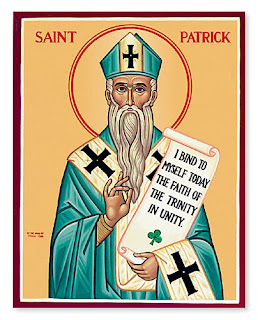 Now the LORD had said unto Abram, Get thee out of thy country, and from thy kindred, and from thy father's house, unto a land that I will shew thee: And I will make of thee a great nation, and I will bless thee, and make thy name great; and thou shalt be a blessing.
Gen. 12: 1,2
I bind unto myself today
The strong Name of the Trinity,
By invocation of the same
The Three in One and One in Three.
I bind this day to me forever
By power of faith, Christ’s incarnation;
His baptism in the Jordan river,
His death on Cross for my salvation;
His bursting from the spicèd tomb,
His riding up the heavenly way,
His coming at the day of doom
I bind unto myself today.
I bind unto myself the power
Of the great love of cherubim;
The sweet ‘Well done’ in judgment hour,
The service of the seraphim,
Confessors’ faith,
Apostles’ word,
The Patriarchs’ prayers, the prophets’ scrolls,
All good deeds done unto the Lord
And purity of virgin souls.
I bind unto myself today
The virtues of the star lit heaven,
The glorious sun’s life giving ray,
The whiteness of the moon at even,
The flashing of the lightning free,
The whirling wind’s tempestuous shocks,
The stable earth, the deep salt sea
Around the old eternal rocks.
I bind unto myself today
The power of God to hold and lead,
His eye to watch,
His might to stay,
His ear to hearken to my need.
The wisdom of my God to teach,
His hand to guide,
His shield to ward;
The word of God to give me speech,
His heavenly host to be my guard.
Against the demon snares of sin,
The vice that gives temptation force,
The natural lusts that war within,
The hostile men that mar my course;
Or few or many, far or nigh,
In every place and in all hours,
Against their fierce hostility
I bind to me these holy powers.
Against all Satan’s spells and wiles,
Against false words of heresy,
Against the knowledge that defiles,
Against the heart’s idolatry,
Against the wizard’s evil craft,
Against the death wound and the burning,
The choking wave,
the poisoned shaft,
Protect me, Christ, till Thy returning.
Christ be with me,
Christ within me,
Christ behind me,
Christ before me,
Christ beside me,
Christ to win me,
Christ to comfort and restore me.
Christ beneath me,
Christ above me,
Christ in quiet,
Christ in danger,
Christ in hearts of all that love me,
Christ in mouth of friend and stranger.
I bind unto myself the Name,
The strong Name of the Trinity,
By invocation of the same,
The Three in One and One in Three.
By Whom all nature hath creation,
Eternal Father, Spirit, Word:
Praise to the Lord of my salvation,
Salvation is of Christ the Lord.
 Now the LORD had said unto Abram, Get thee out of thy country, and from thy kindred, and from thy father's house, unto a land that I will shew thee: And I will make of thee a great nation, and I will bless thee, and make thy name great; and thou shalt be a blessing.
Gen. 12: 1,2
I bind unto myself today
The strong Name of the Trinity,
By invocation of the same
The Three in One and One in Three.
I bind this day to me forever
By power of faith, Christ’s incarnation;
His baptism in the Jordan river,
His death on Cross for my salvation;
His bursting from the spicèd tomb,
His riding up the heavenly way,
His coming at the day of doom
I bind unto myself today.
I bind unto myself the power
Of the great love of cherubim;
The sweet ‘Well done’ in judgment hour,
The service of the seraphim,
Confessors’ faith,
Apostles’ word,
The Patriarchs’ prayers, the prophets’ scrolls,
All good deeds done unto the Lord
And purity of virgin souls.
I bind unto myself today
The virtues of the star lit heaven,
The glorious sun’s life giving ray,
The whiteness of the moon at even,
The flashing of the lightning free,
The whirling wind’s tempestuous shocks,
The stable earth, the deep salt sea
Around the old eternal rocks.
I bind unto myself today
The power of God to hold and lead,
His eye to watch,
His might to stay,
His ear to hearken to my need.
The wisdom of my God to teach,
His hand to guide,
His shield to ward;
The word of God to give me speech,
His heavenly host to be my guard.
Against the demon snares of sin,
The vice that gives temptation force,
The natural lusts that war within,
The hostile men that mar my course;
Or few or many, far or nigh,
In every place and in all hours,
Against their fierce hostility
I bind to me these holy powers.
Against all Satan’s spells and wiles,
Against false words of heresy,
Against the knowledge that defiles,
Against the heart’s idolatry,
Against the wizard’s evil craft,
Against the death wound and the burning,
The choking wave,
the poisoned shaft,
Protect me, Christ, till Thy returning.
Christ be with me,
Christ within me,
Christ behind me,
Christ before me,
Christ beside me,
Christ to win me,
Christ to comfort and restore me.
Christ beneath me,
Christ above me,
Christ in quiet,
Christ in danger,
Christ in hearts of all that love me,
Christ in mouth of friend and stranger.
I bind unto myself the Name,
The strong Name of the Trinity,
By invocation of the same,
The Three in One and One in Three.
By Whom all nature hath creation,
Eternal Father, Spirit, Word:
Praise to the Lord of my salvation,
Salvation is of Christ the Lord.
Saturday, March 15, 2008
PALM SUNDAY

This is a re-run from last year.
We enter into the drama of the Gospel this week. No more powerful expression of the feeling of this week has ever been produced than the opening chorus of Bach’s St. Matthew Passion. The very sound of it evokes deep emotion, as music paints a picture of something beyond suffering. It is the willingness of love to embrace suffering, to own it, and in so doing to give the great gift of charity. It is our sorrow at Christ’s pain and death, but a sorrow of gratitude producing in us the love we could not have without His sorrow, His gift to us. The heart of the drama, as Bach put it into music, as Grunewold painted it, as countless poets have hymned it, and as Mel Gibson put it on the screen, is not the drama of a tragic figure whose life is wrongly taken in a Kafkaesque trial, a mockery of justice. It is the drama of the One Who loved us unto death, and gave that life which no man could take from Him.
We enter into the drama of the Gospel this week. No more powerful expression of the feeling of this week has ever been produced than the opening chorus of Bach’s St. Matthew Passion. The very sound of it evokes deep emotion, as music paints a picture of something beyond suffering. It is the willingness of love to embrace suffering, to own it, and in so doing to give the great gift of charity. It is our sorrow at Christ’s pain and death, but a sorrow of gratitude producing in us the love we could not have without His sorrow, His gift to us. The heart of the drama, as Bach put it into music, as Grunewold painted it, as countless poets have hymned it, and as Mel Gibson put it on the screen, is not the drama of a tragic figure whose life is wrongly taken in a Kafkaesque trial, a mockery of justice. It is the drama of the One Who loved us unto death, and gave that life which no man could take from Him.
This strikes us in our hearts and moves us to love Him, and it awakens our consciences from their slumber. Not because we feel guilty, though it is popular to say that our sins crucified Him. But in truth, our sins had no power over Him. In answer to the question, "Why did He have to suffer and die?" we answer that He had to have done nothing. Indeed, He owed us nothing. He did not die because He had to, or because we made Him do so. Pilate had no power over Him, the priests and Sanhedrin had no power over Him, the soldiers of Rome who beat, mocked and crucified Him, had no power over Him.
Hear the words Christ had spoken a while before ascending to Jerusalem:
"Therefore doth My Father love Me, because I lay down My life that I might take it again. No man taketh it from Me, but I lay it down of Myself. I have power to lay it down, and I have power to take it again. This commandment have I received of My Father (John 10: 17, 18)."
Remember, as we will read on Friday the Gospel of John, that when they came to arrest Him, they all fell backward, and could not stand up until He spoke again and allowed them to do so. And, as St. Matthew tells us, He spoke these words to Peter:
"Put up thy sword into his place...thinkest thou that I cannot now pray to My Father, and He shall presently give Me more than twelve legions of angels? But how then shall the scriptures be fulfilled, that thus it must be (Mat. 26: 53, 54)?"
The One Who prayed in the Garden, "Not as I will, but as Thou wilt" and said "greater love hath no man than this, that a man lay down His life for His friends" would show greater love than is possible for human strength, as He would die for His friends and His enemies. "God commendeth His love toward us, in that, while we were yet sinners, Christ died for us (Rom. 5:8)." He set His face as a flint; His face was set toward Jerusalem. No man could make Him go there; no man could send Him to the cross.
So our consciences are stricken, and our hearts afflicted, by something more profound than guilt; we are brought low, and moved, by this true drama, to gratitude, to give thanks with tears, moved to love, all of which restores to us hope, and faith, and charity for all. Our consciences are cleansed by His death, and made new. They are made active; they stir to holy living. No longer is our life a matter of rules for the sake of rules, laws for the sake of laws. The Law is written on our hearts by the Holy Ghost along with the deepest recognition that we could not give enough thanks to our Redeemer had we a thousand tongues to sing, and that we will never stop giving thanks for eternity, unto ages of ages, or world without end. It is now personal. "We love Him because He first loved us."
We are moved beyond the power of words to tell, not because the cross of Christ makes us guilty in forcing Him to bear our sins; but, rather, because the cross removes our guilt, we are moved to gratitude and to love. It is because He "bore our sins in His body on the Tree (I Peter 2:24)." "He was numbered with the transgressors, and He bare the sin of the many, and made intercession for the transgressors (Isa. 53: 12)." This was the Divine plan, about which we had no say, in which we had no input. Like life itself, it is the free gift of the Triune God to creatures dependent upon His grace, grace to live, and now grace to be restored to His favor. Think upon the words we have read from that famous passage of St. Paul to the Philippians, that He "was obedient unto death, even the death of the cross."
What can that mean if not that the death of the cross was the Divine plan? This is a profound mystery. We can understand the principle that the death of the One Who was without sin, Who never deserved the wages of sin, reverses death and brings eternal life. That His death is, therefore, the sacrifice offered to God by the Righteous One of Himself for all sinners is plain enough as a theological principle, and is itself demonstration of the love of God for the fallen children of Adam. But, the death of the cross, the death of severe pain and humiliation, involving the worst physical suffering man can feel, coupled with all of the shame and torment of cruel mocking and scourging. Why was this the Divine plan? What does each stripe mean? What means the piercing of thorns and nails, the contempt and anger, the beating over the head with a reed? Why the derision of heartless enemies added to the pain of crucifixion? What is all of this about?
The answer, as is written in the First Epistle of Saint Peter, is that He “bore our own sins in His body on the tree.” We are proud, are we not, of our minds? Can we not out think all creatures on earth? But, how does God view the vain and selfish use of our minds? He crowns our proud intellects with thorns. We are proud, are we not, of the work of our hands? Have we not made things greater than the Tower of Babel itself? But, what thinks the righteous God of the selfishness with which we labor? Our hands deserve the piercing of nails. We are proud, are we not, of how we walk before God and men? We suppose that we are not like other men, and are just humble enough to render proud thanks as we pray thus to ourselves, "God, I thank thee." But, in the eyes of God our own standard of righteousness tends to self-flattery. What says He of our walk, but that nails should be driven through our feet?
But, I think I only scratch the surface of this mystery. Certainly, nothing that happened to the Son of God was an accident. He allowed it all, so it all has meaning, and the mystery is more profound than I can say, of what it means that "He bore our own sins in His body on the tree." The cross shows us the Divine sentence upon our sins, and yet, remember, that we had no power to crucify Him.
On this Palm Sunday, let us look at the determination with which He fulfilled His mission. Nothing could keep Him from the purpose for which He came as a Man, and took upon Himself our nature. In the movie The Passion of the Christ, the "bad" thief, the one who does not fear God even while dying, is filled with anger at the sight of the Lord embracing His cross. "Fool!" he yells, "Why do you embrace your cross?!" Christ entered Jerusalem, unmoved by the praise of the crowds, for He had not come to be their King, not yet. He had come to be priest and sacrifice. The great drama of this coming week, the drama Bach expressed so powerfully through music, the drama we feel this day, and which will break our hearts on Thursday night and Friday, is the drama of His love, which produces our love, our thanks; and that afflicts our hearts with both pain and comfort at once. We, though undeserving, are loved.
Thank God and Thank Qatar
As the good cardinal said, let us thank God and Qatar for this great gift.
Thousands of Catholics attend first mass at Qatari church
by Wissam Keyrouz
DOHA, March 15, 2008 (AFP) - Thousands of Christians took part on Saturday in the first mass at Qatar's only church, opened this week despite threats from Islamists.
Vatican envoy Cardinal Ivan Dias presided over the eucharist attended by around 15,000 worshippers at Our Lady of the Rosary Roman Catholic church in Doha, thanking "God and Qatar for this great gift."
The church, which has no bells or crosses on its exterior, opened on Friday ahead of western Christianity's celebration of Easter, which this year falls on March 23. It is the first of five to be constructed in the gas-rich Gulf state.
From early morning, Catholics began arriving at the church, which accommodates around 5,000. Big screens were erected in the grounds to allow the overflow to follow the mass, celebrated during the consecration of the building.
The mass was conducted in English, but prayers were also said in Arabic, Urdu, Hindi, Tagalog, Spanish and French in honour of the many nationalities that would be worshipping in the church.
Dozens of police were deployed around the church, which cost some 20 million dollars (13 million euros), and female officers searched the handbags of women worshippers.
Western embassies, particularly from the United States and Britain warned nationals living in Qatar to be extra vigilant after an Islamic militants on the Internet made threats linked to the opening of the church.
The US embassy on Thursday released a warning that the new church might be targeted.
"Extremists may elect to use conventional or non-conventional weapons and target both official and private interests. Examples of such targets include ... the new Christian Church complex in Doha," it said.
Worshippers said they were not concerned by the threats and were delighted to attend the "historic day."
"It is a day without precedent. I am very happy. The threats were made but I didn't pay them much attention. I trust the country's authorities," Filipino Catholic Shato Mawude told AFP.
Fellow Filipino Ariel Almyede added: "We are believers and we are not afraid ... This church is a sign of a possible dialogue between the different faiths."
Qatari Deputy Prime Minister Abdullah bin Hamad al-Attiyah added: "The church sends a positive message to the world.
"It is a strong message that will help Islam. At the moment we are enjoying the construction of mosques and Islamic centres in the West, so we must be fair" towards Christians in the region and allow them places of worship.
Qatar is a close ally of Washington and hosts the command headquarters for US forces in the Middle East.
Eventually, the Catholic church will be joined by others to be built by the Anglicans, the Coptic, Greek and Syrian Orthodox and India's Mar Thoma church.
Most Gulf Arab states have long allowed Christians to worship in churches. Saudi Arabia, which adheres to a rigorous doctrine of Islam known as Wahhabism and is home to Islam's holiest sites, bans all non-Muslim religious rituals and materials.
But the papal nuncio in the Gulf, Archbishop Paul-Munjed al-Hashem, said on the sidelines of the mass that talks had begun with Saudi Arabia to convince it to become the final Gulf Arab state to allow the building of churches.
He said "discussions are underway with Saudi Arabia to allow the construction of churches in the kingdom," adding that "we cannot forecast the outcome."
"There are around three or four million Christians in Saudi Arabia, and we hope they will have churches" in which to worship, he said.
He also expressed hope in the eventual establishment of diplomatic relations between the Vatican and Saudi Arabia and Oman, saying he expected an announcement soon on ties with Muscat.
Friday, March 14, 2008
More light on this TAC-Rome business
By now it should be clear to regular readers that I am objective on the matter of the TAC and Rome, and that this objectivity is described best in apophatic terms: My position is not opposition, but it is not cheer leading. I am posting the words of a letter that was sent out to TAC churches by the office of Archbishop Hepworth some time (not dated) after the famous Portsmouth meeting, because it sheds some light on this mysterious subject.
I will quote portions, and make a few comments.
Seventeen years ago, just after a group of Anglican refugees had banded together as the “Traditional Anglican Communion”, its leaders met in Rome to talk unity with the Pontifical Council for Christian Unity. Their dreams and expectations that the meetings between the Pope and the Archbishop of Canterbury, the establishing of an International Commission, the pledges of goodwill on both sides, would lead to unity had just been dashed. The long disintegration of the Anglican Communion – bitterly divided over the most fundamental issues of the Christian faith – had begun.
In those seventeen years the Traditional Anglican Communion has responded to many calls from those whose churches have been drawn into the upheaval. We have provided havens of peace and healing as people struggled to maintain the faith and rebuild. Churches, schools, seminaries and orphanages have all been started from scratch. Now we are 41 countries strong, and a force to be reckoned with, and our dreams of a united church, of the churches of Rome and Canterbury reunited after five centuries of hurtful division, have never faltered.
For those who may not know, efforts between the See of Canterbury and the See of Rome seemed to have real substance after the famous occasion when Pope Paul VI gave his ring to the 100th Archbishop of Canterbury, Dr. Michael Ramsey in 1966. Archbishop Ramsey always wore it after that. In the years that followed serious efforts got underway, culminating in ARCIC. As some sort of gesture I fail to understand, Archbishop Rowan Williams gave the same ring back, so to speak, by presenting it to Pope John Paul II a few months before his death.
Two important facts must be taken into account. First of all, the initial effort was to achieve real unity, but after 1976 and the "ordination" of women in certain churches of the Anglican Communion, the talks were less promising. In 1992 the Church of England itself began to practice this innovation of women's "ordination" also, despite urging from the See of Rome not to do so. Since then, all ecumenism between Rome and Canterbury has been a mere formality.
The second fact is this: When the TAC speaks of restoring this hope of unity, it is only right to consider that the goal they speak of is not exactly the same as that of Archbishop Michael Ramsey and Pope Paul VI. In the city of Little Rock, Arkansas, during a service there in 1967, the Archbishop of Canterbury said: "The Pope and I walked arm in arm out in St. Peter's Basilica and there we bowed and dedicated ourselves in a common dedication, the task of unifying the Church. We did not mean we were going to unify the Anglican Church and the Catholic Church only, but we meant we were going to unify all Christendom and all the churches of the world. By unifying them, we did not mean just establishing diplomatic recognition among denominations, but we were going to unify all of them into one church. That is the task that is before us today, to unify all Christendom into the Holy Catholic Church"1
That may sound too big to have been substantive. However, consider that at the same time that the See of Canterbury was talking seriously with Rome, they were engaged in an equally serious effort with the Orthodox Patriarchates to establish unity, that the Anglican Communion and the Orthodox Church would become "one Church." In those days it was normal practice for Orthodox bishops to allow the faithful of their communion to receive the sacraments in Anglican churches, giving them letters granting this permission as long as no Orthodox church was available within a reasonable distance to where they resided. This hope for unity was dashed also, and by the same heresy, namely women's "ordination." In 1978, after it became clear that churches within the Anglican Communion were “ordaining” women and intent on spreading this practice, Orthodox Archbishop Athenagoras remarked: “…the theological dialogue [between the Orthodox and the Anglicans] will continue, although now simply as an academic and informative exercise, and no longer as an ecclesial endeavor aiming at the union of the two churches.”2
The similarity between what the TAC seeks now, and what was sought before the women's "ordination" error, is obvious. But, the difference is, evidently, that no corresponding effort is taking place between them and Orthodoxy. Therefore, it is not entirely accurate to invoke that history as something completely parallel. My own hope is to see the "Eastern lung" considered as well. The real hope of unity in which the Anglican Communion once played a unique role, extended to the potential healing of the Great Schism itself, over the London Bridge, so to speak. But, just as the London Bridge now sits in the Arizona desert, this hope of unity is no longer over the Thames. Nonetheless, to see that hope restored will require a larger vision than unity with the See of Rome.
Here is more from Archbishop Hepworth's letter:
On 9th October last I returned to Rome with Bishops Mercer and Wilkinson. Bishop Mercer is a monk of the famous community in Mirfield, England, and was Anglican Bishop of Matabeleland in Zimbabwe. The late Pope attended Evensong in his Cathedral. Bishop Wilkinson has corresponded with the then Cardinal Ratzinger about the content of a revived Anglican Divine Office. This time we met with the Sacred Congregation for the Doctrine of the Faith, the body appointed by the Holy See to receive applications for “Corporate Reunion” from churches that are not in Communion with the Holy See, and we carried a letter solemnly signed by the Bishops and Vicars General of the Traditional Anglican Communion during a Votive Mass for Unity in the venerable church of Saint Agatha in Portsmouth, England, where we had just completed a powerful Plenary Meeting.
Between these two visits to Rome a great work of teaching, building communities, developing leadership and guiding the growing trust between our Communion and the Roman Catholic Church has been maintained against the almost impossible odds of meagre resources and fierce opposition. Our letter rehearses the long and frustrating history of attempts to unite (in the words of Paul VI) the “church of Rome and the church of Canterbury”. It dwells on the reaction of those who dreamed that at last Anglicans were to become “Anglican Catholics” as the Anglican Communion took step after step to distance itself from the unity that had been promised.
The only problem I see here is this line: "...those who dreamed that at last Anglicans were to become 'Anglican Catholics.'" With all due respect to the Archbishop of the largest Continuing jurisdiction, this line is not something that most Anglicans can accept. We already are Anglican Catholics. Everyone of us is fully catholic in the true sense of that word, and we cannot enter the Catholic Church because we are already in it. Therefore, his phrase does not represent the Anglican mind. It is acceptable to Anglicans only in a denominational sense, that is, respecting the name by which the Roman Communion calls itself. I assume that is the meaning, but it requires clarification to avoid giving offense to fellow Anglicans.
More from Archbishop Hepworth:
More from Archbishop Hepworth:
May I share with you some of the letter’s content and promise …
On our Communion:
“a worldwide community of Anglican Christians has united under the name of The Traditional Anglican Communion for three main purposes:
To identify, reaffirm and consolidate in its community the elements… conduct that mark the Church of Christ…
To seek as a body full and visible communion, particularly eucharistic communion, in Christ, with the Roman Catholic Church …
To achieve such communion while maintaining those revered traditions … that constitute the cherished and centuries-old heritage of Anglican communities throughout the world.
On our acceptance of the ministry of the Bishop of Rome:
We accept the ministry of the Bishop of Rome, the successor of Peter, which is a ministry of teaching and discerning the faith and a “perpetual and visible principle and foundation of unity” and understand this ministry is essential to the Church founded by Jesus Christ.
These words themselves mostly affirm neither Universal Primacy, nor the 1870 innovation of Papal Infallibility; but may in fact be in accord with nothing more than what can be found in ancient writings. Dom Gregory Dix's Jurisdiction in the Early Church (out of print, for no good reason) documents the appellate nature of "teaching authority" exercised by the See of Rome even during the ante-Nicene period. The debatable point is in the words, "a perpetual and visible principle and foundation of unity." That exceeds any consensus to be found among Catholic Anglicans.
More from the letter:
More from the letter:
On our acceptance of the catholic faith:
“We accept that the most complete and authentic expression and application of the catholic faith in this moment of time is found in the Catechism of the Catholic Church…”
These words are subject to interpretation. Anglicans are very good at not saying anything too strongly; therefore such qualifiers as "in this moment of time" followed by the equally ingenius, "is found in," are in the best eirenic tradition. In other words, just what does this mean? For example, "in this moment of time" we have no better expression of Christian morality as applied to modern problems of ethics created by the advances of modern science, particularly medical science and how it relates to the corruption of law. "Is found in..." can be taken to mean that truth is to be found there, not that everything in it is right. We await clarification.
Here is more of Archbishop Hepworth's letter:
Here is more of Archbishop Hepworth's letter:
The bishops affirmed their faith in matters that have until now divided them from the Catholic Church, and finally, for the first time, they made an unambiguous appeal to the Holy See: “Driven by these realizations, which we must now in good conscience bring to the attention of the Holy See, we seek a communal and ecclesial way of being Anglican Catholics in communion with the Holy See, at once treasuring the full expression of catholic faith and treasuring our tradition within which we have come to this moment. We seek the guidance of the Holy See as to the fulfillment of these our desires and those of the churches in which we have been called to serve.”
After presenting these dreams and desires to the Holy See, I was authorized to release this statement:
“The College of Bishops of the TAC met in Plenary Session in Portsmouth, England, in the first week of October 2007. The Bishops and Vicars-General unanimously agreed to the text of a letter to the See of Rome seeking full, corporate, sacramental union. The letter was signed solemnly by all the College and entrusted to the Primate and two bishops chosen by the College to be presented to the Holy See. The letter was cordially received at the Congregation for the Doctrine of the Faith. The Primate of the TAC has agreed that no member of the College will give interviews until the Holy See has considered the letter and responded.”
We have all heard reports that the bishops of the TAC signed the Catechism of the Catholic Church, opened on the altar there in Portsmouth. But, from all of their statements it seems that this is not true, and what was signed was, in fact, the letter asking for full communion with Rome. 3
Archbishop Hepworth appears to be using the term "The Catholic Church" with ecumenical sensitivity, that is, as the official name of that Communion. Used that way, it is no more offensive than the term "the Orthodox Church," or frankly, as the Scots and Americans called Anglican churches, "the Episcopal Church." After all, that last one might seem to imply that no one else has bishops.
These words, "The bishops affirmed their faith in matters that have until now divided them from the Catholic Church..." state that they are not throwing the Anglican baby out with the bathwater. They make it clear that Anglicans have differences with the teaching of Rome, and that these differences require discussion. This is absolutely necessary. Anglicanism is not English culture (not to an American like me), and it is not simply married clergy and well constructed liturgy. We do have doctrinal standards and a few differences with the See of Rome.
This letter does not answer every question, nor lay to rest the potential for continued speculation. But, it helps to shed a bit more light for those of us who are not privy to these proceedings. In any case, we have this prayer in our BCP:
2. As quoted in Anglican-Orthodox Dialogue: The Dublin Agreed Statement, (Crestwood, N.Y.: St. Vladimir’s Seminary Press, 1985), p.3
3. I am prepared to be proved wrong. I could ask Bishop Florenza, but I have too much respect for him to bother him with a question about such a thing, in light of their commitment not to give interviews at this time.
Archbishop Hepworth appears to be using the term "The Catholic Church" with ecumenical sensitivity, that is, as the official name of that Communion. Used that way, it is no more offensive than the term "the Orthodox Church," or frankly, as the Scots and Americans called Anglican churches, "the Episcopal Church." After all, that last one might seem to imply that no one else has bishops.
These words, "The bishops affirmed their faith in matters that have until now divided them from the Catholic Church..." state that they are not throwing the Anglican baby out with the bathwater. They make it clear that Anglicans have differences with the teaching of Rome, and that these differences require discussion. This is absolutely necessary. Anglicanism is not English culture (not to an American like me), and it is not simply married clergy and well constructed liturgy. We do have doctrinal standards and a few differences with the See of Rome.
This letter does not answer every question, nor lay to rest the potential for continued speculation. But, it helps to shed a bit more light for those of us who are not privy to these proceedings. In any case, we have this prayer in our BCP:
O GOD, the Father of our Lord Jesus Christ, our only Saviour, the Prince of Peace; Give us grace seriously to lay to heart the great dangers we are in by our unhappy divisions. Take away all hatred and prejudice, and whatsoever else may hinder us from godly, union and concord: that as there is but one Body and one Spirit, and one hope of our calling, one Lord, one Faith, one Baptism, one God and Father of us all, so we may be all of one heart and of one soul, united in one holy bond of truth and peace, of faith and charity, and may with one mind and one mouth glorify thee; through Jesus Christ our Lord. Amen.
_____
2. As quoted in Anglican-Orthodox Dialogue: The Dublin Agreed Statement, (Crestwood, N.Y.: St. Vladimir’s Seminary Press, 1985), p.3
3. I am prepared to be proved wrong. I could ask Bishop Florenza, but I have too much respect for him to bother him with a question about such a thing, in light of their commitment not to give interviews at this time.
Thursday, March 13, 2008
What has 815 in common with Jerusalem?
One of our readers Laurence Pittenger, said he couldn't help himself, but just had to write this after reading what passes for an Easter message by the CEO (I will not call her a Presiding Bishop) of the Episcopal Church. If you have a strong stomach, and want to get the maximum laugh from Laurence's poem, you can read this "Easter Message" for yourself. You can even try to see what it has to do with Holy Week and Easter. The first one to make such a connection will win 10 million American dollars, provided we can find someone to cough it up.
To the tune St. Kevin by Sir Arthur Sullivan (i.e., Come ye faithful, raise the strain...)
To the tune St. Kevin by Sir Arthur Sullivan (i.e., Come ye faithful, raise the strain...)
Episcopalians, hide those eggs!
Display that branch a-greenin'
But remember, as you do,
The season's truer meaning!
No, I don't mean Jesus Christ,
Or even resurrection,
But what we preach to take His place:
Environmental protection!

Jews and Christians are at fault
For all the world's pollution,
By their foolish rejection of
The Caananite solution!
Fertility goddesses, and the Baals,
And Love Children of the '60s,
Were right instead -- but don?t despair...
We've got your new B.C.P.s!

Here come the 'palian missionaries,
(Though not as you expected)
Sewage, not sin, is to be done in
(The H.O.B. excepted.)
Rising sea levels aren't caused by sin,
We need no Noah's arks,
For what the church should fight today...
Is hamburgers and cow farts!

Episcopalians, raise the strain,
Of your new religion:
Kick the last good bishops out,
Invite more unbaptized in! (*)
Sue the orthodox laity,
Abandon member retention,
We need to sell their buildings off...
So we can pay our pensions!


(*) For those few who might not get the reference: the bishopess of
Utah, a former Mormon, has never received Christian baptism. She is,
sacramentally, what much of the H.O.B. is theologically ?
non-Christian. And, of course, in a similarly total rejection of
Christian sacramental theology, more and more dioceses are not
requiring baptism for the reception of communion.
Wednesday, March 12, 2008
Mizz. Schori's kangaroo court
Or, a tale told by an idiot, full of sound and fury, signifying nothing.
Or, the symbolic nature of symbolic symbolism
Or, an empty gesture.
From Virtue Online:
Or, the symbolic nature of symbolic symbolism
Or, an empty gesture.
From Virtue Online:
The House of Bishops of The Episcopal Church today voted to "depose" two bishops related to the Anglican Communion Network. The bishops are the Rt. Rev. John David Schofield of the Diocese of San Joaquin and the Rt. Rev. William Jackson Cox, retired Bishop Suffragan of Maryland. Before the action was taken, both bishops had come under the care of another province of the Anglican Communion, rendering the action of the House of Bishops a symbolic, but essentially meaningless, gesture.
"This is a bit like saying 'you can't quit, you're fired!'" said the Rev. Canon Daryl Fenton, Chief Operating Officer for the Network. "It will have no practical effect on the ministry of these two godly leaders, but instead makes crystal clear the scorched earth policy that the current leadership of The Episcopal Church intends to prosecute against those who can not in good conscience follow them out of the Christian mainstream.""There is no question that both Bishop Cox and Bishop Schofield remain bishops in the Anglican Communion and will continue in ministry. We at the Network are thankful
 for their willingness to witness for the truth of the Gospel and fully intend to support them in their ongoing ministry," he added.
Also from Virtue Online:
The Rt. Rev. John-David Schofield, bishop of the Diocese of San Joaquin, a member diocese of the Anglican Province of the Southern Cone of South America, was disappointed by today's decision of the Episcopal House of Bishops but he was not surprised by it.


"It is a shame that the disciplinary process of The Episcopal Church has been misused in this way," Bishop Schofield said in responding to the news that the Episcopal House of Bishops voted to depose him. "The disciplinary procedures used by the House of Bishops, in my case, were intended for those who have abandoned the Faith and are leading others away from orthodox Christianity, as held in trust by bishops in the Anglican Communion - and which The Episcopal Church had previously upheld also."
"The question that begs to be answered by the House of Bishops," said Bishop Schofield, "is, why bishops who continue to teach and publish books that deny the most basic Christian beliefs are not disciplined while those of us who uphold the Christian Faith are?" He added, "At least I am in good company. It is a privilege to know that I am standing along side of one of the outstanding theologians of our time, J. I. Packer, who is under similar discipline by the Canadian Church and who, also, has placed himself under the authority of the Southern Cone."
"I have not abandoned the Faith," Schofield observed. "I resigned from the American House of Bishops and have been received into the House of Bishops of the Southern Cone. Both Houses are members of the Anglican Communion. They are not - or should not be - two separate Churches. It is the leadership of The Episcopal Church that is treating itself as a separate and unique Church. They may do so, but they ought not expect everyone to follow teaching that serves only to undermine the authority of the Bible and ultimately leads to lifestyles that are destructive."
"The fact remains," Schofield observed, "that a canon law specifically designed to protect the people of God from wrong teaching and schismatic movements has been used in a clums y way. I do not think it is a coincidence that the canon that was used, was the one that involves the least due process. The decision to act against me was not made by the House of Bishops as a whole. It was made behind closed doors by a small review committee and, only then, presented to the larger body for an 'up or down' vote."
The bishop added, "Tragically, what drives this action of The Episcopal Church is neither the Christian Faith nor the Communion they say I have abandoned. In the end, it appears as though the real motivation behind all of this is the use of raw power and coveting property. If this is so, then any attempts by The Episcopal Church to seize our property directly ignore Saint Paul's warning not to take a fellow Christian to a civil court. [1 Corinthians 6:1-8]"Bishop Schofield resigned from the House of Bishops as of March 7, 2008. "I am still an active Anglican bishop, and I continue to be the bishop of the Diocese of San Joaquin," Bishop Schofield affirmed. 12,  y way. I do not think it is a coincidence that the canon that was used, was the one that involves the least due process. The decision to act against me was not made by the House of Bishops as a whole. It was made behind closed doors by a small review committee and, only then, presented to the larger body for an 'up or down' vote."
March 12, 2008
The Rt. Rev. John David Schofield
4159 East Dakota Avenue

Fresno, CA, 93726, USA
Dear Bishop John David,
Greetings in the name of the Lord Jesus Christ. God has called us to faithfully represent Christ in a difficult time in history. To bear faithful witness to Christ, however costly for us, is less of a price than that which must be paid by those who deny His saving grace.We are deeply honored to have you as Bishop and your Diocese as full members of the Southern Cone. We will continue to proclaim the Gospel together as brother bishops. May God richly bless you and give you peace.
Yours in Christ,
+Greg
The Most Rev. Gregory J. Venables
Primate of the Southern Cone
Monday, March 10, 2008
Translations and theology
I was responding to a comment in another post, and realized that this subject justifies a bit more than one blog comment. We will begin with the comment I was writing in response:
Raphael wrote:
[The Douay-Rheims translation] has been in use since its first edition in 1610. It is a near as possible word-for-word translation of the Latin Vulgate, being the work of St. Jerome (342-420). St. Jerome's work is a careful, word-for-word translation of the original texts.
We do owe a lot to St. Jerome, but here we see a need for better scholarship than was possible in his age. 1 The traditional translation of the First commandment provides a splendid example of what I mean.
My own literal translation of the first commandment, directly from the Hebrew with the original syntax, goes like this:
"No having to you other gods over the face."
This translation is absolutely exact, and it makes no sense. Now, the word I have translated literally as "over" means, by implication, "in front of." This can be summed up in one word: "Before;" that is, as long as we understand that "before" means "in the presence of." Now, from the original, we have a problem. Does the commandment mean, "No having to you other gods before your face," or "before my face," in line with the accepted standard translation ("before Me")?
The traditional translation is drawn from the larger theological understanding that God's presence fills the whole earth, and indeed, all creation. And so, the translation, "Thou shalt have no other gods before me," points to this further revelation, termed by theology as omnipresence. Also, the distinction between having other gods, and having idols, is a distinction between the first and second commandment that helps us learn the subtle difference between a false god and an idol. This may not have been as clear in the days of Moses as it would be later. The Gnostics did not have literal idols, but rather false gods by definition. The ultimate false god that has no idol, that is, no image before which the devotee bows in worship, is the god of Mohamed.
The traditional rendering of the first commandment, consistent with the Latin translation (The Vulgate) is quite helpful in one respect, and not at all helpful in another. By helping us to see that worship of any other god is a sin even without an idol (as would be lost with our alternative option, “before your face”), we are able to grasp the fuller meaning of scripture. It is just as wrong to worship conceptual gods, as Marcion and Mohamed proclaimed, as it is to worship a deity represented by an idol. Unfortunately, the same customary translation that helps us in this respect also fails us by combining the first and second commandment into one commandment (followed by the equally mistaken custom of dividing the tenth commandment into two separate commandments), weakening the strength of this teaching. This was corrected by the Church of England, both in its very first Book of Common Prayer and in the early translations of the Bible into English
Raphael wrote also:
For this reason [by which he refers to what he said about the Vulgate], the Douay-Rheims is considered the definitive translation.
I prefer the translation of 1611. "Translated out of the original tongues, and with the former translations diligently compared and revised, by his Majesty's special command." The translators were aided by their use of the original Hebrew and Greek texts. On the other hand, their conservatism kept them from making arbitrary and radical changes in traditional meaning. Without the second part, their diligence in comparison to former translations, they may have felt free to use translation as an excuse to be overly creative. That is, not that accurate translation would have been the problem, but the feeling and assumption of poetic license. This presumption of too much authority by some modern translators has led to utterly false renderings. In a previous article, I provided the following example (about the first error in one of the worst versions of the Bible available in English):
“The first mistranslation in the NRSV (New Revised Standard Version) combines the first two verses of Genesis into one sentence, adding wrongly the word 'when,' as if the world existed before God’s creation. ‘In the beginning when God created the heavens and the earth, the earth was without form…’ The Hebrew simply does not justify this ‘translation’ ... The first two sentences are not joined in the original Hebrew. The older “And, the earth was without form and void...” is literally correct, and it cannot be used to suggest Pantheism.”
The mistranslation I cited has become quite trendy among people who seem bent on trying to destroy the revealed doctrine of creatio ex nihilo, and so the NRSV is not the only example of this particular abuse. The problem here is either one of deliberate mistranslation, or an exaggerated regard for poetic license. Either way, it flies in the face of the two things that steered the translators of The Authorised Version (the King James). It would have been prevented by a sincere principle to “translate out of the original tongues" added by the second principle as a safeguard, namely, “and with the former translations diligently compared and revised.” What marked the King James as setting the standard for Bible translation was that combination of accuracy and humility. Accuracy of language and meaning, aided by the humility to learn from the work of past generations. Furthermore, this requires both an education in languages and in theology.
1.About St. Jerome, here is an interesting passage from a book.
“'The flesh I might try to break with frequent fasting: but my mind was seething with imagination: so to tame it, I gave myself up for training to one of the brethren, a Hebrew who had come to the faith. And, so after the subtlety of Quintilian, the flowing of Cicero, the gravity of Fronto and the gentleness of Pliny, I began to learn another alphabet, and meditate on words that hissed and words that gasped' The final vintage was to be the Vulgate translation of the Old Testament: he was still working on Hebrew in his old age.”
Helen Waddell, The Desert Fathers, (New York, 1998), p.33
Saturday, March 08, 2008
LENT V PASSION SUNDAY
Hebrews 9:11-15
John 8:46-59
“Verily, verily, I say unto you, Before Abraham was, I AM.”
For once the enemies of our Lord were right about something, frankly, about something that many nominal Christians are wrong about. His enemies understood exactly what he meant by his words, “before Abraham was, I AM.” And, we call this day Passion Sunday because we see the reason, ultimately, that his enemies wanted him dead, and the reason they were unrelenting in pursuit of his execution. They understood him rightly, and because they reacted in the only logical way they could, they picked up stones in order to kill him.
In one of his most famous passages in all his works, C.S. Lewis addressed this very thing that today’s Gospel is about. In Mere Christianity he wrote:
I am trying here to prevent anyone saying the really foolish thing that people often say about Him: "I'm ready to accept Jesus as a great moral teacher, but I don't accept his claim to be God." That is the one thing we must not say. A man who was merely a man and said the sort of things Jesus said would not be a good moral teacher. He would either be a lunatic-on a level with the man who says he is a poached egg-or else he would be the Devil of Hell. You must make your choice. Either this man was, and is, the Son of God: or else a madman or something worse. You can shut Him up for a fool, you can spit at Him and kill Him as a demon; or you can fall at His feet and call Him Lord and God. But let us not come with any patronising nonsense about His being a great moral teacher. He has not left that open to us. He did not intend to. 1
1. Page 56 2. Psalm 49: 6-8 3. from Isaiah 53
Cheesefare Sunday

I hope you will allow me a small personal digression.
Here in Cyprus, it is already Sunday and, particularly, what is known in the Orthodox world as Cheesefare Sunday.
The Christian West is already deep in Lent, in fact I think today may be Passion Sunday, or even Palm Sunday. I must confess that I am blissfully ignorant, because I decided this year to follow the Orthodox calendar toward Easter and, most significantly, to try to observe some semblance of what the Orthodox call Great Lent.
And that doesn't start until Monday, with what is known as Green, or Clean Monday.
For those of you who have been around here for awhile, you will know that last year I proposed doing the same thing, and that proposal went little further than posting an item on the blog with the very same colourful photo I am posting today. I say little further, because I did manage to take Holy Week very seriously in terms of fasting (abstinence really) and managed my first ever 24-hour total fast on Good Friday.
This year, I am really making a stab at observing Great Lent in the Orthodox way. What that means is that, since last Sunday, I have eaten no meat. And from tomorrow, I will also not be allowed any dairy products -- milk, butter, cheese, yogurt and so on.
It all starts in earnest the next day -- Green Monday. From then on, except for Sundays, the following 40 days will be filled with nothing more than fruits, vegetables, grains and oil -- and shellfish and crustaceans. Yes, bizarrely, I could eat lobster, clams, shrimp, mussels, squid and such every day until Easter, and not be violating the rules. Of course I won't -- budget being a small consideration in the matter.
The custom is for Green Monday to be a family affair -- when people gather together for a big feast -- odd for the first day of Great Lent. Of course, there is no meat or dairy products, but feasting is still possible.
My Cypriot house mate, Michalis, and I are preparing a get-together for a few friends, along with my children. We will grill squid, octopus and langostinos, which will all be accompanied by potato and pasta salads and all manner of green things. It will all be washed down with ouzo, the last of the alcohol that will be drunk until Easter, except for Sundays, when we are allowed proper fish and wine.
I just hope that we will be able to keep this up. Believe me, it ain't easy. It is not even technically Lent, and yet I have gone a week without meat. All that implies a radical change in buying and cooking habits and, if there is a lack of imagination, a very tedious diet.
And, of course, this is all meant to be accompanied by, no, guided by, prayer and spiritual exercise. Of this I have not even spoken. But, as in the Western tradition, Lent is a time to reflect on our sinfulness and our mortality, on our need to be shriven; not only to refrain from certain pleasures of life, but also to refrain from those acts and words that are poisonous to us.
I hope I have more to say on all this as the rest of you are headed toward Ascension and Pentecost.
What we can learn from the Mafia
A reader, in fact a bishop, sent this list of rules that were held by the "men of honor" in the underworld here in America. Keeping most of these rules (not all) could improve our own treatment of each other, even across jurisdictions. Talk about an offer we can't refuse.
Although this was initially aimed at members of La Cosa Nostra, it does apply to many others as well churches, fraternal organizations, the Armed Forces, and the like. A way of treating others:
*No one can present himself directly to another of our friends. There must be a third person to do it.
*Never look at the wives of friends.
*Never be seen with cops.
*Don't go to bars and clubs.
*Always be available for Cosa Nostra, even if your wife's about to give birth.
*Appointments must be respected.
*Wives must be treated with respect.
*When asked for any information, the answer MUST be the truth.
*Money cannot be appropriated if it belongs to others or to other families.
*People who can't be a part of Cosa Nostra are anyone with a close relative in the police, with a two-timing relative in the family, anyone who behaves badly and doesn't hold to moral values.
Thursday, March 06, 2008
Stations of the Cross — Without the Cross
Fr. Charles Nalls sent this about a report in CHRISTIANITY TODAY by Susan Wunderlink (what a great name for the internet).
Episcopalian liturgy for Stations of the Millennium Development Goals truncates the gospel, critics say.
In this season of Lent, many Christians in liturgical traditions have been meditating on the Stations of the Cross, a series of events — biblical and traditional — depicting the story of Jesus' death.This year, however, the Episcopal Church is promoting new devotional material for Lent: the Stations of the Millennium Development Goals. The church's Episcopal Relief and Development office created a liturgy based on the United Nations plan to eliminate extreme poverty and other global ills, and sent e-mail to church leaders encouraging its use "in lieu of the traditional Stations of the Cross service."
Mike Angell of the denomination's Office of Young Adult and Higher Education Ministries designed the stations for a September 2007 young adult conference. While the traditional Stations of the Cross meditation has 14 stations (though this has varied through church history), the Episcopalian Stations of the Millennium Development Goals liturgy has only eight stations, one for each goal.
Station four, on reducing child mortality, reads:
Every three seconds a child under the age of five dies. A disproportionate number of these children live in developing countries, without access to clean water or basic medical care.
The article continues with commentary that is largely unnecessary, since we get the obvious point. In his note to us, Fr. Nalls had a better commentary:
"Here is the latest in EOO matters (that would be Equal Opportunity Offense) from my former denomination. They manage to give offense to just about every real part of Christianity. I note that their stations of the cross don’t address how many children die from abortion—you know, one of those 'preventable, treatable causes.' But, such is the nature of their ?-ology. They can’t even leave the Trisagion alone."Bishop Schofield Tenders Letter of Resignation to TEC HOB
Because of my work for The Christian Challenge I keep up with news of the Anglican Communion. Here is the latest in the unfolding story of Realignment.
-Fr. Hart
-Fr. Hart
March 1, 2008
Feast of St. David, Bishop of Wales
The Most Rev. Katharine Jefferts Schori and
Members of the House of Bishops of the Episcopal Church
815 Second Avenue
New York, NY 10017
Dear Bishop Schori and Members of the House of Bishops,
Greetings in the name of our Lord and only savior Jesus Christ! Please accept this letter as my formal response to the charge of abandonment of the communion that has been lodged against me.
On December 8, 2007, the Diocese of San Joaquin was forced to make the painful decision to leave The Episcopal Church. This action enabled the diocese to participate in the provision of the Province of the Southern Cone of South America to become a member diocese on an emergency, temporary and pastoral basis. This drastic action was necessary because The Episcopal Church failed to heed years of warnings from all quarters of Christendom to turn back from false teaching and to accept Holy Scripture as the supreme authority for life. In March 2007, The Episcopal Church and, specifically its House of Bishops, vetoed a plan created by the Anglican Communion Primates, and previously agreed to by Presiding Bishop Schori while in Dar-es-Salaam, that would have offered a spiritual safe harbor to the Diocese of San Joaquin and other orthodox dioceses. This defiance of the collective will of the Anglican Communion clearly demonstrated that The Episcopal Church fully intends to remain on a path that is irreconcilable with God's word and the Anglican Faith.
The evidence in the public record reveals that the Diocese of San Joaquin was left with no choice but to separate from The Episcopal Church to preserve Biblical truth and the historic Anglican Faith and Order. It is important to note that this is separation and not schism. Separation, by definition, is the Biblical answer to unrepentant and public false teaching and immorality. The Diocese of San Joaquin consequently made the appropriate and courageous decision at its Annual Convention by an overwhelming vote in both clergy and lay orders (Pro 173 to Con 22) to realign itself with an orthodox province of the Anglican Communion made possible through the heroic action of both Archbishop Gregory Venables and the Provincial Synod of the Southern Cone of South America meeting in Valparaiso, Chile November 8, 2007.
Immediately after the Diocese of San Joaquin voted to accept the invitation of the Southern Cone, the Annual Convention was greeted by these words of Archbishop Venables: "welcome home. And welcome back into full fellowship in the Anglican Communion." It is my hope and prayer that one day The Episcopal Church will hear these same words.
After the Diocese of San Joaquin had voted to become a member diocese of the Southern Cone, I was received into membership of the House of Bishops of the Southern Cone as the Bishop of San Joaquin. At this moment, therefore, I am a bishop in the House of Bishops of the Southern Cone, and I am the Bishop of the Diocese of San Joaquin. The Episcopal Church has no jurisdiction or authority to affect my status in any of these capacities. This leaves only my status as a member of the House of Bishops of the Episcopal Church to be determined. Rather than force the House of Bishops to a vote, I herewith tender my resignation as a member of the House of Bishops of the Episcopal Church effective midnight EST, March 7, 2008
The Episcopal Church and Bishop Schori will remain in my prayers and the prayers of all parishes and missions in the Diocese of San Joaquin. The door of reconciliation will always be open.
May God bless you and keep you.
Sincerely, in Christ
(Hand signature)
The Rt. Rev. John-David Schofield
Bishop of San Joaquin
Tuesday, March 04, 2008
I'm Home
I forgot to mention that I returned home from Jerusalem on Thursday night, and that it's good to be back.
Monday, March 03, 2008
Hooker on unity with Rome

From Richard Hooker's The Laws of Ecclesiastical Polity, Book III, I, 10
We hope therefore that to reform ourselves, if at any time we have done amiss, is not to sever ourselves from the Church we were of before. In the Church we were, and we are so still. Other difference between our estate before and now we know none but only such as we see in Juda; which having sometime been idolatrous became afterwards more soundly religious by renouncing idolatry and superstition. If Ephraim “be joined unto idols,” the counsel of the Prophet is, “Let him alone.” “If Israel play the harlot, let not Juda sin.” “If it seem evil unto you,” saith Josua, “to serve the Lord, choose you this day whom ye will serve; whether the gods whom your fathers served beyond the flood, or the gods of the Amorites in whose land ye dwell: but I and mine house will serve the Lord.” The indisposition therefore of the Church of Rome to reform herself must be no stay unto us from performing our duty to God; even as desire of retaining conformity with them could be no excuse if we did not perform that duty.
We hope therefore that to reform ourselves, if at any time we have done amiss, is not to sever ourselves from the Church we were of before. In the Church we were, and we are so still. Other difference between our estate before and now we know none but only such as we see in Juda; which having sometime been idolatrous became afterwards more soundly religious by renouncing idolatry and superstition. If Ephraim “be joined unto idols,” the counsel of the Prophet is, “Let him alone.” “If Israel play the harlot, let not Juda sin.” “If it seem evil unto you,” saith Josua, “to serve the Lord, choose you this day whom ye will serve; whether the gods whom your fathers served beyond the flood, or the gods of the Amorites in whose land ye dwell: but I and mine house will serve the Lord.” The indisposition therefore of the Church of Rome to reform herself must be no stay unto us from performing our duty to God; even as desire of retaining conformity with them could be no excuse if we did not perform that duty.
Notwithstanding so far as lawfully we may, we have held and do hold fellowship with them. For even as the Apostle doth say of Israel that they are in one respect enemies but in another beloved of God; in like sort with Rome we dare not communicate concerning sundry her gross and grievous abominations, yet touching those main parts of Christian truth wherein they constantly still persist, we gladly acknowledge them to be of the family of Jesus Christ; and our hearty prayer unto God Almighty is, that being conjoined so far forth with them, they may at the length (if it be his will) so yield to frame and reform themselves, that no distraction remain in any thing, but that we “all may with one heart and one mouth glorify God the Father of our Lord and Saviour,” whose Church we are.
Richard Hooker (1554-1600) wrote to defend the polity of the Church of England against the attacks of the Puritans who wanted to abolish every trace of Roman influence, and who had assumed that the episcopal polity of the Church of England was simply one of those "Romish" things that they wanted to dismantle. In a very lengthy Preface, Hooker criticizes "Calvin's Geneva Discipline" and other theories on how to reinvent the ecclesiastical wheel, tearing down Puritan assertions that their model was taught by scripture. In the process he became the first Anglican writer to provide certain things that have become a basic philosophy that contains features of theology foundational to Anglicanism. The need to weigh all doctrines by Scripture, with the aid of Right Reason and the Church with her Authority (or, as is customary to say today, Tradition- though he meant Polity as well), comes from a careful reading of his Laws of Ecclesiastical polity, as does the idea of the Via Media, not as some sort of compromise for peace, but as a different road altogether, to be taken for the sake of truth.
To appreciate Hooker, we need to remember the times in which he wrote. The nature of religious apologetics was far less polite and far more polemical in the Elizabethan Period than it is in our own ecumenically sensitive time (usually). To write a sweeping dismissal of "Papist" or "Romish" practices as consisting of idolatrous and superstitious abominations is not at all acceptable today (and indeed, it hinders communication and understanding). But, in Hooker's day, the possibility of reunion was the sort of thing that was potentially scandalous and dangerously controversial. His words aimed at something charitable shortly after a time in which "Papists " (to use the word of that period) had murdered Protestants in great numbers for heresy, and in which the Queen still considered obedience to the pope as treason punishable by death, that is, loyalty to a foreign prince who had sought to undermine her rule (i.e. kindle civil war and her execution). Nonetheless, in that period with all of its violence, we find in Hooker the reasonable and pacific attitude that would become characteristic of Anglicanism at its best.
In the above passage, Hooker affirms principles that were unique among Reformation churches.
First of all, Hooker affirmed the antiquity of the Church of England, and the fact that no new church had been formed. "We hope therefore that to reform ourselves, if at any time we have done amiss, is not to sever ourselves from the Church we were of before. In the Church we were, and we are so still." Even though Archbishop Matthew Parker (if not Cranmer before him) could have been considered the first of his line, this was not the position of the Church of England. Instead, Archbishop Matthew Parker was the 77th Archbishop of Canterbury. It was the same Church that had been established at the Council of Hertford in 673 A.D., when the ancient Celtic British and the Anglo-Saxon Christians came together in unity as Ecclesia Anglicana (not at the earlier Council of Whitby in 664, though it had laid the necessary foundation). This first unique principle was, therefore, no new church but rather continuity of identity.
The second thing was principle. The 39 Articles state very simply that the Church of Rome has erred. So, Hooker's words: "In like sort with Rome we dare not communicate concerning sundry her gross and grievous abominations." The English Reformers rejected ideas and practices that were either taught by Rome or allowed by Rome, not in an effort to turn away from the Catholic Faith, but instead to purge it of errors, and get back to its essentials. This kind of thinking is principled where some modern forms of ecumenism fail. The sloppy ecumenism of the Charismatic Movement comes to mind, in which unity was simply assumed by means of ignoring or explaining away genuine points of disagreement. If theological principles are unimportant, eventually moral principles must also fall by the wayside. Without the honesty that this form of principled stand requires, no real efforts toward unity will ever be possible, because no true discussion will take place. The Anglican position was that these principles mattered, but unique to Anglicanism was the notion that these were errors within the Church. The other churches of the Reformation dismissed the Church of Rome altogether as a false or fallen church, even as Antichrist. Not so Hooker, setting the position that would prevail in Anglican thinking.1
Finally, the Anglican position as stated by Hooker was unique in that it held forth the hope of reunion. So he said: "yet touching those main parts of Christian truth wherein they constantly still persist, we gladly acknowledge them to be of the family of Jesus Christ; and our hearty prayer unto God Almighty is, that being conjoined so far forth with them, they may at the length (if it be his will) so yield to frame and reform themselves, that no distraction remain in any thing, but that we 'all may with one heart and one mouth glorify God the Father of our Lord and Saviour,' whose Church we are." It has been argued by anti-Anglican apologists that the Church of England was no different from the other Reformation churches because they never officially "unchurched" the Lutherans or Calvinists. Never mind the fact that (despite much fiction to the contrary) the polity of the Church of England did not allow the functions of ordained ministry to any man unless and until he was ordained by a bishop in Apostolic Succession, a fact that, in itself, teaches the limits of their confidence in the sacraments of the continental European Protestants. What matters in Hooker's writing is that he never "unchurched" the Church of Rome. Furthermore, although in embryonic form, he sets down the goal to someday establish unity with the Church of Rome, a serious effort that would get underway long after his death.
Application
In recent months I have posted a few things aimed at fellow Anglicans who lack confidence in their own heritage as legitimate and validly Catholic, mainly because it is clear that they have learned only from Roman Catholic sources, and have completely lost sight of Anglican principles. RC bloggers have beaten up quite a few of them mentally. And, the weakened state of the official Anglican Communion is enough to depress them, leading to despair that any good thing could ever come from that Nazareth. And, in some ways other Anglicans add to the confusion by losing all proper sight of the via media, becoming either just like modern Evangelicals as extreme low churchmen, or nose-bleed high Anglo-Catholics who live in constant fear of anything that seems "Protestant," forgetting that it is not the opposite of "Catholic."
This fear of anything "Protestant" is easily exploited by people who see the same terms employed by Lutherans or Calvinists as by Anglicans, not realizing that often the overlapping of phrases was inevitable, and that most of these instances were a continuation of theological debate among Catholics in the west that preceded the Reformation period. Sometimes, what they perceive as "Calvinist" is Augustinian, Dominican and even Thomist. The overlapping of terminology was inevitable, but one thing remains certain. The 39 Articles and other Anglican formularies were not Lutheran or Calvinist, nor were most of the terms employed in them unique to Protestantism at all.
If efforts to achieve unity do continue I urge consideration of these few principles I have gleaned here from Richard Hooker. If, for anybody, that involves studying Anglicanism all over again, or perhaps for the first time, it is well worth the effort. Our own baby should not be thrown out with the bathwater
________
1. Indeed, in the same chapter One of Book III, Hooker dismisses Calvin's extreme position on the children of the Church of Rome as, to use his exact word, "crazed"- as in, crazy.
Subscribe to:
Posts (Atom)