Blessed are the pure in heart: for they shall see God.

That is an illustration for us. In our condition as fallen creatures, subject in this world to sin and death, we cannot not look upon the undiluted glory of God in its fullness. It is not a danger, because it cannot happen; for if it happened we would be unable to endure it. It is true that Christ said, “Whoever has seen Me has seen the Father.” But, this was accomplished by His coming to us as a man. Even on the Mount of Transfiguration it was His glorified humanity that shined with the brightness of the sun in its strength. He made known His divine presence by everything He said and did, especially by defeating death when in His resurrection He ushered in immortality. But never did He unleash on anyone a perfect glimpse of His divine nature, for to do so would not have been merciful, but rather terrifying. So He took human nature in its fullness, and this became a part of Him forever by a loving and gracious act of His will. Human nature served as His icon, a perfect image of the Father for us to see. Similarly, His Presence today is very real, but made food for us under “these shadows mean” of bread and wine.
We do hope to see God some day, and not only in the human nature taken by the Son, though never will it be set aside; And whenever we see God we cannot do so without seeing Christ Jesus, for the Trinity cannot be divided or dissected. The goal and hope of Christians is to see God as our Lord Jesus said: “Blessed are the pure in heart: for they shall see God.” This one little line is the reason why this passage that opens the Sermon on the Mount is the Gospel for the Feast of all Saints. The Church long has used the word “saints” to speak of those we believe to have entered already into the perfect state that allows them to be granted the Beatific Vision. That is, to see God as God, the final perfect destiny of the human creature by grace.
Because we are not ready in this life for the Beatific
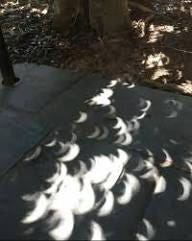
Vision, we must, for now, see God the way I saw the sun during the solar
eclipse in my childhood. What we see, that is the sight of God in Jesus Christ,
is real. And real also is what you see when one of us holds the Sacrament up
and tells you to Behold the Lamb of God. We see that reality in a way that is
given to us by God’s love, because He saves us by showing Himself. Jesus said
to Nicodemus:
We see Him in His human nature, lifted up on the cross. We see Him as the Lamb of God, ourselves not worthy that He should come under our roof, but asking that He speak the word only, and our souls shall be healed. Yes, what we see is real. And what we see is granted to us in a way that saves us rather than destroying us, for He came to save us. Our sinfulness, our weakness and our foolishness is all taken into account by the Father, and what we cannot see in this transitory life is due to His mercy. The fullness of Godhead dwells in Christ bodily, and the Holy Spirit is really and truly present within the Church- within us with all His gifts. But our destiny is to behold the sun in its strength when our eyes are made able to endure the brightness, able to endure seeing God as God. We are meant to know Him as He is, to behold throughout eternity the Beatific Vision, a vision not stagnant because He is infinite, and our knowledge of Him once made perfect will be ever perfected more and more, endless knowledge, joy and love. Yet, we must never presume on God’s grace. Hell is the denial of this joy; not that God denies it to us, but that we deny it to ourselves as long as we resist His love and grace.
Think of the words we call the Summary of the Law. The first and great commandment is the impossible call to be saints, to love the Lord your God with all your heart, all your soul and all your mind, and then to love your neighbor as yourself. When you look at the Epistles of Saint Paul, in the opening of the Epistle to the Romans and the first Epistle to the Corinthians, you see that all of the people who belong to the Church are “called to be saints.”
I like the King James Bible, with that accurate translation
“called to be saints.” That “called to be” part is missing from the
understanding of a good many Protestant revivalists, fundamentalists and
Pentecostals. They teach that every Christian is a saint just by, as they like
to say, “accepting Jesus.” Meanwhile, the opposite error belongs to those who
seem to think of saints as if they were comic book superheroes, people with
special abilities like Superman born on Krypton, or Spiderman with his radioactive
bug bite that enables him to do amazing things. We mere mortals, some people
believe, cannot ever be like them, and it’s best just to be “normal.” But the
truth is simply that a saint is a holy person. That is what the word means. And
the truth is that everyone who belongs to Christ has the vocation to be a
saint. We have not yet arrived at being perfected as saints, but neither are we
supposed to leave that to a special class of superheroes. The scripture
commands us to “follow on to know the Lord (Hosea 6:3).”
The most important thing that we can focus on during the
Feast of All Saints is not the issue of devotions to the saints. Sure, it is
possible, I suppose, to slip into idolatry and to worship saints and angels-
and some people have. But that is not a likely error for many. I think we all
know that only God is to be worshiped as God. The ancient practice of asking
the saints to pray for us is not idolatry and should not be condemned as if it
were. I can make no guarantee that they have a more than merely human capacity
to hear everyone, for that would indicate that they somehow shared the Divine
attribute of omnipresence (which they simply cannot). I cannot place my faith
in any one of them that way. But I know that they must be praying for the
Church militant if only because they have been made perfect in charity.
To keep this in balance, let us consider the words of
Origen:
For we indeed acknowledge that angels are ministering spirits, . . . and that they ascend, bearing the supplications of men, to the purest of supercelestial regions purer still; and that they come down from these, conveying to each one, according to his deserts, something enjoined by God to be conferred by them upon those who are to be the recipients of his benefits. . . . For every prayer, and supplication, and intercession, and thanksgiving, is to be sent up to the Supreme God through the High Priest, who is above all the angels, the living Word and God. And to the Word Himself shall we also pray and make intercessions, and offer thanksgivings and supplications to Him, if we have the capacity of distinguishing between the proper use and abuse of prayer. . . .
And it is enough to secure that the holy angels of God be propitious to us, and that they do all things on our behalf, that our disposition of mind towards God should imitate as far as it is within the power of human nature the example of these holy angels, who again follow the example of their God. (Contra Celsum, V, 4-5)
And he wrote in another place:
When
we have the favor of God, we have also the good-will of all angels and spirits
who are friends of God. For they know who are worthy of the divine approval,
and they are not only well disposed to them, but they co-operate with them in
their endeavors to please God: they seek his favor on their behalf; with their
prayers they join their own prayers and intercessions for them.
We may
indeed boldly say, that men who aspire after better things have, when they pray
to God, tens of thousands of sacred powers upon their side. These, even when
not asked, pray with them, they bring succor to our mortal race. (Contra
Celsum, Book VIII, 64)
The subject of devotions to saints is not our focus on the feast of All Saints. Our focus has always been the call that God has given to all of us, the call to become, by grace, saints ourselves. That is, we are called to be holy, to be faithful in every area of our lives, to press on to know the Lord, to confess the sins we fall into and repent of them in order to be forgiven, and also to be cleansed and delivered from the power of sin. We are called to develop the virtues, faith, hope, charity, fortitude, justice, prudence and temperance. Above all of the others charity, the bond of perfection.
A Paradox
Looking back again at the Epistles of Saint Paul we see a
paradox.
Therefore, as the elect of God, holy (ἅγιος, hagios) and beloved, put on tender mercies, kindness, humility, meekness, longsuffering; bearing with one another, and forgiving one another, if anyone has a complaint against another; even as Christ forgave you, so you also must do. But above all these things put on love, which is the bond of perfection. And let the peace of God rule in your hearts, to which also you were called in one body; and be thankful. Let the word of Christ dwell in you richly in all wisdom, teaching and admonishing one another in psalms and hymns and spiritual songs, singing with grace in your hearts to the Lord. And whatever you do in word or deed, do all in the name of the Lord Jesus, giving thanks to God the Father through Him. (Colossians 3:12-17)
The word translated “holy” at the beginning of that passage is ἅγιος, (hagios), which Saint Jerome translated into Latin with the word Sancti. In effect, in this passage Saint Paul is telling us that, because we are already saints due to God’s love and election, we must become saints. It may indeed seem odd to be told to become what you are. It becomes more reasonable in context, because it means to become what you are in Christ. In terms of nature, it is not so strange to be told that you must become what you are by creation; for indeed, you can choose to sin against God by trying to be something other, and therefore much less than what He made you to be. And now, by baptism, you have born again, born from above, to be a new creation in Christ Himself. Both by the nature of creation and then by the new nature of grace in Christ risen from the dead - risen from mortality itself - become holy, that is sanctified in your daily life. That is the life of a saint, and that is the life you have both been given as one set apart to God, and it as well your calling to be made perfect in living out that sainthood.When you look to the front of a church building, you see
the altar. I recall many years ago that a man, a church warden by title, took
it upon himself to check out the altar before a service. I am not sure why he
thought it was necessary. As he did so he was carrying a cup of coffee, and he
placed his coffee on the altar, while undertaking his inspection or whatever it
was. I immediately asked him to remove his cup of coffee from the altar. It is
not that coffee, something I enjoy every day, is evil; it is not that he had
committed some terrible sin for which the ground beneath would open while he
was swallowed up. It is just that the altar is set apart for a holy purpose.
Serving as a coffee table is not that purpose. It is set apart, sanctified and
consecrated to be the holy table upon which the Eucharist is celebrated, upon
which blessed bread and wine become for us the Body and Blood of our Lord Jesus
Christ.
Like that altar, you have been set apart for the Lord’s
purpose. It is His will that you love Him and that you love your neighbor. It
is His will that your entire life be lived as a joyful offering up of worship
(Romans 12:1, 2). Theoretically, an altar can be set apart but never fulfill
its purpose. A bishop may indeed bless it; but unless a priest uses it to offer
up the Good Thanksgiving (Eucharist) with the assembled Body of Christ in
corporate worship, it never fulfills its calling, so to speak. Look again at
those words by the Apostle, and by God’s grace, fulfill your calling. You are
holy because you are set apart; be holy in how you live every day of your life.
It is the calling of every person to become a saint; it is the calling of every
saint to be that saint.
In order to begin to answer the call to holiness, we must
be thankful. And, that is the best reason to look at the Lord Jesus as the Lamb
of God, lifted up on the cross as Moses lifted the serpent on the pole in the
wilderness. It is in thanksgiving that our hearts respond to Christ’s great act
of love in that our souls are healed, not treating us as our sins deserve, but
rather dying as our atonement. In that love we begin to see the reflection of
Divine glory. Like that reflection I saw as a child, wearing a box as a helmet
on my head, we see the glory of God the way I saw a projection of the sun. And
like the innumerable moon-shaped reflections of the sun that I saw in a pattern
across the ground in those dark few minutes, we see radiant glory in the great
company of saints who have gone before, and who now, with hearts made pure by
grace, behold the glory of God.
