Wednesday, May 27, 2026

AMAZING GRACE!


AMAZING GRACE! In Basic Baltimore Black = Gospel Music Style

Saturday, May 09, 2026

ALIEN FILES A THREAT TO FAITH?

Hogwash. I say, Bring it on.

A group of popular American pastors have warned that President Donald Trump’s release of ‘alien files’ could shatter Christian beliefs, according to the Daily Mail.

They have claimed that US intelligence officials have held a series of meetings with them and told them to prepare churches to hold the Christian community together in the wake of the revelations’ shockwaves.

Popular evangelist pastor Perry Stone said that the alien files could include reports and possibly videos of aliens and extraterrestrial spacecraft.

“You’re going to have people who are going to say if there are galaxies and there are allegedly other creations in the galaxies, then the whole creation story is a myth, and you’re going to have people that’s going to apostatise and turn from the Christian faith because they have no answer for what they’re about to hear,” said Stone.- Firstpost

I have run into this before. Someone insists that there cannot be aliens according to the Bible. They quote Psalm 115:16 which states, "The heaven, even the heavens, are the LORD's: but the earth hath he given to the children of men." (KJV) Well, I am glad they know scripture well enough to quote some of it, but what does the subject of space aliens have to do with “the children of men?” Haven’t they ever watched the Bar Scene from Star Wars? (I mean the first Star Wars, you know, Episode Four). I dig that crazy jazz, and I detect a definite Earth influence in it; but those aliens don’t look anything like “the children of men.” The evidence appears to indicate that they all come from outer space, which is why we call them aliens. I mean, I do not want to be accused of being insensitive, but they look kinda weird if you ask me.

I also think that this Perry Stone fellow might ask what “the heavens” really means, and he definitely needs to look up the definition of the word “myth” in the Dictionary. I mean, I hate to break this to him, but many saints and Church Fathers recognized that the Creation Story is a myth, and that the first eleven chapters of Genesis contained, for them, a great deal of spiritual truth by way of allegory. But that is the problem with Fundamentalism. If you do not believe that the Universe was created in exactly six twenty-four hour days, and only very recently - a mere six thousand years ago - as a literal fact, then you are not allowed to believe that God created the universe at all, or that Jesus Christ rose from the dead.

“What do you mean it isn’t all one book?”

I have had the regrettable duty of breaking this fact to Fundamentalists many times, and I mean by Fundamentalists both Protestant Evangelicals and those who have moved on from Fundamentalist Evangelicalism to, as is inevitable for many, atheism. The Bible is not a book. It is a library, a collection of ancient writings in Hebrew and Greek that was created over several centuries, and it includes several genres, indeed every literary genre that existed in Antiquity. The opening of Genesis is called, properly, “the Song of Creation,” a poetic telling that has been interpreted in various ways, most often as truth that transcends mere recitation of facts. The original Fundamentalists were members of gnostic sects who believed that an evil god or evil gods are depicted in the story as creating man to keep him as a slave in a garden, and the serpent helped to set the first man and the first woman free to be like the gods in knowledge, for which cause the chief of those gods banished them from Eden (not the Gnostics: There was no one group called the Gnostics). And, if you insist on a literal reading of the story, their interpretation was as good as any. But their interpretation contradicted Judaism and Christianity, and it missed the spiritual truth, full of moral teaching, that Jews and Christians believed.

In his refutation of Gnostic and pagan views (particularly in Contra Celsum and De Principiis), Origen of Alexandria interpreted the fourth day of creation, in which God made the sun, the moon, and the stars (Genesis 1:14-19) not as the temporal, material creation of lights, but as a symbolic pedagogical event within his broader cosmological framework. Gnostics, such as the Valentinians, taught that the material world was created by an evil demiurge (Yaldabaoth) and, according to them, the luminaries were instruments of fate designed to trap souls in matter. Origen, in opposition to that gnostic teaching, wrote that the only true God is the good Creator of both the Old and the New Testaments. According to his Christian doctrine, as stated in Contra Celsum, the luminaries should be seen allegorically. He refuted the doctrine that stars are divine beings ruling by the imposition of fate. He saw them as lights that serve a purpose as stated in the text: “Let them be for signs, and for seasons, and for days, and years: And let them be for lights in the firmament of the heaven to give light upon the earth: and it was so.” (Genesis 1:14, 15) Contradicting the gnostic insistence on what we today would call a literal reading, he also pointed out that if there was no sun before the fourth day, how could there have been evenings and mornings? I have come across atheists who use the same argument against what is, in most cases, their own former Fundamentalist beliefs as an argument against a literal interpretation of Genesis chapter one. Of course, they imagine that by showing the folly of a literal interpretation they are somehow destroying Christianity, oblivious to the fact that earliest known use of that very argument was written by an Egyptian Christian, a Church Father, in Alexandria, who posited it as a defense of the Christian faith.

This is what I have seen many times. After they cease to believe in Christianity, they still insist on interpreting everything to do with God and the Bible as Fundamentalists. There are, to be sure, former Catholic, former Orthodox, former Anglican, former Lutheran, etc. atheists who tend to think the same way. In their case it seems they, while not formerly Evangelical, were, nonetheless, somehow also fundamentalists - “f” in the lower case. No doubt that is partly because television preachers and other cultural forces have caused confusion on a massive scale. Of course, when dealing with real Protestant Fundamentalists, I notice that their Readers Digest version of the Bible, a mere sixty-six books, never existed in that abridged form before the nineteenth century.

The very term “Bible believing” is problematic. What they mean is that they believe what their own Fundamentalist Magisterium (located perhaps in Chattanooga or somewhere) has infallibly declared. As my friend, an Orthodox priest named Patrick Henry Reardon has said, “I feel sorry for my Catholic brethren, because they have only one infallible clergyman.” I was reminded of his words when I came across the infallible utterance by Ken Hamm that space aliens do not exist, but that even if they did “they cannot be saved.” Well, I am glad we have that serious theological question resolved. Obviously, if God had made the mistake of creating other intelligent biological beings in His universe, He would certainly lack the imagination to come up with a way to save them from the effects of…Adam’s fall? It looks like we are back to that “the children of men” issue. (I mean, do these guys look like the children of any men that you know?)

I think that Mr. Spock would fail to see the logic of Ken Hamm’s ex cathedra declaration. But poor Spock is eligible to be no more than only half-saved; Doctor Who and Martin O’Hara are screwed.

The good thing is that most of the Christians in the world are not of the intellectually deprived Fundamentalist stripe. It is a relatively new gnostic sect that serves mostly to churn out angry atheists. Having no authority to interpret the Bible according to a received authoritative Tradition, an ancient Tradition that provides a large enough room for an authentic faith that cannot be overthrown by recognizing mythology and allegory in service to truth, what they call “faith” might indeed shrivel up and die if “alien files” are released (though I think it more likely that the White House announcement was to distract attention from certain other files). For them, unless you believe that the flood of Noah literally covered the entire planet Earth (even though the Bible says no such thing inasmuch as the word usually translated “earth” is eretz, meaning the land - kol h’eretz: “the whole land”), because that literal belief in a world-wide flood is what their American Fundamentalist Magisterium requires if you want to qualify as “Bible believing,” then you are unable to believe that “God is Love,” or that Jesus Christ rose from the dead. After all, it’s all one book you know, just like the local library is all one book rightly divided over many shelves, that is, if you are a library believing reader.

This is the problem with a complex system of faith. The more a structure depends on each and every part to hold it together, the more vulnerable it is. Fundamentalist “faith” cannot escape desperate fear because it is fragile. It takes only enough of a jolt for one domino to fall over, and everything comes crashing down. I know of one man who lost his entire faith because he noticed that the Gospel According to Saint Matthew mistakenly attributes a prophetic oracle from the Book of Zechariah to Jeremiah. How come the Universal Church, having that obvious human error in front of its eyes has continued to exist for two thousand years, and no Church Father, no bishop, no pope, ever saw it is as a problem? Maybe it is because it is not a problem: The point that was revealed is this: What happened on the first Good Friday was foretold by the prophets. Would realeasing “alien files” contradict the infallible Fundamentalist interpretation of Psalm 115:16? Yes, it would. Would it destroy Christianity, or overthrow the faith of any authentic believer? Of course not. Do they have “alien files?” If so, I say, Bring’em on. Show us the aliens themselves. I am among those who will have only a greater appreciation of God’s handywork in all of its variety.

Saturday, May 02, 2026

INTERVIEW ON "HOPE RESURRECTED" WITH LANCE CONLEY


I was recently interviewed by Lance Conley on his podcast. For the URL to this same interview you can use this link, and can Like and Subscribe for more of his content.
RH+

Sunday, April 12, 2026

REFLECTIONS ON THE EPISTLE TO THE HEBREWS

It is my desire to use my retirement to write a book about an Epistle that deserves to be considered in light of how history and theology combine. I am posting what I may use as a prologue to see if it wets the appetite of readers for more. 


Prologue

Before opening the Epistle to the Hebrews for examination, it seems useful to look at a story from the Second Book of Samuel about Uziah, King of Judah, whose fifty-two-year rule lasted from about 790 to 739 B.C., beginning when he was only sixteen years of age. Let us look at some of the account from II Chronicles chapter 26. First of all, we see that he was a righteous king: “And he did that which was right in the sight of the LORD, according to all that his father Amaziah did (v.4).”

We will pick up at v. 16.

But when he was strong, his heart was lifted up to his destruction: for he transgressed against the LORD his God, and went into the temple of the LORD to burn incense upon the altar of incense. And Azariah the priest went in after him, and with him fourscore priests of the LORD, that were valiant men: And they withstood Uzziah the king, and said unto him, It appertaineth not unto thee, Uzziah, to burn incense unto the LORD, but to the priests the sons of Aaron, that are consecrated to burn incense: go out of the sanctuary; for thou hast trespassed; neither shall it be for thine honor from the LORD God. Then Uzziah was wroth, and had a censer in his hand to burn incense: and while he was wroth with the priests, the leprosy even rose up in his forehead before the priests in the house of the LORD, from beside the incense altar. And Azariah the chief priest, and all the priests, looked upon him, and, behold, he was leprous in his forehead, and they thrust him out from thence; yea, himself hasted also to go out, because the LORD had smitten him. And Uzziah the king was a leper unto the day of his death, and dwelt in a several house, being a leper; for he was cut off from the house of the LORD: and Jotham his son was over the king's house, judging the people of the land. (vs. 16-21)

The text tells us that “his heart was lifted up,” and ascribes his presumption to the sin of pride. Nonetheless, no king of Judah had ever presumed to usurp the priestly office, the office of the Kohanim, that belonged exclusively to the sons of Aaron, the brother of Moses since the time of the Exodus. What had entered into the mind of this king, one of the few who was generally a good and righteous king, that emboldened him to assume a priestly role based on his royal position? It is difficult to find what it was that seems to have created in his mind a confusion between his role and that of the male descendants of Aaron, but once we see it, it actually makes logical sense. Yes, he should have added to his learning the traditional teaching that he was reminded of, urgently reminded of, by Azariah and the other Levitical priests. But it seems apparent that his pride was that of a young man with a bit of education, a sophomore of sorts, too proud to heed those whose learning was more complete.

         Indeed, there was an old tradition from the Book of Genesis that showed an understanding that was already ancient in the time of Uziah. The story is that of Abraham who was blessed by, and paid tithes to, Melchizedek (Genesis 14:12-18). This mysterious man is described very simply, And Melchizedek the king of Salem brought out bread and wine, and he was a priest to the Most High God.” In fact, this priest even had the word “king” in his name, which means “King of Justice,” or “King of Righteousness.” Salem (Shalem), which means Peace, is a very ancient name for what later became known as Jerusalem to this day. Perhaps Psalm 110 was used as a coronation Psalm for the kings of Judah. It opens with the words “The LORD (YHVH) said unto my Lord, ‘Sit thou on my right hand.’” In the fourth verse these words appear:

The LORD hath sworn, and will not repent, ‘Thou art a priest for ever after the order of Melchizedek.’”

Having a memory of those words addressed to him when he was sixteen, he may have long considered it his right to assert a priestly role as a privilege to be exercised by the king in Jerusalem, a right that went back to Melchizedek himself. The possible confusion in his mind may well have been strengthened by the record we see today in the actual Hebrew words of II Samuel 8:18, which I translate literally: “And the sons of David were priests (V’b’nai David Kohanim hua).”1 I noticed that when reading the Hebrew text, and saw that English translations were mostly deficient, saying things like “royal officials” or, as even the translators of the court of King James were unwilling to deal with the seeming contradiction, “chief rulers.”

I finally found, with no surprise, a correct rendering in Robert Alter’s translation (“And David’s sons served as priests”). Alter’s explanation, in a footnote, is that “This curious detail is probably parallel to a palace guard of foreign origins: just as David creates an elite military contingent outside the framework of the Israelite troops, he invests his own sons with sacerdotal duties within the circle of the court, outside the framework of the hereditary priesthood that controlled the public cult.” 2. That may well be the case, but it is difficult to know much more about it. Perhaps this royal priesthood, of sorts, consisted simply of singing the works of their father in prayer services. It is obvious that the Psalms of David, and others, found a place of Liturgical use in the temple led by men who were not Levitical priests. They did not approach any altar of sacrifice or incense.

         In terms of Christian interpretation, most notably in the Epistle to the Hebrews about which I am undertaking this endeavor, the combination of two royal lines, a priestly lineage and a kingly dynasty, was reserved for the great High Priest who is himself the reality of which all things and persons in the temple were types and shadows. The time had not come in the eighth century B.C. because the types and shadows of the Law were yet serving as “our schoolmaster to bring us to Christ.” (Galatians 3:24)

 The history of the Old Testament contains a shape, a pattern, in which two kinds of men are called “Messiah”– Meshiach 3 First it is the priests, those who offer sacrifice, and then it is the kings. To the writer of the Epistle, both offices are combined in Christ, the true Priest after the order of Melchizedek. He was writing to explain the meaning of the temple, for much of the city was about to be destroyed by the Roman army as Jesus himself had lamented and foretold in a Jeremiad.


1.       וּבְנֵי דָוִד, כֹּהֲנִים הָיוּ

2.       The Hebrew Bible, A Translation with Commentary, Alter, Robert, Norton Books, New York and London, 2019

3.       Meshiach  (  מְשִׁיחָ anointed ) from the word Meshach  ( מָשַׁחְ anoint).


Saturday, April 04, 2026

EASTER FUGUE


                                                          CLICK ON THE EASTER ICON

In The News

I read this report. It is time for many of you to realize that the “Christian” Nationalist Movement will not tolerate those of us who hold the old liturgical traditions.
*********
BREAKING: Pete Hegeth's Pentagon SPITS on Catholic soldiers on Good Friday by hosting a Protestants-only chapel service with the message "No Catholic Mass."

This is absolutely jaw-dropping....

According to HuffPost's Jennifer Bendery, the Defense Department has invited over 3,500 employees to a Good Friday service at the Pentagon Chapel "except it’s only for Protestants, not Catholics." She obtained an email sent out by Air Force leadership, which laid out the outrageous abuse of religious liberty in plain text.

“Just a friendly reminder: There will be a Protestant Service (No Catholic Mass) for Good Friday today at the Pentagon Chapel,” it reads.

“I guess so the Catholics know their kind ain’t welcome. It’s so ridiculous," a Pentagon employee told her.

When Bendery reached out to the Pentagon, a spokesperson confirmed that there will not be another, separate service for Catholics in the Pentagon chapel today. While Catholics do not celebrate the full Mass on Good Friday, they do hold liturgies, intercessions, distribute pre-consecrated Eucharist, and observe the Stations of the Cross. Hegseth’s Pentagon has done nothing to honor these sacred traditions.

This one isn't hard to puzzle out. The Christian Nationalist movement that Hegseth is part of is Evangelical to its core. They view Catholics with something between suspicion and outright hostility. Hegseth previously invited pastor Doug Wilson to lead a prayer service at the Pentagon. Wilson has called for a Christian theocracy in America, suggested that "biblical slavery" might come back under that theocracy, and called for banning Catholic processions.

In this Evangelical vision of a Christian America, Catholic cathedrals are torn down and replaced with golden statues of Trump holding the cross.

This animosity towards Catholics is also rooted in backlash against Pope Leo XIV's outspoken anti-MAGA sentiments. He has repeatedly condemned the cruel treatment of migrants as well as Trump's illegal, bloody Iran War. Many Republicans now view Leo and by extension all Catholics as an enemy.


Thursday, April 02, 2026

Maundy Thursday and the One Mass

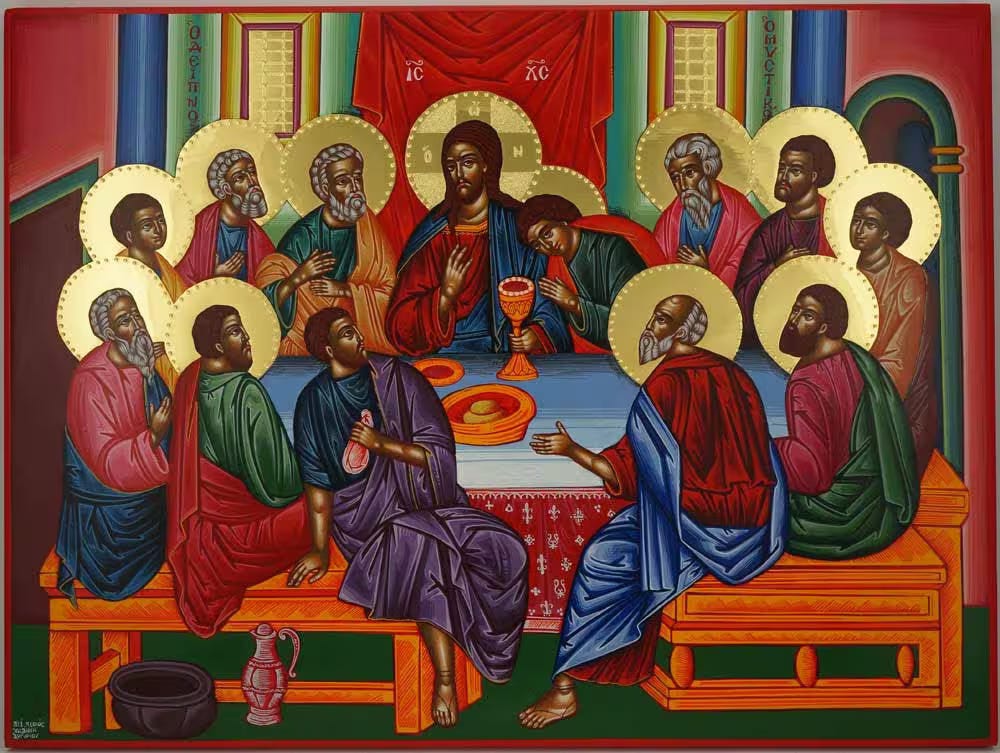
In the Anglican Tradition we call the day Maundy Thursday, from the same root as the word “Mandate.” The mandate is Dominical, that is, from the Lord himself: “Do this in remembrance of Me.” What is the “this” that we are commanded to do? The answer is in scripture.

And as they were eating, Jesus took bread, and blessed it, and brake it, and gave it to the disciples, and said, Take, eat; this is my body. And he took the cup, and gave thanks, and gave it to them, saying, Drink of it all of you; For this is my blood of the new testament, which is shed for many for the remission of sins. (Matthew 26:26-28)

The requirements laid down for us in the Mandate are few, simple, and easy. Several different liturgies have been in use over all of the centuries since that night. This is a point that should be one of unity rather than of division, because whether one uses the Divine Liturgy of the Orthodox Church, the Tridentine Mass of the Roman Catholic Church, or the Anglican Book of Common Prayer, etc., the essentials are the same. The celebrant, serving in the role of Christ, blesses the bread and brakes it, and then takes the cup and gives thanks, with each element repeating the Lord’s Words of Institution. It seems only right to surround this holy service with sincere worship, the kind that is best expressed in profound liturgy and that can be enriched with music. The use of vestments helps because it adds a feeling of timelessness as we give eucharist (good thanksgiving) across generations in the Communion of Saints.

In each of those details our difference of custom is evident, differences in vestments, different additional prayers, different kinds of music, all from the riches of almost every language and culture under heaven. Someday I hope to see an Ethiopian Orthodox liturgy just to appreciate the differences in detail that are, essentially and spiritually the same Lord’s Supper, the same Holy Communion, to which I am accustomed. Years ago, I found myself trying to correct a fellow American Christian who was scandalized by a picture of Arabs prostrating and speaking in Arabic. He was offended because he thought I had posted a video of Muslims at prayer (maybe he thought I was promoting that other religion). I failed to convince him that Arab Christians were calling God “Allah” before Mohamed was born - long before.

Now when this was noised abroad, the multitude came together, and were confounded, because that every man heard them speak in his own language. And they were all amazed and marvelled, saying one to another, Behold, are not all these which speak Galilaeans? And how hear we every man in our own tongue, wherein we were born? Parthians, and Medes, and Elamites, and the dwellers in Mesopotamia, and in Judaea, and Cappadocia, in Pontus, and Asia, Phrygia, and Pamphylia, in Egypt, and in the parts of Libya about Cyrene, and strangers of Rome, Jews and proselytes, Cretes and Arabians, we do hear them speak in our tongues the wonderful works of God. (Acts 2:6-11)

Those Arabians, the last group mentioned by Saint Luke when writing about the Day of Pentecost, called God “Allah” because Arabic and Hebrew, as well as Aramaic, have the same root, El (or Al) as the word for God. It is simply a linguistic and etymological fact with a lot of history attached. The old phrase “Diversity in unity” may seem corny, but it was Saint Paul who appreciated that concept even on the level of a local congregation, the diversity necessary to a body in which each part is necessary for the whole body to live and function. For this reason, the Apostle warned of the danger of failing to “discern the Lord’s Body,” that is that “we are members one of another,” when partaking of that bread and of that cup (after all why else would he mention the betrayal of Christ? See I Corinthians 11:18-34).

Now there are diversities of gifts, but the same Spirit. And there are differences of administrations, but the same Lord…For the body is not one member, but many. If the foot shall say, Because I am not the hand, I am not of the body; is it therefore not of the body? And if the ear shall say, Because I am not the eye, I am not of the body; is it therefore not of the body? If the whole body were an eye, where were the hearing? If the whole were hearing, where were the smelling? But now hath God set the members every one of them in the body, as it hath pleased him. (I Corinthians 12:4,5 14-18)

What was true, and of great importance to Paul, for mutual edification and charity in one local church, became, for it was inevitable, of the same importance on a much larger level because the Church kept growing throughout the world. Yes, the faith of Christ is alive in every language and in every culture - not only Western culture for heaven’s sake! There exists no justification for confusing Christianity and the Body of Christ with Christendom (a word that lost all meaning in 1914) and Western culture. That nonsense is a prejudice we can do without.

Yes, our customs are diverse because the Church is universal, so much so that we may struggle to overcome suspicion by learning appreciation for the richness of what is, in the eyes of God, one and only One Body of Christ wherever it may be manifested in the world. And, as the place of unity is the Lord’s table, there is only one Holy Communion supper as long as we obey the Mandate to “Do this in remembrance of Me.” This one and the same supper has been going on since “The night in which he was betrayed,” and it continues because we continue, all over the world, to “Show the Lord’s death until he come.” (I Corinthians 11:26)

____________________________________________________

Speaking of languages - tongues - here is some Latin with the translation next to it. This is the chant for Maundy Thursday.

Pange lingua - gregorian chant

Wednesday, March 25, 2026

Sunday, March 15, 2026

SPEAKING THE TRUTH IN LOVE


                                                     For the video click on this link.

Sunday, March 08, 2026

Eschatology Kooks

Watch out for the “End times Bible prophecy” people. They connect dots that should not be connected. Their interpretation of scripture is ridiculous. This current war (and it is a war) has nothing to do with “fulfilling Bible prophecy.“ And their focus on some need to rebuild the temple is nonsense. What we learn from the Epistle to the Hebrews is that it doesn’t matter whether the temple is ever rebuilt or not. The Epistle was obviously written to the Jewish Christians in Jerusalem to warn them to leave the city, because the Roman army was coming as Jesus had foretold. So he explains how the temple had fulfilled its purpose with prophetic types and shadows of which Christ is the reality. It was a very realistic concern, because those Christians were also Jews who would have felt the pressure to remain in the city and fight to the death. But God had another mission for the Church, which did not include taking up arms.

Hebrews 13: 12Wherefore Jesus also, that he might sanctify the people with his own blood, suffered without the gate. 13Let us go forth therefore unto him without the camp, bearing his reproach. 14For here have we no continuing city, but we seek one to come.

——
🔥BREAKING: Pope Leo Condemns Trump’s Oval Office Evangelical Pro-War Gathering! – "War is not sacred; only peace is sacred!"

Pope Leo XIV, the first American pope, delivered a strong condemnation from the Vatican today, directly confronting the Christian Zionist leaders who convened in the Oval Office to pray over Donald Trump and "sanctify" his unauthorized military actions against Iran.

In a passionate address, the pope, originally from Chicago, declared: "War is not sacred; only peace is sacred because it is willed by God." He emphasized this point repeatedly, denouncing the conflict as an "immoral" aggression that has already cost American and Iranian lives (including innocent schoolgirls) and risks spiraling into a broader global catastrophe.

"If the world turns a deaf ear to this plea, we are certain that God will hear our prayer and the cries of the suffering," the pope said. He urged religious leaders around the globe to join the call for peace, standing up for the voiceless poor, displaced persons, and the earth itself ravaged by violence.

"We must have the courage to choose peace," he declared. "Enough of these wars, with their tragic toll of death, destruction, and displacement." The pope framed the conflict as a moral dilemma, calling on governments to heed the cries of the suffering, rather than the zealots who justify violence with scripture.

This statement comes as Christian Zionist leaders – many affiliated with evangelical networks supporting Trump’s "end-times" rhetoric – have been praying over the president in the Oval Office, presenting the military action as God's will and a fulfillment of biblical prophecy.

The pope’s remarks sharply rejected that narrative, asserting that no war can be deemed holy, regardless of how it is justified with scripture. His Chicago roots and consistent opposition to Trump’s policies lend additional moral weight to his rebuke, shedding light on the growing global concern over the lack of congressional approval, the human cost, and the reckless escalation without a clear end in sight.

While Trump brushes off the increasing death toll as "just the way it is," and his energy secretary acknowledges the war's connection to securing long-term oil interests, the pope calls for de-escalation, challenging the world to prioritize peace over violence. With even the pope denouncing the war as immoral and the justifications for it as misguided, the moral bankruptcy of MAGA warmongering is exposed.

Wednesday, February 25, 2026

Originally published in Touchstone: A Journal of Mere Christianity.

The Sacred Feminine

Robert Hart on the Incarnation & the Ordained Ministry


In 1995, at an art museum in Chicago, I saw an archaeological find: several identical little statuettes of a woman’s body, from the neck down to the mons pubis. A modern Westerner might assume that the ancient, mostly forgotten people who carved these figures were obsessed with sex and had produced pornography, but this would say more about the modern Westerner than about those ancient people.

The fact is, the statuettes were found in graves. Since they showed the part of a woman’s body most clearly identified with bearing, birthing, and nourishing children, the most logical conclusion is that they were buried with the dead to help assure the safe delivery of the departed spirit into another world. There, the dead would be reborn and nourished.

If this interpretation is correct, it shows that these ancient pagans had a clearer understanding of the sacredness of the feminine than do modern theologians who want to convert the Church into a religion with a Divine Feminine or use inclusive language for God. For these ancient statuettes suggest, however dimly and remotely, the ministry of the Church in its role of administering, as well as proclaiming, salvation.

Christians do not worship a goddess. But it is not an accident or mere coincidence that two things we see in our day—women trying to fulfill the role of the ordained ministry, and women (and men) promoting the new “Feminist Theology” of goddess worship, which is meant to overtake and replace the worship of the Father, Son, and Holy Spirit (“ He, the Spirit of Truth”; John 16:13)—have come together in time, and among the same church bodies and movements.

Necessary Distinctions

Christianity has no room for a Divine Feminine, that is, a goddess, because of the mystery of the Incarnation, the central doctrine of the Christian faith. In chapter 5 of his book Whatever Happened to the Human Mind, Eric L. Mascall writes:

It was male human nature that the Son of God united to his divine person; it was a female human person who was chosen to be his mother. In no woman has human nature been raised to the dignity which it possesses in Jesus of Nazareth, but to no male person has there been given a dignity comparable to that which Mary enjoys as Theotokos, a dignity which, in the words of the Eastern liturgy, makes her “more honourable than the cherubim and beyond comparison more glorious than the seraphim.” . . . The centrality of womanhood in redemption is shown by the fact that the Incarnation itself waited for the courageous and obedient Fiat of Mary (Luke 1:38).

Redemption cannot be separated from the feminine presence of Mary, the only human person to share in the miracle of the Incarnation with Jesus Christ. In fact, we speak here not simply of a feminine presence, but of a female presence. This distinction is necessary in order to clarify its significance to an age that confuses the meanings of the words “sex” and “gender.”

People come in two sexes, male and female, rather than in genders. The Mother of God is a woman. However, the Church is not a woman, but it is the Bride of Christ and, as such, is of the feminine gender, though not of the female sex. Jesus is a Man, a member of the male sex in his human nature. But as God, he is of the masculine gender, together with the Father and the Holy Ghost. God, speaking strictly of the Divine Nature shared by the three Persons of the Trinity, is (as stated in Article I of the Anglican Thirty-Nine Articles) “without body, parts or passions.”

It is necessary to distinguish between the two natures of Christ: the divine nature that is proper to his Divine Person as one with the Father, and the human nature that has been taken into the Divine Person of the Logos. The latter is an alien nature, that is, a created nature taken into the uncreated Person of the Logos, a physical nature taken into a nature of Spirit (though separate and distinct in nature from every created spirit), and a nature fixed in time taken into eternity.


The Female & Feminine in Redemption

Our redemption necessitates this deifying grace: “The Word was made flesh and dwelt among us, and we beheld his glory. . . .” Clearly revealed from the beginning, and more clearly revealed by the naming of God as “Father” by Jesus Christ, God is masculine in gender. This makes the creation, and the human race in particular, feminine in relation to him. Our redemption was not accomplished without the Son of God appearing in the material world by assuming our nature, and this required both the female sex and the feminine gender.

The Blessed Virgin Mary was the woman, the new Eve, the mother of a new humanity in the Last Adam, Jesus Christ, in whom all are made alive. The female sex was necessary for our salvation, since the redemption that has been revealed by God is not merely a spiritual idea supported by speculation, but a real-life drama that involved everything that was part of the life lived among us by Christ, including the Cross and the Resurrection. This required the Incarnation; it required a womb.

Furthermore, the Church provides our need for the feminine gender. It is the Bride of Christ and the mother of all believers. Because it is called in Scripture the Body of Christ, the Church is an extension of Christ’s Incarnation; in fact, it is his own appointed agent. This, too, requires the Church to be feminine.

The image of this mystery is marriage (Eph. 5:32), where two are made one flesh. In the Church, Christ acts to give new life and salvation to all who truly believe. The Church not only proclaims salvation by the ministry of the Word; it also administers salvation as the sacramental community, called in Scripture the Body of Christ.

Reconciliation to God involves walking in the light with others in the Church (1 John 1:7), and so we see the necessity of a Sacred, though not a Divine, Feminine. Mary is the woman who bore the Son of God for our salvation, and the Church is the Bride of Christ, within which we are born again and nourished unto life eternal.

Ministry of Christ

Even though many churches do not use the term “Apostolic Succession” in the same way that Roman Catholics, Orthodox, and classic Anglicans do (with a historic episcopate and lines of succession), most churches, including those formed during the Protestant Reformation, believe that ordained ministry is essentially apostolic in both its origin and its work.

The apostolic ministry is not simply a function or a job to be done. It is not the possession of any man, even of those who are part of it as Christ’s ambassadors to the people of the Church (the clear meaning of 2 Cor. 5:20). Rather, it is the extension of Christ’s own ministry in the world, established with unique power and authority, and it cannot be assumed or granted merely by human power:

Then said Jesus to them again, Peace be unto you: as my Father hath sent me, even so send I you. And when he had said this, he breathed on them, and saith unto them, Receive ye the Holy Ghost: Whose soever sins ye remit, they are remitted unto them; and whose soever sins ye retain, they are retained. (John 20:21–23)

Among the many reasons Catholics, Orthodox, and Traditional Anglicans give for the all-male priesthood is that the priestly ministry is not that of the men themselves, but of Jesus Christ working in his Church. When a priest forgives sins, it is, as believed in traditional liturgical church bodies, the extension of the ministry of Jesus Christ, who gives this power unto men (Matt. 9:8). And when a priest stands at the altar and offers the Eucharist, it is Christ who says, “This is my Body. . . . This is my Blood.”

Thus, the ordained ministry, in almost all church traditions, belongs to the Bridegroom, and represents him in an exclusive sense not fully shared by any layperson, no matter how gifted and holy. It is for the benefit of the Bride of Christ. This understanding is shared by churches in the Protestant Reformation tradition as well as by those that emphasize the liturgical and sacramental ministry.

Embassy of Christ

In writings from the ancient Church, the larger emphasis is on the presbyter’s (i.e., elder’s) pastoral care for the people of the Church, often described in Scripture and in other early Christian writings as his “rule” (proïst’mi) over his flock (see 1 Tim. 5:17, Heb. 13:17, 1 Thess. 5:12–13). The application of this rule belongs exclusively to the pastoral ministry, and includes the functions of preaching, teaching, and leading worship. These are essential functions, whether we think in terms of the Catholic (i.e., Roman Catholic, Orthodox, or Anglican) priesthood or of the Protestant pastorate.

This pastoral ministry has been given to the Church by Christ to be medicinal and healing for those who are redeemed from sin and death, and to aid in their salvation and sanctification by the Holy Spirit. The objective of such rule by the presbyteroi, or elders, is the care or cure of souls. Thus, it is not to be exercised in a dictatorial or authoritarian manner, like a lord over God’s people, but in a loving and paternal way, like a father in God’s family. “For if a man know not how to rule his own house, how shall he take care of the church of God?” asks St. Paul, rhetorically (1 Tim. 3:5).

Indeed, laypeople may function as teachers and prophets, and also carry on a kind of priestly ministry as those who are called to be saints. The ordained ministry, however, is believed by most church bodies to belong to the heavenly Bridegroom in a special way that makes it the embassy of Christ among his own people, of the Bridegroom to the Bride, of the Lord to the Church. The Church is one with him as his Body, which he nourishes and protects.

For this reason, among others cited in this journal over many years, the pastoral ministry is rightly reserved to men who are called and ordained, and only to them. This, properly understood, protects rather than denies the sacred feminine ministry in our salvation history and in the life of the Church as the Bride of Christ, holy and beloved.