Tuesday, December 27, 2005

St John the Evangelist

Therefore are they before the throne of God, and serve him day and night in his temple; and he that sitteth on the throne shall dwell among them.

They shall hunger no more, neither thirst any more; neither shall the sun light on them, nor any heat.

For the Lamb which is in the midst of the throne shall feed them, and shall lead them unto living fountains of waters: and God shall wipe away all tears from their eyes.

Revelations 7. 15-17
 Posted by Picasa

Monday, December 26, 2005

A Christmas Sermon (4)

The Holy Family, Giulio Romano, ca. 1520-23, Getty Collection

Our Lord's ultimate purpose in being born as one of us was not that He might be like us, but rather that we might become like Him—a far greater miracle, and a far greater incentive to rejoice in our present lowliness than the Modernist heresy which tries to make God adore man!

"THERE ARE two principal lessons which we are taught on the great Festival which we this day celebrate, lowliness and joy. This surely is a day, of all others, in which is set before us the heavenly excellence and the acceptableness in God's sight of that state which most men have, or may have, allotted to them, humble or private life, and cheerfulness in it. If we consult the writings of historians, philosophers and poets of this world, we shall be led to think great men happy; we shall be led to fix our minds and hearts upon high or conspicuous stations, strange adventures, powerful talents to cope with them, memorable struggles, and great destinies. We shall consider that the highest course of life is the mere pursuit, not the enjoyment, of good.

But when we think of this day's Festival, and what we commemorate upon it, a new and very different scene opens upon us. First, we are reminded that though this life must ever be a life of toil and effort, yet that, properly speaking, we have not to seek our highest good. It is found; it is brought near us, in the descent of the Son of God from His Father's bosom to this world. It is stored up among us on earth. No longer need men of ardent minds weary themselves in the pursuit of what they fancy may be chief goods; no longer have they to wander about and encounter peril in quest of that unknown blessedness to which their hearts naturally aspire, as they did in heathen times. The text speaks to them and to all, "Unto you," it says, "is born this day in the city of David a Savior, which is Christ the Lord."

John Henry Newman

Read it all here:

http://www.sspx.ca/Angelus/1983_December/Religious_Joy.htm Posted by Picasa

A Christmas Sermon (3)

The Holy Family, Goya, Prado

Come, let us adore Him

A Christmas Message From the Most Reverend John Hepworth
Primate of the Traditional Anglican Communion
EVERY now and then, an article appears that speaks of the Holy Land as a "melting pot of religions". This is quite a silly claim. The Holy Land
remains just as it was when Jesus walked its length and breadth. Each religion remains starkly clear and true to itself. Each religion continues to contest its claims.

So it was with the ancient religions that surrounded the People of God in Israel. So it was with the imported religions of the Greeks and Romans. So it was when the Temple was destroyed and Jerusalem was ringed with crosses, and the cry of those who fled to Masada was "No surrender!"

So it is now. The great religions of Judaism, Islam and Christianity remain at war in the lands of the Bible, as we who live elsewhere look on helplessly as historic hatreds flow over lands walked by the Son of God with His prophets and His angels. How used we have become to Bethlehem with guns and soldiers and barbed wire!

God came down at Christmas, and faithful shepherds heard the Christ child cry. Were they among the fist-shakers who passed by His Cross? Christmas, with its crib and its swaddling clothes, forces our minds from the baby to the purpose for which he came.
We must do two things this Advent and Christmas. In the first place, we must create in our inner lives, in our families, and in our communities of Grace, the peace "beyond all understanding" which is the gift to those who have knowledge of the Son of God. As the hostility of strange gods and false worship swirls around us again, we do not fight or bomb, but offer the vision of the New Testament: "See how they love one another!".
And in the second place, we must proclaim to those who still dwell in the shadows where God is seen dimly that there is a Light, illuminating the narrow pathway into the realms of God, and that Light is the Christ, the Son of God.
Those who live in the greatest darkness need His Light most of all. And we must be fearless in shining His Light in the darkest places. From the Baby of Bethlehem comes illumination in the things of God and the things of humankind. In a world that craves illumination, let us fearlessly sing to those who do not believe: "Come, let us adore Him!"

Ieva, Nic, Alex and Anna join me in wishing you a richly blessed Christmas.

+John

Posted by Picasa

Sunday, December 25, 2005

A Christmas Sermon ( 2)


Madonna and Child, Bernini, 1640s, Web Gallery of Art

......and he shall be called the prince of peace.

I speak to you in the name of the one Holy and undivided Trinity, Father +Son and Holy Spirit.

To many, Advent is no more than a period in which we do our Christmas,shopping, attend the many parties and celebrate the holiday which is all but,over by the time Christmas day itself has arrived.

For those who practise their Christian faith with some greater dedication to the spiritual preparation, Advent has been a valuable time to look at how we lead our lives and how the Nativity is the fulfilment of a promise made to us so long ago.

To some it might seem innocuous that late on during the Advent period the Holy Catholic Church celebrates what is called the Immaculate Conception, a feast which for some Anglicans and many Protestants feel has no place in the church's life let alone in Advent. In this we are reminded that the holy mother of God was born without stain of sin. At first glance it may appear that their is no Biblical authority for this. However, Christmas is about the fulfilment of a promise by God to his people that he would send his Son (or more accurately if we try to understand the nature of the Holy Trinity) come himself to guide mankind and show the wayto eternal salvation of our souls.

Did God wake up one morning and say, "I think I'll send my Son to Earth in about nine months time, let's find a suitable mother?" That seems both silly and rather unlike the ways of the Eternal God who transcends all time and exists in infinity.

If we look back into the prophecies and particularly those of Isaiah we find most clearly that God made this promises very early on and repeatedly where the concept of God with Us (Immanuel) was always present. The Messiah, the anointed king of all the world was so clearly given to us in God's promise, his covenant with mankind.

As Christians we acknowledge that God has always been and always will be -- the creator living in Infinity which has no beginning and no end, a picture painted again in the new Testament when describing God as the Alpha and Omega.

It may be easier however to see God in the pictorial sense of a circle which has neither start or finish. In this way we can accept that living in an infinite existence allows God to know the past and the future in a way no human person can. As a consequence of this God must know but not necessarily direct what will happen in all life. So when Mary the mother of Jesus was born her future would be known already to God and the nature of her birth would indeed be such that her conception would herald the very start of what we now celebrate as Christmas - the two seem to be inexorably connected.

Amongst all the decorations and Christmas commercialism there remains the single and most poignant truth, that God fulfilled his promise and sent to us through a human mother himself as a man. Jesus is the example of the peace-bringer and yet the world in so many places rejects what he taught us that by a Christian life we are led to peace.

In these troubled times may we constantly look on Jesus and his teaching and find the way to peace between individual and nations.

May God bless you and your dear ones this Holy Christmas.

Dom Jonathan Webster, Order of Port Royal Posted by Picasa

Saturday, December 24, 2005

Letter to a Christmas Christian

I know that most of you are (or definitely should be) regular readers of CaNN and may have read this. But for those of you who haven't seen it, I commend it to you. And I ask you: How many times in your life have you written a letter like this, or had such a conversation with someone?

Dear Greg,
It was good to see you in church Christmas Eve. This is getting to be a tradition with us, since I ran into you there last Christmas Eve too.

We've been friends for awhile now, so let me get right to the point, and I hope you won't think me too pushy. I wish you'd come back and join us in church sometime other than Christmas — say, next Sunday.

I think I know what your first reaction is; it's the same one I used to have some years ago. The moment you read my invitation, you began to feel cornered, and half a dozen different excuses sprang up in your mind. I work hard during the week and I need to rest over the weekend. I just can't find a church that "gets it right." I'm a Christian, but I don't need to go to church; I can worship in my own time and my own way. And so on.

Forgive me for being blunt, but I don't buy any of it. I think I know you well enough to say that you remind me a lot of me. During all those years when I used to make those same excuses, I always knew deep down that none of them was the real reason. The real reason was that I wanted to call myself a Christian without actually knowing Christ — and I was afraid that if I spent time in church I couldn't avoid seeing Him more than I'd find comfortable.

Matt Kaufman

Read all of it at: http://www.boundless.org/2005/articles/a0001187.cfm

Puer Nobis Natus Est!

Unto us a Son is born!

Alleluyia.

Here in Cyprus, I'm an hour and a half into Christmas Day. In Spanish style, we had Christmas Eve dinner along with four "strays" from my office, after having opened the presents in the afternoon.

I got a lovely blue sweater from my wife, chocolates from my daughter and some absolutely hideous aftershave, called STR8, from my son.

Merry Christmas to you all!

En Arche

I have to rerun this poem as a separate post, because Ed appended it to another, and it might not have been read. It should be read. And I thank the Poetreader for honoring us with what is the first poem ever composed on the The Continuum. (I apologise if I got the line breaks wrong; it came in all jumbled, and I broke where it made sense to me).


At that time, at the old time,
At the time before there was a time,
Then the Word that is was spoken,
And, spoken, spoke the worlds to be,
And when the later, fuller time was come,
He came,

And, within the made, the Maker walked,
And, walking, spoke the word that was His Name,
and, in His Name, and in His Blood poured out,
The Word that spake spoke our salvation,
And in that Word we live and breathe,
And, breathing, praise forever

(Written today in this space. A truly blessed Christ-Mass to all.) ed pacht

A Christmas Sermon


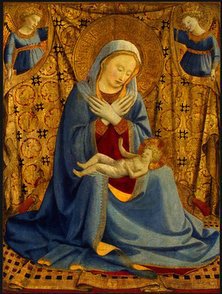
The Madonna of Humility, Fra Angelico, Mellon Collection


I never tire of the prologue to St. John’s Gospel. This is the Gospel for the first Mass of Christmas, which is also the last Gospel of almost every High Mass. These words are hakadesh hakadeshim- the holy of holies- in all of scripture.

I have no need this day to stand here and relate any personal story, or any tale of fiction. The finest and most entertaining story cannot begin to compare with these words which we have heard from scripture. Though we hear the opening of St. John’s Gospel on every Sunday outside of Advent and Lent, we cannot hear it enough. It cannot become tiresome though we were to read it daily. In fact, listen to the words of our hymns this day. In Hark the Herald, look at Charles Wesley’s words, especially the second verse (the verse beginning Christ by highest heaven adored). Such words as these can never become tiresome either.

A Roman Catholic priest of my acquaintance via e-mail, Fr. Joseph Wilson, wrote, in an article, that it is impossible to overemphasize the Incarnation. How right he is. Many heresies come about by overemphasis on one little part of Christian truth at the expense of the rest of it. This cannot happen to the doctrine of the Incarnation, for it contains all of the truth in itself. This truth, that Christ is God the Son come to us in the fullness both of His Divine Nature, and of His human nature, is the truth, the central doctrine, of Christianity. Take it away and we have nothing. Keep it, and we have everything. No wonder St. John also tells us that this simple true statement, that Jesus Christ is come in the flesh, is the one doctrine that the spirit of Antichrist refuses to permit.

The doctrine of the Incarnation contains all of the truth of Christianity. The full revelation of the Trinity becomes necessary for God is the Son, and God is the Father; but the Son is not the Father. And the Son is present with us by the Holy Spirit. But, the Son and the Father are not the Holy Spirit. Yet, every Jew always knew that there is only One God- sh’mai Israel... The truth of the Incarnation opens more questions than it gives answers; the questions are because God is revealed fully by Jesus as being, in His words, The Father, the Son and the Holy Ghost. He leaves us this new name for God, and teaches us that we can spend eternity asking questions about the infinity of the True and Living God because He will always be beyond our full comprehension. Yet, because He can walk among us as a man, in the person of the Son, we can know Him. He is beyond us forever; He is with us forever. His name is called Emmanuel- God with us.

The truth of the Incarnation tells us that we are sinners, lost because we are lost in sin. The light shines not against lesser light, but in the very darkness itself, a darkness that neither understands nor can solve the problem of this bothersome light. The darkness comprehended it not, the darkness into which we have fallen, and in which we were blind. Even many of the very chosen people themselves received not this Light; no wonder then that most of the world cannot receive Him either. Those who can receive Him do so because they face the light. This light hurts our eyes at first; for it tells the truth, the truth about ourselves which we wanted never to see nor hear.

The writer to the Hebrews wastes no time in telling us that this Man, the Son of God who is the very icon of the Father, in Whom the glory of God is perfectly seen, has purged our sins. The Gospel we would read if we had a second Mass, is from St. Luke. In it the words of the angels are heard, “Glory to God in the Highest, and on earth peace, goodwill toward men.” What peace is this? Is it some magic that makes sinful and fallen men stop waging war, as if the cessation of violence is actually worthy in itself to be called peace? Is not the greater war shown to us in scripture? That God has a right to wage war upon man because of our sins? As early as the story of Noah’s flood we see that God accepted the sacrifice of Noah after the flood- a sacrifice that pointed to Christ’s own death on the cross as did all the sacrifices. We are told that God hung up His bow as a sign in the heavens. He hung up what we call the rainbow, His bow of warfare, and promised not to destroy mankind from the face of the earth. This is the peace of which the angels speak. The sacrifice that had been offered in the story of Noah, after he came out of the ark, was only a type and shadow of the cross, the shadow of which hung already, over a newborn Son lying asleep in a manger. Only by this cross, by this sacrifice, is peace made between God and mankind.

“Nails, spear shall pierce Him through
a cross be borne for me for you,
hail, hail the Word made flesh,
the Babe the Son of Mary.”

All of the events to come, right up to His dying and rising again are foretold in these words of the angels. We do not see goodwill among men, as some
misinterpret the angelic words, but goodwill toward men, from God. The whole revelation that God is Love is thus given to us, also, by the Incarnation. This is the great gift of love, that He would give His own Son; He offers the sacrifice that He would not allow our father Abraham to make. Abraham was ready to obey God, and prepared to offer his son, his only son Isaac whom he loved, upon whom had been laid the wood of the altar while they had climbed Mount Moriah.

Abraham was spared this terrible agony of slaying his beloved son, because God used this dramatic means to teach His people that He never would accept the sacrifice of their children, such sacrifices as the pagans made to what were no gods. But, God in His love gives His only begotten Son Whom He loves. This is the goodwill toward men. This goodwill was seen that night in the manger in Bethlehem; this goodwill was seen on the cross many years later on a Friday afternoon.

In the Incarnation we see that God would call a people to be His children, adopting them in the very Person of His only begotten Son; for as St. Paul tells us, we are in Christ. It is because we are in the Beloved, in the Son Himself, that we are chosen by God for salvation, instead of having been abandoned to the fate we had deserved for ourselves.

We see also that He would establish His Church, and give to it His Word and Sacraments for the salvation of all who believe the Gospel. St. John, in opening his epistle, tells us that he had been among those whose hands had handled, and whose eyes had seen the Word of Life; and he goes on to tell us that we too are called to fellowship with God and His Son Jesus Christ through the invitation of the apostles. St. John is telling us that in the Church the sacraments are given and God’s Word is spoken, that we may know Him. Without the Incarnation the apostles have no word to tell, and there is then no Word from God, nor any sacraments. Because of the Incarnation we are given the Word of His truth. And the sacraments stem from His own coming in the flesh, and are only given to us because He was given to us when He came in our own nature, a created nature that was alien to His uncreated Person as God the only Son, eternally begotten of the Father.

In his classic, On the Incarnation, St. Athanasius said that while Christ walked the earth as man, He still filled the heavens as God. The Council Of Chalcedon taught us that He is fully God, being of the same nature as that of the Father, and fully human, being of the same human nature as ourselves, like us in every way except for sin, having human nature from his mother Mary, the Virgin, the
Theotokos- which means the Mother of God.

None of this is explained to us. How is it that God is made man, that the Word is made flesh and that He dwelt among us, that we beheld His glory? We do not really know all the answers- which is part of the revelation. God cannot be figured out, dissected and explained. He cannot be understood, analyzed and described. But, He can be known through Christ, the Only Mediator Who Himself is God and Man.


How do sacraments work? How is bread and wine made into the Real Presence of the Living Christ? How does water, with the right words, give new life when applied to human flesh? How can priests, themselves men, forgive sins? How did Christ’s death take away the sins of the world? How does His resurrection save us from death? If we needed to know the answers in some mechanical way, then salvation would be reserved only for people far too clever for the likes of me; people who are capable of the greatest achievement of science and engineering. The point is to know that it is beyond our understanding, because we are not God. We know not the how of it. But, what we do not understand we can know; we can know the love of God shown to us in the coming of Christ into the world. “For God so loved the world,” and that is the why of it.

I will close with words written in 1765, by Christopher Smart, words which made it into our hymnal, but for reasons I will never understand, not into the Christmas section of it:

O Most Mighty!
O Most Holy!
Far beyond the seraph’s thought,
Art Thou then so mean and lowly
As unheeded prophets taught?

O the magnitude of meekness!
Worth from worth immortal sprung;
O the strength of infant weakness,
if eternal is so young.

God all bounteous, all creative,
Whom no ills from good dissuade,
Is Incarnate and a native
Of the very world He made.

Now unto God the Father, God the Son and God the Holy Ghost, be ascribed, as is most justly due, all might, majesty, dominion, power and glory, now and forever.
Amen.

Fr Robert Hart, 2003 Posted by Picasa

The One Thing Jesus is Not

God sent the human race what I call good dreams: I mean those queer stories scattered all through the heathen religions about a god who dies and comes to life again and, by his death, has somehow given new life to men. He also selected one particular people and spent several centuries hammering into their heads the sort of God He was — that there was only one of Him and that He cared about right conduct. Those people were the Jews, and the Old Testament gives an account of the hammering process.

Then comes the real shock. Among these Jews there suddenly turns up a man who goes about talking as if He was God. He claims to forgive sins. He says He has always existed. He says He is coming to judge the world at the end of time. Now let us get this clear. Among Pantheists, like the Indians, anyone might say that he was a part of God, or one with God: there would be nothing very odd about it. But this man, since He was a Jew, could not mean that kind of God. God, in their language, meant the Being outside the world Who had made it and was infinitely different from anything else. And when you have grasped that, you will see that what this man said was, quite simply, the most shocking thing that has ever been uttered by human lips.

One part of the claim tends to slip past us unnoticed because we have heard it so often that we no longer see what it amounts to. I mean the claim to forgive sins: any sins.

CS Lewis

Read it all here: http://www.spectator.co.uk/article.php?issue=2005-12-17&id=7090

Friday, December 23, 2005

Welcome to Ed Pacht

I want to welcome Ed Pacht, who officially joins us today as our latest contributing editor.

Ed (who uses the name "Poetreader') is a layreader at Trinity Anglican Church, Rochester, New Hampshire, in the Anglican Church of America.

Now 64 years old, he was born and baptized in Boston, Massachusetts, and raised in the Lutheran Church, Missouri Synod. He was confirmed at Church of the Advent in Boston in 1965, and was an active Episcopalian until 1978.

He spent the next quarter-century as a pastor, first in a Pentecostal denomination, and then at Grace Community Church (an independent Evangelical body across the road from Trinity).

During these years he married, subsequently losing his precious Dorothy to cancer. He was received at Trinity in 2002, and was for a time a postulant for Holy Orders. That did not work out, but he continues as an active layreader, taking responsibility for the Daily Office at Trinity.

Ed is a self-published poet, continues as lay chaplain at a small home for the elderly where he has ministered for 15 years and continues an informal study of theology.

Until recently, he been involved with an Evangelical ministry to those wrestling with various kinds of sexual brokenness, including homosexuality, but found it necessary for various reasons to withdraw.

Alhamdullillah!

Muslims offer Indonesian Christians sanctuary at Christmas

One of Indonesia's largest Muslim organisations has offered hundreds of its buildings as safe venues for Christmas religious services amid fears of terror attacks, reports The Age in Melbourne, Australia.It also says it will provide security guards at many churches, as previously reported on Ekklesia.

"We invite our Christian brothers and sisters to say prayers on Christmas Eve and to celebrate Christmas in our schools and other buildings," said Din Syamsuddin, who chairs Muhammadiyah, a conservative Islamic organisation with millions of members.

The Jakarta Post newspaper on Friday said Din made the offer during a gathering on Thursday of religious leaders. The meeting came up with a multi-faith message of peace to be read across Indonesia ahead of three major holidays: Christmas, New Year's Day and the Islamic Day of Sacrifice on 10 January 2006.

Indonesia is the world's most populous Muslim country and its Christian minority has been targeted by some hard-line Islamic groups.

The Post said more than 40 Christian houses of worship, mostly in West Java, have been closed by local authorities since 2004, in response to complaints from Muslim communities and because of a lack of clear planning procedures for the building of churches.

This year there have been strong fears that extremists might attack churches over Christmas. But local Muslims are increasingly angry about what is being done in the name of their religion.

Courtesy of Ekklesia

Alhamdullillah is Arabic for "all praise to Allah". Remember, friends, that Allah is the Arabic for God, and is the name used by Arabic-speaking Christians in their prayers. And I say "praise be to God" that these people have offered refuge and protection to their Christian brothers and sisters at this very special time.

Thursday, December 22, 2005

Re-enchantment

I am probably preaching to the converted here, but I came across the following piece written by Fr Al Kimel, the former Episcopal priest and recent convert to Rome who is well known in these parts as the Pontificator. It was published on the web site of Adoremus, Society for the Renewal of the Sacred Liturgy. While Roman Catholic, it has a lot to recommend itself to us.

“The ‘re-enchantment’ of the Catholic Liturgy”, declares Father Aidan Nichols, “is the single most urgent ecclesial need of our time”.

I like the use of the word enchant to describe the Divine Liturgy of the Church. I still vividly remember my first visit in June 1975 to St. Paul’s Church, K Street, in Washington, DC. I had just finished college. Earlier that year I had become a believing Christian. Upon returning to Washington, an old high school friend invited me to join him one Sunday at St. Paul’s. Solemn High Mass, with a visiting African bishop to administer Confirmation; solemn procession, with two thurifers; chanting, crossings, bowings, genuflections, incense -- all of this was completely new for me.

My only prior experience with the Lord’s Supper was as an addendum to the Methodist preaching service, with cubes of bread and shot-glasses of grape juice. Here was something utterly different. I was taken up into a sacred world. On that day I discovered the Eucharistic Christ. I was enchanted.

I found it possible to believe the Eucharistic promises of Christ because of the enchanting beauty and power of the Divine Liturgy that I experienced that first summer at St. Paul’s. I was enchanted into faith. I experienced the glories of heaven and thus came to know the truth of the Eucharist. I will always believe that the consecrated elements are truly the Body and Blood of Jesus Christ. And it is the liturgy that has sustained and generated my faith for the past thirty years.

Surely the Holy Eucharist should enchant us. The Divine Liturgy is nothing less than the presence of the coming Kingdom of God. By the Spirit we are lifted into the heavens in union with our Great High Priest. By the Spirit we are brought before the Throne of God and behold the glory of salvation. Whether we imagine the liturgy as our ascent into heaven or as the descent of heaven into our midst, what truly matters is the gracious presence of the Holy God in glory, love and beauty. Thus the psalmist sings: “Give unto the LORD the glory due unto His name; worship the LORD in the beauty of holiness”.

Read it all here: http://www.adoremus.org/1205Mass.html

Wednesday, December 21, 2005

Christmas Light Conquers Evil

"The light of Christmas" was the theme of Benedict XVI's special catechesis in today's pre-Christmas general audience, which was held in St. Peter's Square in the presence of 15,000 people.

"Today's audience is taking place in a climate of joyful and eager expectation as we await the imminent Christmas festivities," said the Pope, adding that many symbols help us to understand the mystery of Christmas, "among them that of the light, which is one of the richest in spiritual significance."

"Christmas in our hemisphere coincides with the days in which the sun completes its descendent cycle and the period of daylight gradually begins to lengthen ... This helps us to a better understanding of the subject of light overcoming shadow; a symbol evoking a truth that touches the most intimate part of man: the light of goodness that overcomes evil, ... of life that overcomes death.

Christmas - which re-presents us with the announcement of the definitive victory of God's love over sin and death - causes us to think of this interior light, this divine light ... As we prepare to celebrate with joy the birth of the Savior in our families and our ecclesial communities, a certain form of modern consumer culture tends to remove Christian symbols from the Christmas celebration.

Let everyone, then, seek to understand the value of the Christmas traditions, which are part of the heritage of our faith and our culture."

"In particular, when we see streets and squares adorned by dazzling lights, let us remember that these lights call us to another light, one invisible to the eyes but not to the heart. As we admire them, as we light the candles in church or the lights on the nativity scene or the Christmas tree in our homes, let our souls open to the true spiritual light, which was brought to all men and women of good will."

The Pope concluded his catechesis by calling on the faithful to "maintain their interior wonder" as they celebrate the birth of the Savior, and wishing everyone "a happy and holy Christmas."

Vatican Information Service

Tuesday, December 20, 2005

Female Clergyperson?

As a journalist I am more than sensitive about the rank ignorance that so many of my colleagues demonstrate in their coverage of religion, in general, and Christianity, in particular. This story contains some real gems -- linguistic, journalistic and theological -- not all of them the fault of the poor reporter. Spot them all.

Church ordains city's first female Episcopal priest

Carol Petty was ordained as a priest Monday night at Trinity Episcopal Church in Longview, becoming the city's first female ordained priest in the Episcopal church.

"It's a great honor to be ordained as a priest in the church," Petty said. "I've been in ministry of various kinds for about 15 years."

Petty attended Southwestern Baptist Theological Seminary at its Houston campus, earning two degrees. However, she soon became interested in the Episcopal church, being "drawn to the beauty of the liturgy and the grace," she said.

Kevin Wittmayer, rector of Trinity Episcopal Church, called the ordainment "monumental for us," adding, "We couldn't have a better woman to be our first female clergyperson. It's a real good thing for us."

Petty attended a year of Anglican study at the Episcopal Theological Seminary of the Southwest in Austin after entering the discernment process for holy orders at St. Stephen's Episcopal Church in Beaumont. She came to the Longview church in July.

According to Rayford High, the assistant bishop of Texas, females were allowed to be ordained priests and bishops in 1976 at a general convention meeting in Minneapolis. Before that, women could be ordained only as deacons.

High confirmed Petty's ordainment as the first of a female in the Episcopal church in Longview and said female ordinations are commonplace throughout the country.

"There are only three out of 100 diocese that don't ordain females," High said – in Fort Worth; San Joaquin, Calif.; and Quincy, Ill.

By Gabriel T. Brooks at the Longview News-Journal

Monday, December 19, 2005

Church Planting

Found this on the ACC Diocese of Mid-Atlantic States web site, and thought it might be of interest to those giving thought to planting a church.


The material in this booklet was contributed by members of the Anglican Catholic Church (ACC) who were instrumental in the formation of new parishes in areas where previously no ACC parish existed.

Endowed with a spirit of evangelism and a strong loyalty to the historic faith, and trusting in the Holy Spirit to guide them, they set about accomplishing what might have seemed at the outset to be impossible. Today these efforts have come to fruition as three thriving parishes of the ACC.

It is the sincere hope of the contributors and the publishers that this outline will be helpful to others who may have the opportunity to bring the Church into a new area.

Read it all at:

http://www.anglicancatholic.org/dmas/startmission.html

Surfing: Maggie's Kitchen

While we encourage as many people as possible to make use of this blog, many people still do not know about us. So I have decided to begin a new feature, Surfing, in which I shall share gems and clunkers that I come across in my daily surfing. One gem I have discovered is Maggie's Kitchen, which I found on the website of an ACCC parish, St Michael's, in Fredericton, New Brunswick. The following is an excerpt from Maggie's December column. All of it can be read at http://www.zeuter.com/~accc/accc/fredericton.htm#maggie

Of the feasts of the waning year -- Hanukkah, Kwaanza, Divali, Christmas, and no doubt may others -- only Christmas, the Feast of Christ’s Incarnation, is a Feast spread out for all people everywhere and at all times, for all creation visible and invisible, for all of heaven and earth. Christ didn’t become incarnate for a few followers, or even for millions of followers, but for all, friend and foe alike. It makes me wonder why we Christians are so apt to treat it as our feast alone, as if it had no real significance for Jew or Moslem or pagan. These would probably be just as happy if Christmas went away altogether. I imagine that to accommodate them we could “spiritualize” Christmas by sweeping away our material observances, the way some Christians “spiritualize” the Sacraments by dispensing with the outward signs. But those little matters of cookies and gifts, of festoonings of house and church, are little statements of our Lord’s Incarnation -- little reminders of the wonder of His coming into the world in human flesh -- little echoes of His Words of Institution which we will have still ringing in our ears from the Christ Mass. Little proclamations of the Good News.

Saturday, December 17, 2005

No More Christ(ians) in Bethlehem?

With only a week left until the Feast of the Nativity, I want to share with you one of my deepest concerns -- that the Christian presence in Bethlehem and the rest of the Holy Land is being threatened from all sides -- political, religious and economic.

Year before last I had the joyous experience of visiting the Holy Land. I met there Fr Peter Vasco, a New Yorker and a senior member of the Franciscan community in Jerusalem, who gave me a personal guided tour of the Holy City.

Fr Peter was one of the founders of the Franciscan Foundation for the Holy Land, and I commend their web site to you. If you are looking for a special charity to bless this Christmas, your money couldn't be better spent.

The following is a piece written about a talk given by Fr Peter.

http://ffhl.org/news/thefloridacatholic.asp Posted by Picasa

Thursday, December 15, 2005

The Archbishop of Canterbury's Christmas Message to the Anglican Communion

Perhaps the two images most of us will carry away from the last twelve months are those of the devastation caused by the tsunami just after last Christmas and by the hurricanes that devastated the southern states of America in the autumn. The natural world became a place of terror and disaster.
The question never quite goes away of why God made a world in which such tragedy is possible. But Christmas reminds us of the one thing we know for sure - and that is God’s way of responding to suffering. He doesn’t wave a magic wand, or descend briefly from the sky to clean things up. He arrives on earth as a human being who will change things simply by the completeness of his love. Jesus is dedicated to the will of the one he calls Father, the divine source of his own divine life. Never for a moment does he put any obstacle in the way of that ultimate, total outpouring of love that is the wellspring of his own life. He gives himself to this transforming purpose in every moment, whatever it costs. And the world changes - even the physical world: death is overcome and the material world reveals God’s glory in its depths. So we are changed. New things become possible for us, new levels of loving response and involvement. As has often been said, the Christian answer to the problem of suffering is not a theory but the story of a life and a death, Jesus’ life and death. And for that answer to be credible now, that story has to be visible in our story. We must give an answer to suffering and tragedy in what we do - because the one thing we know is that this is what God does. Faith is restored and strengthened not by talking but by witness in action. And one of the moving things that this year has brought for me is the awareness of how generously so many have responded to the desperate needs of the tsunami victims and those who suffered in New Orleans.
I have had moving letters describing the sacrificial work of Anglicans in the Province of South-East Asia, and in the diocese of Kurunagula in Sri Lanka, to name only two instances, clearly witnessing to the willingness to respond first and ask theoretical questions afterwards. And only a few days ago, I listened to a woman from Texas speaking of her work day and night over many weeks in Houston with those who had been made homeless by Hurricane Katrina. Here are stories of people who know how to answer the challenges of terrible suffering in God’s way - by obedience and service and love.
There is something about Christianity that always pulls us back from imagining that everything will be all right if we can find the right things to say - because for God, the right thing to say at Christmas was the crying of a small child, beginning a life of risk and suffering. God shows us how, by his grace and in his Spirit, we can respond to the tormenting riddles of the world. And, as we agonise over the future of our beloved church, with all its debates and bitter struggles at the moment, it does us no harm to remember that God will not solve our Anglican problems by a plan or a formula, but only by the miracle of his love in Jesus. If we want to be part of the solution, we must first be wholly and unconditionally pledged to that love, with all its costs. May God who works in the weakness and smallness of the Christmas child work in our weakness and smallness; may he bless and strengthen you all at this season.

+Rowan Cantuar:

The Weight of Years That Fill the Place

Introduction

May 21. 2005. Trinity Church, Cornish NH. In 1808, at the urging of a young college student named Philander Chase, later to be bishop of Ohio, an Episcopal church was built, and remained for almost two centuries a place of holy worship. Not long ago, as the Episcopal Church was drifting from its historic faith, Trinity was finally closed and the lovely church in the midst of its churchyard filled with those who have gone before stood unused and forsaken. Mere months ago it began to be used once more, and Trinity Church revived, as a parish of the Anglican Church in America.

Today Bishop Langberg instituted Fr. Brian Marsh as the new rector and ordained David Moody as a deacon. A vibrant congregation joined together in celebrating the one Sacrifice once offered, and I believe the angels rejoiced, along with the blessed ones whose remains lie in the churchyard. . . .

The Weight of Years That Fill the Place

I
The weight of years that fill the place,
the many times the words were said,
the white robes humbly worn by men
with hearts on fire to spread His Name . . .
Now through windows clear and filled with sun
the solemn standing stones are seen
that mark the rest of those who prayed
and heard and feasted on these holy things –
those who now in patient silence wait,
gathered long and gathered silent here,
listening for the holy angel's final trump
that loudly greets the resurrection day.

II
The weight of years that fill the empty place
where words long said are heard no more,
and fire of hearts has cooled and dimmed,
and cherished truths are laid aside,
and pews left empty gather dust,
and week by week the altar lies unused,
and in the Yard where Christian dust lies buried
the sense of expectation seems to fade
with none within to hear the trumpet
of that final coming day.

III
The weight of years that fill the place that lives again,
where words again are said and heard and prayed,
where fire of hearts rekindled by the Spirit
once again shines forth, a holy beacon,
and a man to whom a key and books are given
humbly kneels and humbly prays before a humble altar,
receives a charge and gives a charge to the flock before him,
and all the stones that name the saints of days gone by
seem to glow and silent shouts of praise are almost heard
and hope renewed begins to fill the holy place,
and almost can the promise of the trumpet now be heard.

IV
The weight of years that fill the place that lives again,
the place where words are said and sung and prayed,
where sweetly rises fragrant smoke in praise
of Him who makes and loves and judges men,
of Him who comes and lives and dies and lives,
and comes and feeds and comes and loves and saves,
of Him who comes and fills and pours His power.
of Him who Three is ever One, and One is ever Three,
in whom the gulf of death that sin has wrought
cannot prevail, cannot prevent the union now
of those who rest beneath the quiet sod outside
and those who at this altar pray in fervency,
in this place where weight of years is known
and past and present are but one,
as, in solemn joy they wait together
for that final blast of angel's horn.

V
The weight of years that fill the place today,
as, joining those whose robes of white have here been seen,
a humble man lies prostrate at His feet,
as chanted prayers are filling every voice,
and every angel turns his eyes to earthward,
and all the saints in silence give attention,
and at the placing of the hands upon him,
the holy Dove descends from heaven,
and a servant's heart is filled with power to be a servant,
and by him the timeless words of Christ are spoken,
and by his hands the Blood of life received;
and, silent sighing from the Yard arises,
and we and he and they await the Day.

VI
The weight of years that fill the place,
the many times the words were said,
the sacrifice of praise so oft repeated,
so often spoken yet forever one,
and at this altar blessed union,
blest communion of the saints,
timeless time and never ending,
even when the trumpet comes.

Ed Pacht

Wednesday, December 14, 2005

Lord Carey Defends Wearing of Religious Jewelry

NEVER one to shy away from what it means to be ‘British’, Lord Carey of Clifton’s most recent outburst over the weekend has accelerated the debate over the wearing of religious jewellery in British schools. Speaking in a GMTV interview on Sunday morning, the former Archbishop of Canterbury took a swipe at the farcical levels of political correctness that have permeated our society. Last week, Sam Cooke, 16, was sent home from her school in Derby by the deputy headmaster for refusing to remove her crucifix necklace. Lord Carey branded the fiasco as ‘nonsense’ and warned England risked facing a move towards French attitudes. He said: “I think at the one level is a view around that practising Christians and all the symbols that go with it embarrasses people of other faiths and of course that is nonsense because the Jews and Muslims are only too delighted that Christians take a greater pride in the cross.”He added: “What does worry me is that it may represent a worrying hostility towards Christianity and all religions by a minority of people in leadership today who want to privatise religion, push it to the boundaries, not allow it a voice in the public arena and go the way of France.” A cross, he said, was an expression of faith and not to be considered ‘jewellery’. He urged any pupil faced with a similar dilemma to confront the headmaster and explain the importance of religious imagery. Last month Lord Carey backed the Archbishop of York, Dr John Sentamu’s call for the English to celebrate St George’s day in proper fashion. Echoing these words he said: “I think what we need to recover is identity, what it is to be British today and to be British I cannot understand how you can be British without having that core faith at the heart, which is Christianity.” When asked if it was possible to appreciate Britishness without an appreciation of Christian faith he replied: “If you take the Christian faith out of British identity what have you left?”

Alex Delmar-Morgan in the Church of England Newspaper

(See Free Piglet on this blog, posted on 6/12/05)

Reds Under the Bed?

It's nice to be talked about, even if for the wrong reasons. I found the following comment and reply over at Free Republic http://www.freerepublic.com. I won't comment on my own politics -- they're none of anyone's business -- but I think a regular reading of The Continuum will allay any fears of "Reds under the bed" around here. That said, I wonder if there is some reason to consider it unnatural having political liberals in a continuing church. Comments?

-------
I'm not so sure that this blog should be recommended. The top item refers to the folks who went to Iraq to generate some anti-American propaganda as "Peacemakers" who have "been striving for the betterment of life in Iraq."

-----
The second is a good point and so the blog is worth watching. Liberalism is not unknown in the Continuum churches (even my own! and from parishioners who have definitely long been part of our church family). But I will not toss it on one element alone. Note also: "I had expressed discomfort with women’s ordination and outright opposition to the ordination of practicing homosexuals to Holy Orders."
I, for one, would hate to be held to account and forever labeled for every mis-expression I've made.
Let's give the bloggers here at Continuum some time. There's little enough, as Will at Prydain notes, coming from the Continuing Churches. If we see here a leftist element, it's quite worth watching; if it's a misstatement we'll see that soon enough.

Merger ... or Acquisition?

The following comes from http://thoughtfulcrab.blogspot.com, The Thoughtful Crab:


I thought my readers might find the following links of interest:

http://www.anglicanuse.org
http://www.bookofdivineworship.com/
http://www.walsingham-church.org/mass.htm

A couple decades ago, the Roman Catholic Church Church made a pastoral provision for some Anglican parishes to convert wholesale to Roman Catholicism and retain their priest (After reordination) and some elements of the traditional Anglican liturgy. The Book of Divine Worship is a reorganized version of the Episcopalian Book of Common Prayer (With elements from both the 28 and the 79 prayer books), altered to reflect Roman Catholic theology. The liturgy is a cross between the traditional Anglican liturgy and the traditional Roman Catholic liturgy.Of course, like anything, there are some catches. One is that those in Anglican-Use parishes are required to assent to all elements of Roman Catholic teaching. The other catch, and this is a big one -- they can be forceably converted to the regular Novus Ordo Roman Catholic mass at any time. Apparently, in many cases, this has already happened. There are also few long term provisions for continuing the tradition -- once your priest dies, it seems as though you're kind of out of luck and the parish will be converted to the Novus Ordo and stripped of it's Anglican traditions, if it isn't done before that point by a jumpy Roman Catholic bishop.In some respects, this is a promising start. In the long run, though, I don't think it's wise for any Anglican parish to convert to Roman Catholicism on the premise that they'll be able to retain their heritage. There are no guarantees that they'll be allowed to continue as Anglican Use for long. In fact, the odds are against it.To have any assurance of being able to continue as Anglicans in any sense of that word, I think Anglicans interested in this sort of thing would have to be offered an "Anglican Rite" like the Eastern Rite Catholics -- complete with their own bishops, priests, seminaries, clerical discipline, and liturgy. A rite is something lasting that people can hang their hats on, to a certain degree. A rite will be there in a few decades or in, theoretically, a few hundred decades. A use is just a bridge intended to get people to the other side, that'll be cut off behind them when they cross it -- these "use" parishes seem destined to all eventually become Novus Ordo parishes, barring a change of direction.

Discarding Accretions

I commend to you the following thread, over at Continuing Home, which can be found at http://continuinghome.blogspot.com/.

In a discussion in class this evening our Rector noted his annoyance at some practices that have accreted to our celebration of Mass over the years. I think to his surprise, I know to my (pleasant) surprise, there are a few of us in the class who've been annoyed by them and now each of us knows we are not alone.

One, a congregational response that is not in the 1928 Order for Holy Communion, is traceable to the ECUSA 1979 BCP and was probably brought in by a convert (refugee?) from ECUSA. I think this probably occurred in the earlier days of our parish when former Episcopalians made up the majority of our congregation (we are a distinct minority now, I counted just 10 to 20% a year ago), and they would have been accustomed to the '79 service.

Another is reading the Prayer of Humble Access out loud along with the priest. I have no idea where that came from; somebody brought that in from somewhere else. The congregation varies widely on this; a few read it out loud, others (including me) remain silent, the rest seem to follow whichever group is the majority. But the rubrics are quite explicit on this point.

I suspect we're going to be discarding these practices. Without so much as a(nother) word from the Rector.

Tuesday, December 13, 2005

Jesus Ain't Deaf


I found this on a blog in Brazil, which may be most appropriate as a message for the less Anglo-Catholic among our readers:

A bit of graffiti across the street from a church ...

Jesus isn't deaf!!!
Pray quietly
and respect the ears of the other children of God. Posted by Picasa

Civil partnerships are 'opportunity' for the church

This comes from Ekklesia.

As the first civil partnerships are about to be registered in England on 21 December, the progressive Anglican organisation Affirming Catholicism has announced the publication of a booklet calling on the Church to welcome the development as a pastoral opportunity and a means of listening to the experience of lesbian and gay Christians.

Translation: We ask the Church to accede to a reinterpretation of the Christian faith, with homosexual unions being accepted, a priori, and then pastoral care can proceed on the basis of our agenda.

The booklet, written by an Anglican priest, argues that civil partnerships will provide a way out of the ‘catch 22’ which faces many homosexual Christians whose relationships are criticised for being unstable while - at the same time - the Church fails to offer any support which might help couples stay together.

I won't even begin to try to decipher that one ... On second thought, I will. It flows on well from the previous paragraph. Homosexual relationships, which we now have acknowledged as being acceptable, are criticised for being unstable. (I think the evidence shows that they are). So we provide the support to keep them stable.

Canon Nerissa Jones, MBE, the Chair of Trustees for Affirming Catholicism said: "The period of listening and reception to which Anglicans are committed can’t happen on a purely theoretical level. It must also be about the lived experience of lesbian and gay Christians who need to feel safe enough to tell their stories. We believe that civil partnership can help give that security and that local clergy should offer prayer and support for couples."

Op cit

The Church of England Bishops have stated that, while there could be no authorised liturgy to bless same-sex couples until there was consensus on Church teaching, parish priests should nonetheless respond sensitively and pastorally to gay couples seeking blessings.

The publication, which opens with a foreword by The Very Rev’d Jeffrey John, Dean of St Albans, calls for an end to the double standard at the heart of current Church teaching which accepts gay relationships between lay people but bans sexually active homosexual women and men from the priesthood.

I agree entirely with the Dean of St Albans. The double standard should be ended. The Church should teach clearly, forcefully and unashamedly that all sexual relationships outside of marriage are sinful.

The booklet will be published on Friday 27 January 2006.

Get your orders in early.

Monday, December 12, 2005

Santa Lucia


Today is the feast of Santa Lucia, one of the patron saints of my daughter, Andrea Lucia.


St Lucy of Syracuse : Lucy was born toward the end of the third century and lived in Syracuse, Sicily. She was the daughter of very noble and rich parents. Her father died when she was still young. Lucy secretly promised Jesus that she would never marry so that she could be his alone. She was a lovely girl, with beautiful eyes. More than one young noble set his heart on her. Her mother urged her to marry one whom she had chosen for Lucy. But the girl would not consent. Then she thought of a plan to win her mother. She knew her mother was suffering from hemorrhages. She convinced her to go to the shrine of St. Agatha and pray for her recovery. Lucy went along with her and together they prayed. When God heard their prayers and cured
her mother, Lucy told her of her vow to be Christ's bride. Her mother let Lucy follow her vocation, out of gratitude for her cure. But the young pagan to whom she had promised Lucy was furious at losing out. In his bitter anger, he accused her of
being a Christian. He threatened her with the frightening torture of being blinded. But Lucy was even willing to lose both her eyes rather than belong to anyone but Jesus. And that is just what happened. Many statues show St. Lucy holding her
lovely eyes in the palm of her hand. Jesus rewarded her for her heroic love. He worked a miracle and gave her back her eyes, more beautiful than ever. The pagan judge tried to send the saint to a house of sinful women. He hoped that Lucy might be tempted to give up Christ. But when they tried to carry her away, God made her body so heavy that they could not budge her. In the end, she was stabbed and became a martyr for Jesus in the year 304. Her name in Latin means Light and, as her
feast-day fell in December, she became associated with the one true Light who was coming as the redeemer of the world, the Light that would lighten the nations, the Light that would banish darkness and let the eyes of all behold Truth incarnate.
In many countries, and Scandanavia in particular, her feast day is celebrated with the youngest daughter of the family wearing a crown of candles and bringing in the first meal of the day. Posted by Picasa

Thirst for More Than Just Beer

This comes from a discussion list in which I have been active for several years, followed by a comment I made in reply. Are any other Continuers engaged in a similar ministry, and why not?

I receive the newsletter from the parish in the Hyde Park neighborhood of Chicago where I grew up. They are doing great urban ministry there. On the first Friday night of the month, the curate goes to Jimmy's Woodlawn Tap, that's right, a bar, and holds forth about theology ... This has been so well received that it has been expanded to another night each month.

---------

One of my favorite topics.

My "local" is a mock Irish pub/restaurant in Nicosia called Finbarr's. It's
a great meeting point for Cypriots and foreigners, and has become the
closest thing I have to a "club."

The owner and staff, all of whom I count among my friends, are aware of my
priestly vocation, and I have become a sort of an unofficial spiritual
director to some of them. Moreoever, they have a habit of introducing me to
new folks as "Father Albion" or simply as a priest. While that is more than
a slight exaggeration, I find that this opens up the opportunity for me to
engage in the ministry of apologetics, and even evangelism.

There is nothing of a formal nature like at Jimmy's, just conversation when
it comes up. But I never cease to be amazed at how much thirst there is for
more than just beer.

A Chuckle

A man suffered a serious heart attack and had an open heart bypass surgery. He awakened from the surgery to find himself in the care of nuns at a Catholic Hospital.

As he was recovering, a nun asked him questions regarding how he was going to
pay for his treatment. She asked if he had health insurance.

He replied, in a raspy voice, "No health insurance."

The nun asked if he had money in the bank.

He replied, "No money in the bank."

The nun asked, "Do you have a relative who could help you?"

He said, "I only have a spinster sister, who is a nun."

The nun became agitated and announced loudly, "Nuns are not spinsters!
Nuns are married to God."

The patient replied, "Then send the bill to my brother-in-law."

How very nice

The following appeared on the Prydain blog. I hope we can all live up to the initial praise.

Interesting new blog: "Continuum"
There are not very many blogs out there that focus on the Continuing Anglicans, those churches that split from ECUSA in the 1970s over the ordination of women. Until this week, the only blogs of this type of which I was aware were The Continuing Anglican Churchman and Continuing Home, both of which are fine blogs and make a needed contribution to the discussion of alternatives to ECUSA.

This week I found out about Continuum, which appears to be a group blog with contributors such as Fr. Robert Hart and Fr. Matthew Kirby. In addition, the prime mover behind "Continuum", a man who goes by the name "Albion" is no slouch either; he writes very well and is in the process of joining the Anglican Church in America, with a view towards eventually being ordained. This blog has a great deal of potential, I think, and would be worth checking out.

Saturday, December 10, 2005

Pray for the Hostages

Please pray for the four members of the Christian Peacemakers Team held hostage in Iraq. A deadline for their "execution" was extended until today.

O God, soften the hearts of their abductors, that they might set free four men who have been striving for the betterment of life in Iraq. In Jesus'name. Amen.

Friday, December 09, 2005


Just one more thing, and then I will really go to bed.

Here is a picture of the house I bought in Spain, and hope to have renovated by next summer. Posted by Picasa

A (long) bit more about myself

When I introduced myself at the inception of this blog, I said I would tell you more about my churchmanship in due course. As we are beginning to coalesce here, much to my great joy, I think now is an appropriate time to say more. At the outset, it didn’t really matter; now, I think, it does.

I like to call myself a genetic Anglican, because my parents were both Episcopalian. I was baptized as an infant at the Church of St Thomas, Eustis, Florida, in April 1951, and confirmed there some 10 years later. In my teens, I moved to the parish of St Edward’s, Mount Dora, which was closer to my home and to my social life. It was at St Edward’s that a first inkling of a vocation to the priesthood emerged, and was nurtured by my priest, Fr Walter Peterson. By the time I was a senior at the University of Florida, majoring in journalism, I concluded that the priesthood was where I was meant to be. I entered the “process,” and came out the other end like so many others of my age at the time – with my vocation “affirmed” but being told to “come back later after you get some experience in the ‘real world.'” I was also asked to do some group therapy, to learn how to say “no.” (I didn’t, but I do).

Anyway, as happened with so many like me, I went out into the real world and never came back – at least not for a very long time. That occurred when I was living in Madrid in the early 90s and began attending St George’s, whose chaplain, Henry Scriven, later became the suffragan bishop of the C of E Diocese of Europe, and is now right hand man to Bishop Duncan of Pittsburgh.

My relationship with +Henry led to my eventually being trained and licensed as a Reader in the C of E in London. During that period, I began to realize that my real vocation was where it always had been.

Quick jump to 15 months in Washington (and its wonderful St Paul’s, K Street) before moving to Cyprus more than five years ago, where I became a Reader at St Paul’s Cathedral, in the Episcopal Church of Jerusalem and the Middle East. It was there that I openly began to pursue again my vocation. After three years, and two selection panels, I was rejected.

Officially, I failed to communicate to the panel a “real understanding of the nature of priesthood.” My hunch is that the real reason is either that I was considered unfit, which may be true, or more likely that I had expressed discomfort with women’s ordination and outright opposition to the ordination of practicing homosexuals to Holy Orders.

I won’t go into further detail for now, because matters are sub judice, as it were, but I am in the process of joining the Anglican Church in America, with a view to eventually being ordained.

Forgive my long-windedness, but I think it fair for you to know who I am, and where I am coming from.

The Immaculate Conception of Our Lady (Feast Dec. 8)

While there may be individual continuing Anglican Catholics (AC) who would object to the content of this teaching for similar reasons to the Eastern Orthodox (EO) and earlier AC divines such as Pusey, especially because of its precarious-looking status in terms of the Vincentian Canon, it is in our authorised Missals, and so counts as part of the Tradition.
The reaction against it in both AC and EO circles has been partly based on its elevation to dogmatic status. To say it is divinely revealed in the same sense the Trinity and Resurrection doctrines are divinely revealed is simply false. A teaching that is revealed only in the most indirect and implicit fashion and is long either unknown or disputed, is obviously not a good candidate for dogma, even if the community of Faith becomes morally certain of its truth. This was precisely the objection of many Roman Catholic (RC) bishops when the Pope asked for their advice before defining the Immaculate Conception (IC) as dogma.

Another element in both AC and EO objections to RC Marian devotion in general is that it can tend very easily to lose its Christocentricity and teeter towards idolatry. For example, EO icons of Our Lady almost never picture her on her own, but in company with her Son. This is not so in Western art. As another example, and one that many Anglicans have found particularly galling, we had statements in popular RC devotional literature of the past that talked of Mary “commanding” her Son and of being the neck in Christ’s Body, so that all flowing from the Head, Christ himself, must flow through her as an intermediary. Wherever excesses and imbalances still exist, at least some of Pusey’s criticisms would still be valid. What would present-day RCs think if they read a passage like this below in a living RC theologian or heard it preached from the pulpit?

“There is some portion of the Precious Blood which once was Mary’s own blood, and which remains still in our Blessed Lord, incredibly exalted by its union with His Divine Person, yet still the same. This portion of Himself, it is piously believed, has not been allowed to undergo the usual changes of human substance. At this moment, in heaven, He retains something which was once His Mother’s, and which is, possibly, visible, as such, to the saints and angels. He vouchsafed at mass to show to S. Ignatius the very part of the Host which had once belonged to the substance of Mary.”

One of the most famous ACs of the Nineteenth Century, Pusey, believed that the IC dogma was going to lead to further dogmatisation, including of opinions such as those above. He seemed to think that the IC was only the start of an irrepressible urge to magnify Mary with virtually no limits except nominal denials of ascribing full-blown latreia to her. Fortunately, he was wrong. The RCC has, since then, tried to ensure popular exaggerations and devotional imbalances that distract from the Christ and the Gospel are kept in check much more than it used to. A welcome “development”.

However, Pusey was not infallible, and never claimed to be. The very fact that the English Calender maintained the Feast of the Conception as a black letter day even after the Reformation was considered significant by ACs. The BCP Preface to the Sanctus in the Canon for Christmas has the suggestive statement “Jesus … was made very man of the substance of the Virgin Mary his mother; and that without spot of sin”. These factors, and theological arguments of men like the great Anglican Neo-Thomist Fr Eric Mascall have all had their impact. The repeated description of Mary as Immaculate and All-Holy in the Ecumenical Councils was also determinitive: entirely without sin must mean what it says. So we have developed too.

The objection of many EO and some ACs in the past that the doctrine assumes the Augustinian doctrine of Original Guilt is not a problem once one realises it can be expressed without reference to this Western peculiarity. The key is to think positively rather than negatively and see the IC as the infusion of “sanctifying grace” simultaneous to her life beginning, or better still, as the immediate presence and power of God to save and sanctify doing so ab initio. Indeed, it was Mascall I think who noted that the IC simply involved God granting Mary the benefits of grace at her conception that we receive at baptism. The difference is that this meant sin and concupiscence were never able to find a place in her, whereas the implanting of a new nature continues to have "competition" from the pre-existing "old man" in us after baptism.

To sum up, the ecumenically Catholic belief in our Lady’s immaculacy implies, if taken seriously, a belief she was tainted by no sin or stain at all. This would include Original Sin. In addition, the suitability of Mary to be Christ’s mother must rest on what she is, not just on what she had or had not done. Her unique success in not committing any sin at all must be understood as resting on a unique condition, otherwise we risk falling into Pelagianism. Even if we do not accept the full Augustinian paradigm in soteriology, it is true to say that mankind’s fallen condition means humans come into existence affected by Original Sin, which is more than mortality[1] even if it is less than automatic liability to eternal condemnation.[2] Therefore, if all Catholics reject the idea of a sinful Mary with a corrupt human nature, they must logically all accept that she lived in that immaculate condition for a reason, and that that reason lies with God’s initiative, not hers.

There does not appear to be any justification for limiting or qualifying her immaculacy temporally if we do not do so in other ways. In other words, the mature Tradition does not leave us room to say “Mary was without any sin or sinfulness at all – except for the early part of her life.”

The following propositions I suggest are an ecumenical and orthodox statement of this doctrine.

The Blessed Virgin Mary was wholly without actual sin or sinfulness from the beginning to the end of her life on earth.
This was due to the grace of God in Christ and, later, her free co-operation.
This unique blessedness made her a fit life-spring and vessel for the Blessed One.


----------------------------------------------------------------------

[1] Some Eastern Orthodox claim that the Eastern Fathers do not talk of inherited sin but inherited mortality. While these Fathers do not accept inherited guilt, they certainly do accept inherited sinfulness or corruption. Another objection put forward is that the doctrine of the Immaculate Conception separates our Lady from the succession of Old Testament sanctity and breaks her link with her ancestor saints. The proper reply to this may be that her “preventative cleansing” and gracing were a reward for their faithfulness and an answer to their prayers for the complete redemption and restoration of the “virgin” Israel. It should not be forgotten that Eastern liturgical prayers on the Feast of the Conception of the Virgin call her immaculate. I am reminded of a conversation related to me by one of our priests, who discussed the issue with a Romanian Orthodox priest on December 8. Our priest concluded by saying that on that day he would celebrate the Feast of the Immaculate Conception of our Lady and that the next day his Romanian friend would celebrate the Feast of the Conception of our Immaculate Lady, so he didn’t see much difference!

[2] The Roman Catholic Church seems to have qualified its acceptance of Augustinianism by, for example, its statement in the recent Catechism of the Catholic Church (sections 404 & 405) that Original Sin is called so analogically and is not, strictly speaking, a personal fault.

Fr Matthew Kirby

Merger ... and why not?

In a thread on Splinter Groups over at Anglo-Catholic Central, I came upon the following comment from ACA Lay Reader Ed Pacht, who is now already a major contributor to this blog (actually one of the few at the moment, in its early life). Does anyone have any answers?

The various Anglo-Catholic Continuing bodies, though they range from moderate to extreme in their catholicism, have precisely no substantial reason, theological or liturgical, to remain separate. The proximate cause of their separation and its continuance is nothing more or less than the perversity of fallen mankind. It's pride, self-will, and stubbornness, and a lack of agape. Reunion is a present necessity.

Why cannot sacramentally minded Anglicans who emphasize the truths of the Reformation and Anglo-Catholics who emphasize the continuity of Tradition unite around the Creeds and the Sacraments? It used to be so. It still can. And He prayed, "That they all may be ONE".

I'm part of the ACA, and thus of the TAC, and am glad of that -- but I bristle at being separated from brethren of other 'jurisdictions' -- this has to come to an end. A revisionist and non-(or barely)Christian Anglicanism has emerged. Why can't we who have determined to hold the Catholic and Apostolic Faith that they have rejected, hold it in unity?

Are you boring?

"Man nurtures the suspicion that God, at the end of the day, takes something away from his life, that God is a competitor who limits our freedom and that we will be fully human only when we will have set him aside," Benedict said.

"There emerges in us the suspicion that the person who doesn't sin at all is basically a boring person, that something is lacking in his life, the dramatic dimension of being autonomous, that the freedom to say 'no' belongs to real human beings."

Benedict XVI

Thursday, December 08, 2005

'Merry Christmas' school lunch menus recalled

'Merry Christmas' school lunch menus recalled

SEATTLE (AP) -- Holiday religious issues arose in two suburban school districts, one for lunch menus with the words ''Merry Christmas'' and the other for a ''giving tree.''

In Federal Way, between Seattle and Tacoma, December lunch menus for all 23 elementary schools were recalled and reprinted with the words ''Happy Holidays'' at a cost of $494 after a new nutrition services employee mistakenly prepared them with the greeting ''Merry Christmas,'' spokeswoman Diane Turner said.

Using ''Merry Christmas'' on the menus violated school system policies because ''it has a religious connotation for some people,'' Turner said.

There's a silver lining in every cloud. It's nice to know that Christmas has a religious connotation for "some people."

Narnia and Kids

Here is my contribution, courtesy of Zenit, to the slew of commentaries being made on the Narnia film. Interestingly, the assertion that children will not notice the film's Christian themes does not hold true in the case of my family. I asked my son Winslow, who couldn't have been more than eight or nine at the time, if he thought Aslan was like someone else. "Duh, Daddy. Jesus. Anybody can see that." I look forward to the film.

The Subtle Magic of C.S. Lewis' Narnia
Michael Coren's Perspective as New Movie Looms

"The Lion, the Witch and the Wardrobe" may provide an opportunity for adults to talk about the faith, but don't expect children to notice the film's Christian themes.

So says Michael Coren, author, columnist and broadcaster who recently wrote "C.S. Lewis: The Man Who Created Narnia" (Ignatius), a biography of Lewis written for teens.

Coren told ZENIT how mostly adults will understand Lewis' subtle Christian allegory, and how "The Lion, the Witch and the Wardrobe" has the power to plant seeds of faith in kids just the same.

Q: What do Catholics need to know about C.S. Lewis?

Coren: They should know he wasn't a Catholic, but that doesn't mean he wouldn't have become one eventually. G.K. Chesterton became a Catholic in 1922 but had really been one for 20 years.

Lewis was born in Belfast, in sectarian Northern Ireland, so he was raised anti-Catholic like most Protestant children there. He was a man of his background but his views were very Catholic: He believed in purgatory, believed in the sacraments, went to confession.

Otherwise, he was the finest Christian apologist in modern times and could communicate the Gospel message in a thoughtful, accessible way.

Q: How blatantly does C.S. Lewis use Aslan as the figure of Christ in the Narnia series?

Coren: He does and he doesn't. Unlike many modern Christian writers, Lewis was subtle and implicit. When I read the book as a little boy I was overwhelmed by the greatness of it, but I didn't realize the Christian message until I was an adult.

It's explicit when you're older, but I don't think we should necessarily be pointing it out to children; we can let them find it themselves. They don't need a running commentary. Let them read it and be overwhelmed by it and not realize what they're really getting at the moment.

Q: What are some of the most notable parallels between Jesus and Aslan the Lion in "The Lion, the Witch and the Wardrobe"?

Coren: There are many in this book and the other six in the series, but some obvious ones are: the breaking of the stone table and the old law being shattered; how it is winter but never Christmas, and it doesn't become Christmas until Aslan arrives; how Aslan dies for a sinner, a little boy who represents everyone, and takes away his sins; and how Aslan comes to life again and re-creates the world.

In the scene before Aslan's sacrifice for the little boy, Edmund, the White Witch says, "Because he has sinned, he is mine," and she intends to kill Edmund. And Aslan says, "But I can give myself in his place." She agrees to this and kills him, but then he is resurrected.

Q: What can we learn from Lewis about the integration of popular fiction and Christian values? Do you hope modern writers might follow suit?

Coren: J.K. Rowling has said that Lewis had a huge influence on her, yet many people have problems with Harry Potter. I've heard many writers say they've been influenced by Lewis and they try to copy him. It is often too similar; all these books are pale imitations.

He was of his age and wrote at a specific time in history. Some of his characters would not translate into modern times. If someone wrote a book today with those characters, kids wouldn't be able to relate to them. He was a man of 1963.

Q: What is the significance of another Christian film coming out of Hollywood, on the coattails of "The Passion of the Christ"?

Coren: I don't think "The Lion, the Witch and the Wardrobe" is a "Christian" film; we have to be careful with calling it that. I don't believe "The Passion" produced this movie -- I think "The Lord of the Rings" did.

What is more significant is why there have been no biblical movies after "The Passion." They could make a really bad movie and it would do well financially because there is such a hunger for Christian movies out there.

But Hollywood would rather do anything than make a movie with Christian values. It is a wonder that nothing has come after "The Passion."

Q: What are your hopes -- and fears -- for "The Lion"? Do you expect it to bear fruit as a witness to Christ and the Gospel message?

Coren: I haven't been able to see any special early screenings of "The Lion, the Witch and the Wardrobe" up here in Canada; the Christian world is not as organized or influential like in the States. I will be going to the midnight screening on Dec. 8 with everyone else.

I have no fears about the movie. There will always be some Christians who define their faith by what they are offended by, and nothing is ever pure enough for them. There will be people who say this or that is wrong, and some who think the movie should not have been made.

I think the movie will be a helpful way to talk about Christianity. People will read Lewis, talk about faith and the movie and other good things.

I read the book when I was 6 or 7. I wasn't raised in a Christian family and had no exposure to Christianity. Twenty years later I came into my faith and I am convinced the seeds were planted by that book. I believe my faith began then.

But we can't expect someone to see the movie, have an evangelical experience, and come out of the theater on their knees and say "Save me!" We shouldn't think it will change everything -- what did "The Passion" change? They are only movies. The Holy Spirit can use a movie but it doesn't need to.

Wednesday, December 07, 2005

Polity and disunity

For the past few years I have followed, with genuine interest, the story about the TAC (Traditional Anglican Communion) working towards unity with Rome. At one point I was certain that I knew a great deal about it, but no longer. A few confusing and contradictory pieces of information have come my way; so I wait in hopes of learning the details and ascertaining the facts.

I cannot tell if the goal of establishing an Anglican "Uniate" Church has been replaced by a hope for "intercommunion" with Rome. Such a relationship is enjoyed by only a few churches, such as, for example, the Polish National Catholic Church; and then only under special circumstances.

As many readers will know, the institution the Catholic Church (when used exclusively to mean the Church of Rome and all of the churches that are under obedience to the Pope), contains several rites beside the Roman Rite, especially several Eastern Rite churches. When first I heard of the talks between the TAC and Rome the goal was that of establishing an Anglican Rite in the same way. As this was expressed to me about three years ago, it would exceed the significance of Anglican Use liturgies, because, to a much greater extent, the Anglican Ethos would survive in many of its crucial aspects as part of the larger Communion that includes all of the churches that are in communion with the Apostolic See of Rome.

Nonetheless, as a matter of stating the obvious, one very real and thorny issue appears to stand as an obstacle. And, I am sorry for that. I believe in One, Holy, Catholic and Apostolic Church (and for Prayer Book purists, who insist on the scribal error of dropping “Holy” from one Creed, remember it remains in the Apostle's Creed).

The Church, despite its apparent divisions, already is One. That is an article of faith, and one that keeps me from thinking that I must choose one or other of the two "One True Churches." So, I am hoping that the one obstacle I see will give way to the Unity of the Church by the working of the Holy Ghost.

When the Lord Jesus prayed "that they all may be one," this was not the pathetic cry of a suppliant hoping that we, mere mortals who wrestle with demonic powers, are somehow required to grant to Him. One Person of the Godhead expressed the Divine Will to Another Person of the Godhead. Other words had been spoken within the Trinity from the dawn of time: "Let there be light ... Let us make man in our image ..." The same Triune God spoke His will concerning the first husband and wife, creating marriage as part of human nature and making the man and woman one flesh within its bonds.

"That they all may be one ..." makes the One Church an article of faith for us. The word of God created it so, just as His word makes every married couple into one flesh. Some married couples live apart, whether by separation or by the legal fiction called "divorce." But, their oneness is the work of God, part of His very creation.

Likewise, the divisions of the Holy Catholic Church are only apparent. They are realities only insofar as they affect relations among Catholic Christians. We Anglicans are told that our belief about the Church should be called the "Branch Theory." But, if it is a theory it is still a fact, just like the Theory of Gravity. No doubt the Church has suffered apparent divisions, and needs to experience reconciliation. But, its oneness is established and confessed in Credo.
So, of course, I wish to see efforts towards visible unity succeed.

What is the problem? The simple fact is, the only people who can lead Catholic-minded Christians into workable unity are the bishops. Quite obviously, in light of the recognition by Rome of the validity of the Old Catholic orders, and to this day Rome’s recognition of the validity of the Polish National Catholic Church, married bishops are not a doctrinal problem. Rome recognizes married bishops as valid successors of the apostles, with full sacramental powers. And, yet, in its polity Rome has no room for married men to hold the office of bishop. I see no simple or obvious way around this problem. Perhaps someone reading this blog has an accurate answer. But, for now, it seems to me to be a genuine obstacle.

Fr Robert Hart

Tuesday, December 06, 2005

Free Piglet

I recently read the story of a secretary at a town hall (council) office in England who had a coffee mug or a stuffed animal of Winnie the Pooh and Piglet on her desk. A Muslim man who had come into the office on business complained that he was offended by the presence of the pig, and demanded it be removed. It was. This led to the formation of the Free Piglet campaign. From time to time, I will share with you examples of other incidents in which Christians are being persecuted, not only in countries where their religion is theoretically a majority, but also where it is not. The following comes from Drudge Report.

UK: GIRL SENT HOME FROM SCHOOL FOR WEARING A CRUCIFIX
Mon Dec 05 2005 19:45:41 ET

A school today defended its decision to exclude a pupil after she refused to take off her crucifix necklace.

Sam Morris, 16, was told to remove her cross and chain on Thursday by deputy head teacher Howard Jones at Sinfin Community School in Derby.

When the year-11 student refused she was told not to return until today and without the item of jewellery.

The 1,070-student comprehensive has a strict policy which bans most jewellery being worn.

Items can be worn out of view or if they are part of religious beliefs, such as the Kara, a bracelet worn by Sikh males.

But the policy has been described as "unfair" by Sam's mother, Debra Saunders.

Sinfin Community School deputy head teacher Howard Jones said her daughter's one-day exclusion had been a "last resort" after a 30-minute conversation failed to persuade her to take it off.

He said: "There was a long period of persuasion with her and she was given time. It was only at the end of that that I reluctantly had to exclude her for a day.

"I met with her mother today and readmitted her daughter."

Mr Jones said the strict jewellery policy, which bans large earrings or items worn on the outside of clothing - was to avoid accidents and to remove temptation from thieves.

However, Sikh male pupils are allowed to wear the Kara, one of five physical symbols worn by followers of the faith.

Mr Jones said: "As a Christian I don't have to wear a crucifix but Sikhs don't have that option and we have to be understanding. We live in a multi-faith society."

Mrs Saunders, of Thackeray Street, Sinfin, told the Derby Evening Telegraph: "Sam has worn this necklace for more than three years and it is of great sentimental value to her.

"No-one has told her to take it off before and she doesn't want to.

"She thinks it is very unfair when other people are allowed to wear religious symbols and it just ends up creating a divide between the pupils when everyone is told they should be living in unity."

Developing...

Monday, December 05, 2005

Welcome to Fr Matthew Kirby

Fr Matthew Kirby joins The Continuum today as my second co-host. He is also a prolific blogger, and a serious thinker and apologist for Continuing Anglicanism.

Here is what he has to say about himself on his homepage:

"Hello! I am a priest in the Diocese of Australia in the Anglican Catholic Church, an Anglican body that holds, teaches and practices the Faith of the Church, "the pillar and ground of the truth" (1 Timothy 3:15), as it was before the sad divisions of the last millennium. Like the Eastern Orthodox, we accept the entirety of Holy Tradition derived from the Apostles. This Tradition, that is, "teaching handed on from generation to generation" (see 2 Thessalonians 2:15 & 2 Timothy 2:2), includes the Scriptures, the Creeds and the Seven Ecumenical Councils. I am also a Franciscan Tertiary.

The other hat I wear is that of a physics/maths/religious studies teacher in a local Roman Catholic Senior High School, St Mary's Campus of All Saint's College, Maitland.

A Book Review on Sacred Language

Michael Dirda
A season to remember the transforming power of sacred language.

THE BOOK OF COMMON PRAYER

The Elizabethan Prayer Book

Edited by John E. Booty

Virginia/Folger. 427 pp. $29.95

W.H. Auden used to warn against those who read the Bible for its prose. Ignore this advice. The hoopla of the next few weeks should be interrupted from time to time with quiet moments when we reflect on our lives and the years past and to come, and one of the best ways to do this is by meditating on grave and noble sentences. So, whether believer or not, turn to the Gospel of Luke:

"And it came to pass in those days, that there went out a decree from Caesar Augustus, that all the world should be taxed. . . . And Joseph also went up from Galilee, out of the city of Nazareth, into Judea, unto the city of David, which is called Bethlehem (because he was of the house and lineage of David), to be taxed with Mary his espoused wife, being great with child. And so it was, that, while they were there, the days were accomplished that she should be delivered. And she brought forth her firstborn son, and wrapped him in swaddling clothes, and laid him in a manger; because there was no room for them in the inn."

As a boy, I would hear these words spoken aloud toward the end of December, year after year, and they never failed to deliver a shivery thrill of pleasure. I used to wonder why. The sentences were utterly plain, both in diction and syntax. Neither did they possess any narrative excitement, since I knew the story already, indeed knew it far better than any other in all the world. But the language -- like that of so many other passages from the Bible -- enchanted me with what I now think of as its deeply felt seriousness.

Read it all here: http://www.washingtonpost.com/wp-dyn/content/article/2005/12/01/AR2005120100946_pf.html

Sunday, December 04, 2005

Welcome to Fr Robert Hart

I would like to introduce Fr Robert Hart, who joins me as a co-host of and contributor to The Continuum. Many of you will know him from his thoughtful and stimulating commentary on other blogs.

Fr Robert, a Contributing Editor of Touchstone, a Journal of Mere Christianity, was ordained as a priest in the old Anglican Rite Synod of the Americas (at the time a part of the Phillippine Independent Catholic Church).

For several years, he was vicar of Saint Andrew's Church in Easton, Maryland. This year, he was received as a priest into the Anglican Province of Christ the King under Bishop Frederick Morrison in the Diocese of the Southwestern States. He lives in Fountain Hills, Arizona, and is vicar of the Church of the Atonement.( http://www.atonementchurchfountainhills.org/ )

Speaking about himself, he says: "I was a cradle Episcopalian, baptized in 1958 and confirmed in 1971. But, during the mid-seventies, I was a Charismatic Evangelical. This was during my youth. It was in 1980 that I began to turn back to my Catholic beliefs, due mainly to the influence of Dr. Aristeides Papadakis. At the University of Maryland, Baltimore County, he taught Church History to all three of the Hart Brothers one at at time, (Fr. Addison Hart, Dr. David Bentley Hart and myself). Eventually, I left the Episcopal Church."

Fr Robert is married, with four children.