Sunday, August 27, 2006

Eleventh Sunday after Trinity

I Cor. 15:1-11 Luke 18:9-14

What ties together the Epistle and the Gospel for the Eleventh Sunday after Trinity is the life of Saint Paul. In his time he had been both of the men in today’s parable, both the Pharisee and the Publican. He knew what it was to believe himself a righteous man. Listen to other words he wrote, to the Church at Philippi:

“Though I might also have confidence in the flesh. If any other man thinketh that he hath whereof he might trust in the flesh, I more: Circumcised the eighth day, of the stock of Israel, of the tribe of Benjamin, an Hebrew of the Hebrews; as touching the law, a Pharisee; Concerning zeal, persecuting the church; touching the righteousness which is in the law, blameless. But what things were gain to me, those I counted loss for Christ. Yea doubtless, and I count all things but loss for the excellency of the knowledge of Christ Jesus my Lord: for whom I have suffered the loss of all things, and do count them but dung, that I may win Christ, And be found in him, not having mine own righteousness, which is of the law, but that which is through the faith of Christ, the righteousness which is of God by faith.”- Phil. 3: 5-9

What happened when he approached Damascus turned his whole world upside down, as indeed, he needed. He was sure that what crowned his righteousness was his zeal to persecute the Church. What he learned was that his crowning act of righteousness was, in reality, the worst sin a man can commit. By persecuting the Church he was persecuting the Messiah, and making himself the enemy of God. At once he was face to face with his guilt, but also with mercy, suddenly knowing the cross of Christ for what it is. He was no longer self-righteous, but regarded himself as the chief of sinners, and the least of the apostles, unworthy to be called an Apostle, because, as he reminds us, he had persecuted the Church of God. He could now humble himself, like the Publican. The old Saul of Tarsus was dead. He would write: “The life I live now in the flesh, I live by the faith of the Son of God, who loved me, and gave himself for me.” I will say more about his conversion further on.

In today’s Gospel the Pharisee and the Publican have one thing in common: Both men are telling the truth. The Pharisee really did not commit those outward acts of sin that he mentions - that is, those specific outward acts of sin which he selected from the list. And he really did pay tithes and fast twice a week. The Publican spoke the truth also, by calling himself a sinner.

Back on Good Friday I found some old printed copies of the Reproaches, and thought to use them for the service at noon. But, although they began as the classic Reproaches in the Missal, they diverted into a liturgy of group repentance for such things as the Crusades, the Holocaust, racism and pollution of the earth. I threw away every copy we had. Repenting of sins that we regard as having nothing to do with our own lives, especially when it affords us the opportunity to feel morally superior, is to pray with the Pharisee: “I thank Thee God that I am not as other men are- polluters, racists, and intolerant bigots,” the whole time using the words of the Publican and feigning a plea for mercy. This is a very subtle trend in modern religion, and can be a handy tool in self-deception, as if we needed one. The Pharisee did the same thing. He confessed other people’s sins rather than his own. He was simply a bit more honest than sophisticated modern people who imitate his self-righteousness, only by making a mockery of repentance instead of making a boast as he did

This brings me to the advice I give about Confession, which came from recognizing my own fault one day. I was driving to see another priest and confess my sins, and trying to think of a way to confess one of them in such a way as not to sound quite as bad as I really am. I wanted to whitewash the picture just a bit. But, then it dawned on me that I was supposed to be appearing for the prosecution, not for the defense. When you make your confession of sin, understand that you are appearing for the prosecution, that you are there to accuse yourself. Not in a morbid and dramatic way, but rather in an honest way, simply tell the truth. As the Lord put it in today’s Gospel, humble yourself. In confession you are the prosecutor; you have an Advocate who pleads your case by His cross and death.

In fact, your whole defense is what the Epistle for today is all about, that selection from the fifteenth chapter of I Corinthians that I refer to as the Gospel According to Saint Paul. Here we see a definition of the Gospel, with its facts clearly spelled out for us. The very word “Gospel” must be understood from this portion of scripture. In recent years a very phony bit of noise has been made about Gnostic gospels- so called, especially the supposed “Gospel” of Thomas. The Church never covered up the existence of any of these books; rather the Church simply refused to grant them any status since there never was a basis for recognizing them as authentic or true. But, even if the book of Thomas had been received, it still would not have been proper to call it a Gospel. It stops short of the four things that Saint Paul listed as the definition of the Gospel. The four Gospels are called Gospels because they contain within them the Gospel.

Looking at those first eleven verses of I Corinthians chapter 15 we find that four facts emerge. Furthermore, each of these can be found in every sermon of Saint Peter, and then in every sermon of Saint Paul, that is recorded in the Book of the Acts of the Apostles. Each of those sermons contains these four facts, because these facts are the Gospel itself.

1. Christ died for our sins according to the scriptures.

Here, as in the Creed, the phrase “according to the scriptures” means “in fulfillment of the scriptures.” Look at the 22nd Psalm. Look at the Suffering Servant passage from the 53rd chapter of Isaiah: “But he was wounded for our transgressions, he was bruised for our iniquities: the chastisement of our peace was upon him; and with his stripes we are healed. All we like sheep have gone astray; we have turned every one to his own way; and the LORD hath laid on him the iniquity of us all.”

2. He was buried.

That is, He died, really and truly in fact, He was dead. The one Man who ever lived and did not deserve the wages of sin, death, was dead and buried just like everyone else.

3. He rose the third day according to (again, in fulfillment of) the scriptures.

Throughout the book of Acts the most commonly used passage of the Old Testament for this is in the 16th Psalm: “Therefore my heart is glad, and my glory rejoiceth: my flesh also shall rest in hope. For thou wilt not leave my soul in hell; neither wilt thou suffer thine Holy One to see corruption.”

4. He appeared to witnesses.

This last part is essential to the Gospel. Without these eyewitnesses, the resurrection of Christ would be a mere story. But, the resurrection of Christ is a fact of history, recorded with the blood of martyrs, men who saw Him alive again after His resurrection. While Saint Paul was writing this Epistle, many of these witnesses were yet alive, giving the Church that assurance and confidence that it needed to survive the earliest days of persecution. Eventually, this witness, this martyrdom, cost them their lives in this world; but having seen the resurrected Christ, they despised death; they feared the grave no longer.

Months from now, in the winter, we will celebrate the Conversion of Saint Paul. On that day, we clergy wear white. If the feast is about Saint Paul, then surely we ought to wear red, should we not? Red is the color of martyrs. But, the Feast of the Conversion of Saint Paul is not about Paul; it is about the last Easter appearance, a part of Easter “out of due time,” just as Saint Paul was called by seeing the Risen Christ “as one born out of due time.” His conversion came from being the last witness of the resurrection of Christ, at which point he learned all of these things we meditate upon today. He learned that he was a sinner. He learned that he was forgiven. He learned that this forgiveness was given by the sacrifice of Christ on his behalf.

The love of God is not just a theoretical thing, a warm fuzzy feel good sentiment. If you want to know the depths of God’s love for you than look at the beaten, crucified bleeding Christ, hanging there and pouring out His soul unto death for you. Take it personally, this love, just as Saint Paul did: “I am crucified with Christ: nevertheless I live; yet not I, but Christ liveth in me: and the life which I now live in the flesh I live by the faith of the Son of God, who loved me, and gave himself for me.” -Gal. 2:20. Knowing this love, seeing it in these four facts that define the Gospel, you can then pray for God’s mercy, just as the Publican did. And, you can do so in full assurance of hope.

Is There a Fourth Hart Brother?


I just couldn't resist this, published in The Hindu:


THIRUVANANTHAPURAM: Meet David Hart, an Anglican priest, who recites Gayatri Mantram with the same devotion with which he celebrates the Eucharist or offers namaaz at Muslim prayer halls.

He is a "religious pluralist." His fascination for Lord Ganesha has prompted him to celebrate Vinayaka Chathurthi by consecrating an idol of Ganesha at a specially-erected podium in front of his rented house at Karumam on the outskirts of Thiruvananthapuram. Rev. Hart is an associate professor in Theology and Religious Studies at the University of Winchester in the U.K. He says his "pilgrimage to the ocean" on September 1 to immerse the idol will mark the culmination of a spiritual journey he had undertaken since his school years.


You can read it all at:

http://www.thehindu.com/2006/08/27/stories/2006082710700400.htm

Fox Journalists 'Convert' to Islam

I have yet to see the videotape of the two Fox journalists freed today in which they announced their "conversion" to Islam, but I did hear one of the two men, Steve Centanni, say that they read their statements with guns pointed at them.

Their plight might be compared to those of early Christians, many of whom were commanded to renounce their faith and burn incense to Caesar, or die.

One might say that if these two men were "real" Christians (and I have no knowledge whatsoever about their faith, or lack thereof), they would now be in the presence of God.

Such a thought troubles me, and causes me to make the following observations:

1. They were captive, and cut off from the eyes of the world.
2. They were being forced at gunpoint to make a statement that was being videotaped
3. They could assume that videotape would be used for propaganda purposes
4. If they refused to make the statement, they had every reason to believe they would be shot
5. They also had every reason to believe that no videotape of their refusal and subsequent deaths would ever be made public
6. Hence, their martyrdom would be lost to the wider world, though not to their murderers
7. They had reason to hope that if they did consent, they would be freed
8. As free men, they would have the opportunity to repudiate their "conversions"
9. Tough call

Any comments?

Does Anyone Know What's Going On?

Fr Jerome, over at On Pilgrimage, has the following observation:

"I have been monitoring with some considerable interest the recent dialogue between the TAC (Traditional Anglican Communion) and the Holy See. When I say 'monitoring' I mean observing the few and sparse official statements in TAC periodicals but reading avidly any written statement posted by Anglo-Catholics of the Continuum on blogs and forums. While I admit, as they do, that these are only personal observations and 'wishes' nonetheless they express a genuine enthusiasm for some movement on the situation. Sadly though I am beginning to perceive that somewhere there has been a 'cooling off' on the official front - while it is rumoured that dialogue has been significant and progressive there seems to be no mention of it officially from the other side... i.e. Rome and nothing much recently from the TAC."

Back in December and January there was much buzz about how the TAC bishops were going to hold an extraordinary syndod of sorts in Rome and that, during their stay, there were likely to be some high-level contacts with the Vatican. Never heard another word about that, though I may have missed it.

Ironically, a blog created specifically for the purposes of providing news and speculation on Anglican-Roman reconciliation, The Rome Report, ceased to provide any sort of news or speculation after its final posting on Feb 21.

Do any readers from the TAC, or Rome, have any clue what, if anything, is going on?

ECUSA's troubles

COLUMBUS, OH: No female Presiding Bishop for Fort Worth DioceseBy Peter Toon Virtueonline correspondent http://www.virtueonline.org/ 6/19/2006

There have been appeals over the centuries to the Archbishop of Canterbury for help for a variety of reasons but none has previously asked for "alternative Primatial oversight." This is what the Diocese of Fort Worth has requested in Letters sent to London, England, from Columbus, Ohio, on Monday June 19, 2006.

Read the whole article.

Tuesday, August 22, 2006

On Pilgrimage

I just discovered a new blog that looks like it might be of interest to readers of The Continuum.

"On Pilgrimage," it is called, and offers the "meandering thoughts and writings of a 'conservative' Catholic priest on route to his heavenly home ..."

The blogger is one Fr Jerome, who describes himself in his profile as "committed to the promotion and study of unity between the Roman, Old and Anglo-Catholic expressions of the Church Catholic. I am a Companion of St John Vianney (CSJV), an ecumenical fraternity of 'catholic' clergy. The fraternity exists to provide a network of fellowship and support to clergy of various 'catholic' denominations to pray for unity and to work towards unity through the sharing of knowledge, experience, devotion and continual formation in the Sacred Ministry."

You can find the blog at http://frjerome.blogspot.com

Monday, August 21, 2006

Jesus is the Lord

Reflections on the Epistle for the Tenth Sunday after Trinity

“Wherefore I give you to understand, that no man speaking by the Spirit of God calleth Jesus accursed: and that no man can say that Jesus is the Lord, but by the Holy Ghost.”
- I Cor. 12:3

We must consider two venues when we think of this basic confession of Christian Faith.


1. Confessing Jesus as the Lord within the Church:

We make this very confession in this specific portion of the Creed:

“…Begotten of his Father before all worlds, God of God, Light of Light, Very God of very God; Begotten, not made; Being of one substance with the Father; By whom all things were made: Who for us men and for our salvation came down from heaven, And was incarnate by the Holy Ghost of the Virgin Mary, And was made man…”


The Jewish people had once known the ineffable Name of God which is represented by four letters of the Hebrew alphabet that correspond to our Latin alphabet with the letters YHVH (יהוה). This is the Name that is in the original Hebrew text every time that you find the word LORD rendered with every letter in the higher case, that is, in the KJV and other English translations that follow ancient Jewish and Christian tradition. The prophet Jeremiah had said that, upon their return from Babylon, this Name would no longer be pronounced by any man of Judah. The tradition of the Jewish people was to use the word Adonai whenever reading the Holy Name of God out loud in scripture, that name YHVH. The Hebrew word Adonai, which means “the Lord,” would be substituted by a Jewish reader, and that has remained the Jewish practice to this very day. The First century Christians who relied on the Greek translation called the Septuagint (generally rendered LXX in books) were accustomed to finding this Name of God translated as Kyrios (Κύριος), the Greek word for “Lord.” So, when we say that Jesus is the Lord, we are saying that this man who walked the earth, lived, died and rose again is Himself to be identified with the God of Israel who made heaven and earth. We are saying that “the Word was made flesh and dwelt among us.” We are confessing the Incarnation. On that day when the apostle Peter said to Jesus, “thou art the Christ, the Son of the Living God,” the Lord answered him, “Flesh and blood hath not revealed this unto thee, but my Father in heaven” If you know, and can say with all your heart, that Jesus is the Lord, you are saying that He is one with the Father. You are saying, therefore, that “the Word was made flesh and dwelt among us.” You are saying that God the Son has taken human nature into His Divine Person, our created nature into uncreated Person. You are saying that He has taken what is alien to Him, our humanity, as the One who is wholly other from every created thing, to forever transform human nature by making us partakers of the Divine Nature, as is written by the apostle Peter. This is why you cannot say that Jesus is the Lord but by the Holy Ghost. Oh, someone can say the words, perhaps, without conviction. But, to speak of the Incarnation with faith, you must have the Holy Spirit within you making Christ known to you.

2. Confessing Jesus as the Lord before the world.

This is more difficult. To the ears of a Roman Magistrate such a confession was a crime punishable by death. The Empire had one Lord, and that was Caesar. Furthermore, Christians were taught to obey and honor all earthly authorities, including Caesar, but (and here is the rub) only as far as the informed Christian conscience allows. The Church was taught to obey and honor his title, but not his ultimate title, his claim to total authority over the human conscience as formed by the word of God. Caesar was believed to be the lord and god of his empire, and for a Christian to save his life, once charged with the crime of Christianity, he had to renounce Jesus (apparently, calling Him accursed in the region around Corinth), and then make an offering of incense to the image of Caesar, as the image of the lord and god of the whole world. It is implied by Saint Paul’s words in this Epistle that certain lapsed believers sought to be allowed back quickly into the fellowship of the Church by claiming that the Holy Spirit had guided them to renounce Jesus in this manner, and save their lives. Saint Paul addresses this by teaching that such a notion is impossible, not setting aside the possibility of forgiveness, but firmly correcting an unacceptable excuse and wrong idea.

Here in the modern Western world we cannot identify easily with the ancient Christians, who at any moment could face denunciation to the authorities, or even have their gatherings raided. However, in other lands Christians live with the power of the state, that Beast that has suffered a mortal wound and yet lingers before that wound brings about its inevitable death, the power of the state demanding to be acknowledged as lord and god by trampling the human conscience. The Twentieth century saw more martyrs than all previous centuries combined, and we see no change in the world even now except for the fall of one state, the Soviet Union. How poor an excuse it is, therefore, if under a threat no more serious than social pressure, we fail to live up to the dictates of an informed conscience and declare by word and deed that Jesus is the Lord.

Of course, it is also true that human pride is given no room by the courageous examples of the martyrs; for Saint Paul tells us that if we are faced with death it is only by the Holy Spirit that we have the power to confess Jesus as the Lord. C.S. Lewis once wrote: “Courage is not simply one of the virtues, but the form of every virtue at the testing point.” And, this virtue requires the Holy Spirit giving His grace to say “Jesus is the Lord.”


Saturday, August 19, 2006

Mary the Conqueror

This past week we celebrated the feast of the Assumption (if we use the Anglican Missal). The reading from the book of Judith has been understood by the Church to prefigure the unique vocation of the Blessed Virgin Mary in a way that may seem to strange to us. The picture is one of the violence of war, and the slaying of a cruel enemy in the spirit of the ancient judges (reminiscent of the story of Jael, the wife of Heber – Judges 4:17f).

In the 16th chapter of Judith we read:
6: But the Almighty Lord hath disappointed them by the hand of a woman.
7: For the mighty one did not fall by the young men, neither did the sons of the Titans smite him, nor high giants set upon him: but Judith the daughter of Merari weakened him with the beauty of her countenance.
8: For she put off the garment of her widowhood for the exaltation of those that were oppressed in Israel, and anointed her face with ointment, and bound her hair in a tire, and took a linen garment to deceive him.
9: Her sandals ravished his eyes, her beauty took his mind prisoner, and the fauchion passed through his neck.
10: The Persians quaked at her boldness, and the Medes were daunted at her hardiness.
11: Then my afflicted shouted for joy, and my weak ones cried aloud; but they were astonished: these lifted up their voices, but they were overthrown.
12: The sons of the damsels have pierced them through, and wounded them as fugitives' children: they perished by the battle of the Lord.
13: I will sing unto the Lord a new song: O Lord, thou art great and glorious, wonderful in strength, and invincible.

The head of Holofernes, cut off by the fauchion, ought to remind us of the Biblical Protoevangelium: “And the LORD God said unto the serpent, Because thou hast done this, thou art cursed above all cattle, and above every beast of the field; upon thy belly shalt thou go, and dust shalt thou eat all the days of thy life: And I will put enmity between thee and the woman, and between thy seed and her seed; it shall bruise thy head, and thou shalt bruise his heel.” - Gen. 3:14, 15

I have often thought that the unimpressive stature of the hobbits- in The Lord of the Rings - the smallest of persons and seemingly unfit for battle by reason of frailty- should remind us that without the faith and obedience of Mary, the Woman (so identified by Christ in Cana, and from the cross), the enemy would never have been overthrown, and we would not have been delivered from sin and death. Only one person shared direct involvement with Christ in the greatest miracle of all, the Incarnation, to become the Mother of God. Her seed bruised the serpent’s head in the one real war.

Friday, August 18, 2006

The Marriage

The Marriage

Mercy and truth are met together; righteousness and peace have kissed each other. (Psalm 85:10)
-----------
Truth looks down at the sons of men,
and righteousness it cannot find,
for when it looks at the human race
as they live before God's face,
and judges them by God's own mind
as they rebel, deny, rebel again
against the One who made them all,
and fully desired them never to fall,
yet watched them defy His will and then
flee from His presence, newly blind,
flee from the garden, once their place,
to wander a world that's bitter as gall,
........condemned
........by truth
........they are.
--
Mercy melts at the thought of pain
and wishes only that it might be eased,
the symptoms hid by a soothing balm,
while underneath there is no calm,
and a righteous God is far from pleased,
while fallen man falls yet again,
and by his sin from rightness turns,
and the will of holy God he spurns,
and in his pride attempts to reign
a life that has by evil been seized,
and shielded by "mercy" from God's alarm
until it becomes too late to learn
........that mercy alone
........leaves him
........condemned.
--
Righteousness demands a price,
a price no human soul is able to pay,
until it takes its final breath,
and enters into eternal death,
eternal darkness with never a day,
and lasting suffering that won't suffice
to pay the debt the sinner owes,
or ransom him from the place he goes,
for to be righteous in God's eyes,
can only be done if he find the Way,
the Truth and the Life,
as the Scripture saith,
for otherwise, as rightness knows,
........he stands
........condemned
........and lost.
--
Peace, shalom, wholeness, health,
contentment, sureness, comfort, life,
these were the plan in paradise,
until they thought themselves so wise,
that peace with God was replaced by strife,
and openness was turned to stealth,
and holiness grievously turned to sin,
and fallen mankind now had to begin,
to strive and sweat for a little wealth,
in a fallen world with problems rife,
where what is living without fail dies,
and, striving for peace we never win,
........but know
........that we are
........condemned.
--
But on the cross hangs Mercy in sight,
the mercy that caused the Son of light
to die at the hands of wicked men,
that they might know the truth again.
--
And on the cross hangs Truth on high,
the truth that sin has got to die,
and that the price must ever be paid,
and righteousness in the tomb be laid.
--
And on the cross Righteousness reigns,
as the Pure One suffers my pains,
and there for my sin remission buys,
dying my death before my eyes.
--
And on the cross Peace is proclaimed,
wholeness and health and holiness named,
for there at the cross all evil is felled,
and there at the cross in love I am held.
--
And now in joy let the wedding begin,
and now in joy let the bride come in,
for mercy and truth now are met,
in them eternal union is set,
and righteousness plants a kiss with love,
and in peace at last takes her above.
--
And they live happily ever after.
--
Amen.

.........................ed pacht

Sunday, August 13, 2006

Reflections on the Prodigal Son (for Trinity IX)

The Gospel. St. Luke xv. 11.

1. We have three characters in this parable, and the most important of them is the father. It is the love of this father that remains the most important lesson. He is genuinely shown in such a way as to give us the true picture of God’s impassibility, because his love is constant, never destroyed, never diminished, always present. Because we think of love in strictly emotional terms, that is emotion instead of feeling, we think of changes and reactions as part of what it must be. Not so the love of God. The father in the parable is patient, quick to forgive and completely gracious because nothing changes him.

When the prodigal returns to his father’s house, he finds that the return itself is sufficient for him to receive forgiveness, because the father does not base his love on reaction, or on whims. If we believe that the love of God is based upon how He feels at the present moment, then we do not understand the cross. The forgiveness of sins can be anticipated with hopeful expectation because Jesus Christ died for all of our sins, and He is the propitiation for our sins, and not for ours only, but also for the sins of the whole world. If we understand that mercy or judgment depends on where we stand, because both were present on the cross, God’s impassibility becomes a great comfort, and His love becomes our certain hope and expectation.

2. Another character is the elder brother, the one who does not know that he too is a sinner. Neither does he care that his bitterness grieves his father, because, after all, he is right. Right, that is, in that he is correct. If ever we forget that everything we do in Church is all about the Father’s love for sinners, we become the elder brother. In every Mass I quote Saint Paul in the Comfortable Words: “Christ Jesus came into the world to save sinners.” The elder brother takes many forms, and that includes the forms he takes among Anglican Catholics like ourselves. I have been present in services where people were more concerned with a performance than with anything else; more concerned with observing all the little fussy details of the choreography found in Ritual Notes from the Alcuin Club (never mind how effeminate an attitude all that fussiness creates), than with worshiping God in spirit and in truth. Far more important than getting all the details right about when to step to the right or left, how any times to swing the thurible, or which candles to light first, is remembering why we are here to begin with.

Everything we hear from God’s Word, and every sacrament we receive, is all because Christ Jesus came into the world to save sinners. The elder brother is not capable of obeying the words of Saint Paul, “Do the work of an evangelist.” He cannot do this work, because he is so very correct about how unworthy the younger brother is. And, because of this his heart is far from that of his father. He cannot make merry because joy depends upon love. And, to understand his father he would have to be filled with the love that forgives and restores.

3. Finally we must consider the prodigal son himself. Anyone who cannot identify with this repentant sinner (including his elder brother) wallows in self-deception because, as the Beloved Disciple wrote: “If we say that we have no sin, we deceive ourselves, and the truth is not in us. If we confess our sins, he is faithful and just to forgive us our sins, and to cleanse us from all unrighteousness. If we say that we have not sinned, we make him a liar, and his word is not in us (I John 1:8-10).” In order to learn about sin, I did not depend upon a textbook in Seminary. All I ever needed was to look in the mirror. Like Dracula, some people have no mirrors in their houses, and could not see their reflections even if they did. What is the mirror but the word of God, the perfect Law of liberty that James tells us we must look into? The laver in which the priests cleansed themselves before entering the Holy Place was made of mirrors, all of which helped them to wash. Look into God’s word, and let the truth convict you of your own sins.

When I teach people about Confession and Absolution I tell them that they must remember that Christ is the Advocate for us; but we appear before the priest to make confession as witnesses for the prosecution. Without excuses, without sugar coating, we must testify against ourselves, and let the love of the Father come through to us by way of this sacrament of the priesthood. We must learn to identify with the prodigal son, to be able to say, “I have sinned against heaven and before thee, and am no more worthy to be called thy son.” “ ‘Bring forth the best robe, and put it on him; and put a ring on his hand, and shoes on his feet: and bring hither the fatted calf, and kill it; and let us eat, and be merry: for this my son was dead, and is alive again; he was lost, and is found.’ And they began to be merry.” In other words, spoken through the priest, “I absolve thee of thy sins in the Name of the Father and of the Son and of the Holy Ghost.”

Saint Paul tells us that we are all called to become saints, both in the opening chapter of I Corinthians, and in the opening chapter of Romans. My Roman Catholic mother in law once gave me a dose of “nun theology.” Her bad understanding of her Catholic Faith became quite clear as I was told that we should never think that any of us could be like the saints: They are special people who were able to be holy. This makes them sound like superheroes, bitten by just the right spider so they can shoot webs out of themselves, or that they can fly because they come from Krypton. On the other hand, I have had Fundamentalist friends who preach that once you “come to Jesus” you are no longer a sinner, but rather you are already a saint. However, what Saint Paul told the Corinthians and the Romans was that they were called to become saints, because holiness of life is a vocation for every Christian.

But, unless we first identify with the prodigal son, we haven’t a snowflake’s chance in “the other place” of becoming saints. Knowing we are called to become saints, but seeing the terrible truth in the mirror of God’s word, we must be willing to appear for the prosecution in order to receive the grace of the sacrament of Absolution. The sweetness of sin forgiven creates charity; and this, in turn, creates the ability to do the work of an evangelist.

Saturday, August 12, 2006

A Night at the Church


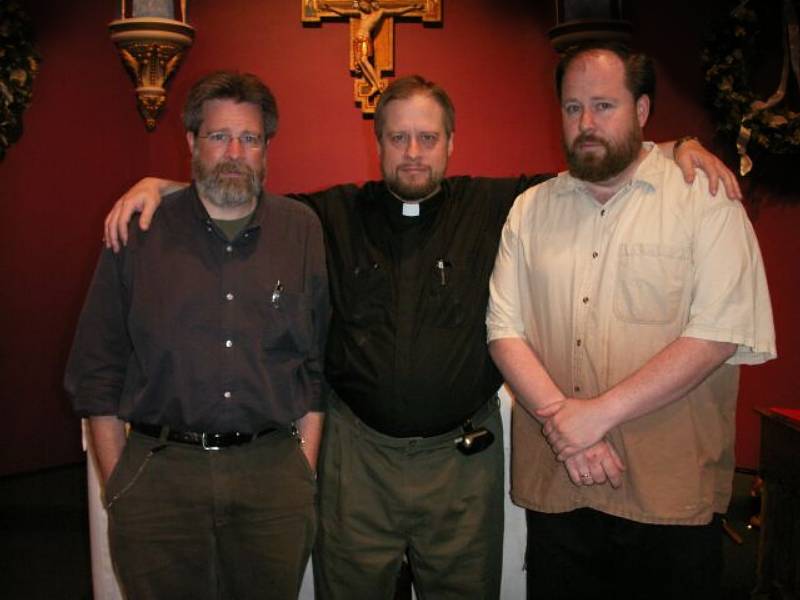
Left to right: Fr. Addison Hart (Roman Catholic Priest), Fr. Robert Hart (Anglican Priest, APCK), and Dr. David Bentley Hart (Orthodox Theologian, member of the OCA).


For those curious about our appearance these days, this picture was taken yesterday, August 11th, by my dear friend Bishop Joel Johnson (who ordained me all those years ago) in the town of Easton, MD., in Saint Andrew's Anglican Church. Here we are, the Groucho, Harpo and Chico of theology- the Hart Brothers.

I'll be posting something serious rather soon.

Transfiguration

August 6, 2006, Feast of the Transfiguration. Dr. Jonathan Munn (warwickensis), preaching in Dartford, England, delivered a sermon, which he then posted online (at O Cuniculi...). This is one of my favorite feasts, and one of my favorite preaching themes, but Jonathan managed to bring out thoughts a bit different from any I’d previously had. I read the text several times, extracted some key portions of it, and used them to structure this piece . . .

Transfiguration

A veil hangs thick between this world
and the world that lies beyond,
a world of brightness everlasting
that the eyes of men are never able to behold,
and of timeless time beyond our understanding,
around a throne that makes infinity look small;
and we before that veil walk on unknowing,
unseeing, unsuspecting in the presence of that Light,
until . . .

until in arms of teenage virgin Mother,
until the waters of the Jordan flow,
until transfiguration on the mount of light
until the dance of darkness on the Cross
until the breaking of the bonds of death
until the taking of the Bread and Cup
that stand transformed upon the Table of the Lord.

until the veil is breached and broken
and a Man is shown as Son of God and shines
and infinity has stormed across the mighty veil,
and breaks into this world of time,
and then . . .

The cloud falls,
the sight of glory is obscured,
obscured and hid from eyes that cannot see
of men that cannot long endure
the fullness of that majesty
without that they be burnt away,
consumed by joy beyond all strength
unless . . .

The cloud falls,
the vision is removed.
misunderstood, half unbelieved,
obscured but not forgotten,
held in memory to the proper day,
held in memory till eternity

We may have seen, but truly do not know
the meaning of the things we see,
and sometimes grope with blindness in the dark,
seeking somehow something we can understand,
but Christians are not fed by explanations,
and what we understand with finite minds
cannot nourish,
cannot feed our hungry souls,
and so we seek for more than explanation,
and so we seek for God,
and finding God is finding love,
and finding love is finding God,
and finding God is gain.

Knowing God comes not from understanding,
but from the wordlessness of meeting, touching, feeling,
holding, being held and hearing words that can’t be said,
and thinking thoughts the mind will never comprehend

And if we truly wish to meet Him,
truly wish to come into that Presence,
and long that we come close to God,
we may . . .

But it is in that cloud we come to know Him,
in that cloud where even thoughts are hid,
and where the only thing that we are knowing
is that we are knowing nothing,
but await the presence of the Lord of Love.

And when He comes upon this altar we may come,
coming, seeking explanations,
thinking that we understand,
and add a layer to that mighty veil,
that bars the way that leads beyond,
for, if we think we understand the mystery,
the heart of mystery never will we find
until . . .

We walk with boldness and yet humbly toward the cloud,
and entering into what seems darkness,
see the Light,
and, unknowing,
know.
-------------
--- ed pacht

Thursday, August 03, 2006

Have Continuers Stepped too Far Ahead?

I draw your attention to an article by the Revd Dr Peter Toon over at the blog of the Prayer Book Society of the USA entitled "The Affirmation of St Louis (1977), The Anglican Communion Network and The Anglican Way."

I would welcome your comments on this piece, particularly on his conclusion:

"It is difficult to come to clarity on the question of whether the Affirmers in 1977 saw themselves as Anglo-Catholics committed to historic Anglicanism (as set forth for example in The Canadian Solemn Declaration of 1893 and printed in the 1962 Canadian BCP), who allowed their private and cherished opinions to influence their description of the Anglican Way in a kind of reactionary pendulum flow, OR that leaving the two mainline Churches provided the Anglo-Catholic participants with the opportunity to reform Anglicanism in a Rome-ward or perhaps Orthodox-ward direction and they took this opportunity to do so, believing they were forging a new and better path for others after them to walk in. If the latter then, it would appear, they are making their impact in ways never envisaged in 2006 through the Common Cause partners of The Network!

"Apparently for some Continuers today in the ACC, ACA, APA and APCK neither the doctrinal decrees of the Council of Trent nor the doctrine of The Articles should be considered confessional documents, but rather the doctrinal decrees of the first Seven Ecumenical Councils that are commonly recognized by Rome and the East, should be so regarded. This view allows Continuing Anglicanism to be both informed by the historical importance of the Articles and open to Roman Catholic (Tridentine) doctrine and liturgy as pious opinions, but not dogmas. The peculiarly English traditions of worship created in 1549 are central to this position in the Continuum, though some borrowing from Latin and Greek traditions is allowed when judged to be edifying to the English mind and spirit. This viewpoint is also said to be the reasonable trajectory of the "Caroline Divines." (The problem with this approach is that it is imaginary and it tends to create a form of religion which is that of a tiny minority alongside but not in with the fellowship of 80 millions of the Anglican Way in the Anglican Communion of Churches, and also not in with or part of historic Catholicism of East or West.)

"Certainly all reasonable people accept that The Affirmation of St Louis goes beyond the normal statement of The Anglican Way and thus cannot be signed or accepted by those who are committed to the classic Anglican Formularies as they are presented, for example, in The Solemn Declaration of 1893 of Canada and in the Constitution of The Church of England, the Anglican Church of Nigeria, and in virtually all other Anglican provincial constitutions and presented in many editions of The Prayer Book of 1662 around the world.

"The Network, it seems, faces a dilemma. If it embraces the Seventh Council and Seven Sacraments then it steps ahead of world Anglicanism and away from the historic Formularies of the Anglican Way. If it does not, then it will not apparently win the hearts of a very small group of Continuers for whom, it appears, the “extras” of the Affirmation count more than the solid center where they agree with the historic Reformed Catholicism of the Anglican Way.

"A suggestion --- Let those of The Network, who actually hold to the historic Formularies, seek to persuade the Continuers to hold their cherished views as private opinion not required church doctrine; and then there can be real progress towards common witness and aims on the basis of unity on Scripture and classic Formularies."

Monday, July 31, 2006

The Cup of Salvation

The Cup of Salvation
a meditation by Ed Pacht

"This is My Body," said Our Lord, displaying the bread of that Last Supper before sharing it with His disciples. "This is My Body," repeats the priest at the Christian altar, displaying the bread of the Sacrament before sharing it with the faithful. The meaning is clear, the intent obvious, and so it has been understood by the Church of God for nearly two millennia. The priest, speaking as the living icon of his Lord, indicates by the Lord’s own words that this very bread, now held and pointed at or lifted up before our eyes,. has become the true Body of that same Lord, given once and for all on the Cross of Calvary and here placed into the hands and mouths of mortal men. This is a great and glorious Mystery, and we believe and confess it to be true.

There is a deepening of the Mystery, however, when we come to consider the life-giving and holy drink of His Blood. He took the cup, and, as recorded by SS. Matthew and Mark and quoted in our own Book of Common Prayer, said, "This is My Blood." However, SS Luke and Paul render these words as, "This cup is the New Testament in my Blood," and the Gregorian Canon of the old Latin Mass quotes it as, "This is the cup of My Blood." Even in Matthew and Mark, as also in our liturgy, though the contents are quite obviously meant, and are declared to be His Blood, it is the cup that is being pointed at, and not the contents. Why? Is it merely because the wine is hiding inside the cup? Well, of course there is something in that, but, surely one could indicate that rubrically by saying, ‘he shall take the wine,‘ verbally by not mentioning the container at all, and ceremonially by pointing down into the cup at the contents themselves. Why are we not as consistent in this as we are with the host? The question causes me to look deeper.

The Blood of His dying poured from his tortured Body, the physical life and strength draining from him, soaking into the ground at the whipping-stake, and on the Via Dolorosa. It soaked into the wood of the Cross and yet again into the ground at its foot. His life-blood drained and the life with it. He cried, "It is finished," and gave up the ghost. It was, as the author of Hebrews points out, much like the blood of bulls and goats in the temple sacrifices, whose blood was poured out on the ground and sprinkled upon the holy things as a sign of worship to God and blessing by Him, poured out and forever separated from the sacrificial victim.. But the Sacrifice that wrought our salvation did not stop there. There is more.

When, at Mass, we participate in that one sacrifice once and eternally offered, we eat the Body of Our Lord, and drink His Blood; but we are not drinking the blood of a dead sacrifice. In the Temple that was forbidden, so fervently that Orthodox Jews to this day will not eat meat that still contains blood. They use rock salt to draw the last of the blood from the flesh before they will cook the meat. What, then, does it mean that Christians are asked, yea commanded, to drink His Blood? And what makes the cup so important an element?

The Blood of His Death was, as we have seen, poured out, dispersed, lost in the earth, but it is not the blood of death with which we celebrate. We do not remember a dead God. We worship a living Saviour and King as we celebrate the marriage feast of the Lamb once slain and now living and reigning forever. Our feast is not upon dead things, but upon His living and loving Presence. Then, His Blood was poured out, dispersed, but now, His Blood is contained, contained as in any living creature, in His living Body. And His Body, we are told, is His Church.

The Wine is His Blood, which is no longer poured out, but contained. Oh are we careful that not one drop be lost! It is to be contained, cherished, and free to flow in the living Body that carries His Presence in this earth. "This Cup is my Blood." We drink from the Cup, and the Blood of the Sacrifice courses through our veins, and we walk, filled with His own life, into the world for which He died and rose.

July 29, 2006

Thursday, July 27, 2006

Outline of an Anglican Life

The man who wrote the book on Continuing Anglicanism was Fr. Louis Tarsitano, a priest of the ACA who was also an Associate Editor of Touchstone: A Journal of Mere Christianity. Now, this book, which has gone in and out of print over the last few years, is available in PDF format. It is useful for educating oneself, for Confirmation candidates, and maybe even to help rescue people from the sinking ECUSA ship- if they will but read it.

I recommend it.

Tuesday, July 25, 2006

Dear Prudence

I would like to quote from a letter that was written to me. I cannot reveal the name of the writer for reasons that will be obvious. I thank him for making a practical idea available in case it may help others.


Dear Father Hart:

Because of some of your articles in Touchstone Magazine I wanted to write to you, so that you may use this (but please don’t give out my name)… I found myself becoming addicted to mild forms of Internet Pornography. It began small, just looking at pictures of naked women a bit here and there. Eventually, I found myself waking up without sleeping most of the night, because I had been up all night looking at always just that one more picture. I have never actually broken this acquired addiction, well, at least not exactly. Rather than fight temptation I prefer to avoid it. I bought a filter program for my computer. After a lot of tinkering I got [the filter] to do what I need, namely to block out those porn sights, but never interfere with legitimate functions that I need. Then I secured the filter with a password by closing my eyes while I created it, cutting and pasting it, so that I could not memorize it. It is printed in case I ever have to let a technician work on my PC, but the only copy is miles away in a desk in an office where there is no computer. So far this works, and I have peace, and finally get the sleep I need…

This reminds me of something David Mills posted in Mere Comments from another Touchstone reader a few years ago; it had come from a man who was tempted by homosexual desires and who also had become addicted to Internet pornography. In his case, his wife controlled the filter with a password, and in this case we have a man who has placed a barrier between himself and the password. I recall that David praised the first man for his prudence, and I praise this man for having the same virtue. And, both of them have shown the charity that it takes to try to make their experience profitable to others. It is a very practical solution to avoid temptation, or as some versions of the Act of Contrition put it, “to avoid the near occasion of sin.”

In the Sermon on the Mount the Lord spoke of plucking out the eye and cutting off the hand, which Saint Paul referred to as “putting to death your members on earth.” The violent take the Kingdom of Heaven by force, and this force is to resist unto the shedding of blood in striving against sin (Heb. 12:4). The language of bloodshed and self-mutilation seems rather strange to a mild soft-sell generation like ours. But, when the New Testament was being written Christians needed to be ready to die as martyrs, and therefore free from inordinate attachments and lusts. What we must learn is to be ruthless with ourselves, and to find practical ways to avoid the near occasion of sin. If unlimited Internet freedom offend thee, cut it off and pluck it away. Better to enter into life maimed than to have thy whole body cast into Hell.

For those who want to know about the virtues, we have seven. Four come from Wisdom 8:7 (“And if a man love righteousness her labours are virtues: for she teacheth temperance and prudence, justice and fortitude: which are such things, as men can have nothing more profitable in their life”) and the other three from I Corinthians 13: 13 (“And now abideth faith, hope, charity, these three; but the greatest of these is charity”).

More on "East and West"

“I see this going on in Orthodoxy all the time. The continuous discovery of new and improbable ‘differences’ between East and West has become virtually a cottage industry among some Orthodox Christians. Many of these alleged differences, however, seem not to have occurred to most Orthodox Christians who lived either before the Russian Revolution or outside of Paris.”
-Fr. Patrick Henry Reardon

In the ongoing discussion about East and West, no one can speak with more authority than the pastor of All Saints Orthodox Church in Chicago, Father Patrick Henry Reardon (who also is a senior editor of Touchstone, and the author of several good books). In one lifetime, he has done what it has taken all three of the Hart brothers to do: he has been Roman Catholic, then Anglican and is now Orthodox. What sets him apart is the depth of his learning, since his knowledge of the entire Christian Tradition is about as exhaustive as any one man can possess. After all of his decades of scholarship, he has been able to speak in terms that all Christians can appreciate, demonstrating the reality of our common ground. Fr. Reardon has stated more than once the threefold separation between man and God that has been overcome for us in Christ, the separation by nature, by sin and by death. We are saved from our separation by nature in Christ’s Incarnation. We are saved from our separation by sin in Christ’s death, and we are saved from our separation by death in Christ’s resurrection.

I want to use this to answer the opinion of a commenter who calls himself Kolokotronis, specifically when this Kolokotronis wrote: “The West's concept of God, salvation, human nature, even sin itself, are near 180 degrees off that of the early Church, but are in many ways quite consistent with Greek pagan philosophy.” Before I do, let me say that this idea exalts Greek Paganism beyond measure. If the “Western” “concept of God” is consistent with Greek Paganism, then the pagans must have believed in a transcendent God who is Wholly Other from every created nature, dwelling in eternity, unknowable and unapproachable. Somehow, this does not fit the notion of Zeus on Mount Olympus, or of the gods who were subject to passions. It is simply another empty charge and invented excuse for maintaining and deepening division at any price.

About salvation, just how different is the “East” from the “West?” I believe that Saint Paul, unless he was capable of time travel, never read Cur Deus Homo by Saint Anselm. And, yet, he summarized the entire concept of the Jewish sacrificial system in the Law, and the Suffering Servant passage of Isaiah, with the words “Christ died for our sins, according to the scripture (i.e. in fulfillment of those scriptures about sacrifice).” – I Cor. 15 : 3. Here we look again at those three ways in which salvation is offered to us in Christ. By dying He took away the sins of the world. Can this really have no relationship to Divine Justice? Is God so immoral or a-moral? Christ overcame death, but in His cross He conquered both sin and death. Furthermore, in order for the Incarnation to save us from death and open to us the hope that we become “partakers of the divine nature,” sin must first be taken away by the Lamb of God, the “propitiation for the sins of the whole world.” In order for His resurrection to give us immortality, sin had to be removed first. In order for us be given the grace to partake of the divine nature by Theosis, we first needed this redemption from sin/ death (really one thing for us, not two).

To what degree this Kolokotronis believes that the East and the West have different concepts about what sin is, I would rather not even begin to question. It simply makes no sense. I really cannot say what Kolokotronis meant by condemning the “Western concept” of human nature, unless he is referring to a belief taught only in some Protestant circles that the Fall created something new called “sin nature,” a kind of anti-grace in the descendents of Adam. The Fall should be understood in terms of what we lost: we lack the grace to become what we were created to be. Our only hope is in Christ, His Incarnation, His cross, and His resurrection, by which grace is restored.

Friday, July 21, 2006

Theosis East and West

Robert Hart


Among the things that “everybody knows” we find the irreparable great gulf fixed between East and West, by which two totally different theologies are expressed in the same Creed, the same scriptures and a shared reverence for the sacraments. Of course, among the things that “everybody knows” in times past were the flatness of the earth, the revolution of the universe around our world, and the simplicity of the amoeba. It seems that common knowledge is a haven for shared and reinforced ignorance of many kinds.

Therefore, it is best to learn the art of skepticism when faced with common knowledge, and to question its certainty in a radical way. Are the basic theological understandings of the East and West really irreconcilable differences? The answer depends upon whether we try to perceive on a genuine level of honest study, or on a caricature (of course the terms East and West are part of the over simplification. But, we all know what I mean). The caricature of the East (so-called, by which really we mean Orthodox) is that it is devoid of any logic, entirely mystical, and that it has no room in it for any concept of the Atonement. This caricature is not entirely due to the prejudice of uninformed Westerners; it is also very much the fault of Orthodox Christians who, mostly living in the West, very much want to be different, above all different rather than Christian. The caricature of the West (by which we mean Roman Catholic, classical Anglican, and many shades of Protestant) is that it has no room for mysticism, is so scholastic that it has no idea of “spirit,” and is only able to see Redemption in a way that is limited to substituionary atonement and nothing more. Certainly the whole idea of Theosis or Deification is only understood by the East- right? This caricature is not due solely to prejudiced Easterners, but to poorly taught Westerners as well, especially those who cannot tell Mormonism from Patristic Christology, or their right hands from their left (and also much cattle).

I suggest that we turn from “common knowledge” to knowledge, which is like turning from being honest to God simply to being honest (to draw from the well of C.S. Lewis). To begin with, the West, and Saint Anselm in particular, did not invent Atonement, and have never taught that God was morbidly and emotionally “pleased” with the sacrifice of Christ; neither has it been taught by the West (or by Saint Anselm in particular) that Christ overcame sin alone, and not death as well. Neither has it ever been taught by the East that Christ’s death on the cross was unrelated to the fulfillment of Isaiah’s Suffering Servant prophecy in which the One Man was the Lamb of God upon whose life was placed the iniquity of us all. If either of these two caricatures were true, then neither East nor West would have been remotely Christian, as each would have denied central doctrines of the Faith expressed in the Creed we all share. Perhaps emphasis is mistaken for doctrine, and taste for Creed. For those who are content not only to live with these caricatures, but who wish in every way to represent them by fasting from the common well of Patristic Faith, it is good for one lung to breathe in a little more deeply the blessed state of sin forgiven by Christ’s once for all offering of Himself as the Propitiation for the sins of the whole world (I John 2:2), and for the other lung to breathe more deeply the blessed hope of Deification. But, each lung would be breathing air native to it.

Now, to answer specific questions that modern Western Christians have, Deification is taught in scripture, especially by those haunting words of Saint Peter: “Whereby are given unto us exceeding great and precious promises: that by these ye might be partakers of the divine nature, having escaped the corruption that is in the world through lust .” – II Pet. 1: 4. This is not, I say not Mormonism, which teaches that even the Lord Who made heaven and earth was once a mere mortal, and that people can become gods equal to YHVH Himself. Obviously, Christians never have believed such blasphemy; therefore it is not the meaning of the formula of Saint Athanasius, "For the Son of God became man so that we might become God." (St. Athanasius, Bishop of Alexandria, BOOK: De Decretis, about 325?), or of Saint Thomas Aquinas (those who want to see the great Angelic Doctor as simply a Western scholastic may wish to turn a blind eye): "The only-begotten Son of God, wanting to make us sharers in his divinity, assumed our nature, so that he, made man, might make men gods." (St. Thomas Aquinas, Philosopher, Theologian, Angelicus Doctor, BOOK: Opusculum contra errores graecorum, by order of Pope Urban IV 1261-64).

Our Lord quoted the words of Psalm 82: 6, “I have said, Ye are gods; and all of you are children of the most High.” About these words, the Hebrew language is very clear: Elohim, b’nai Elyon. He used these words in a context about His own Divine Nature as the only begotten Son of God, using the phrase “sent into the world” by which He spoke always of Himself in a unique sense (John 10: 34- 37). No other man has a nature we call “pre-existent.” No one else has been sent into the word, for the rest of us originated here. And, it is only in the context of the Incarnation that we dare speak of Deification, or Theosis. By grace we may become what He is by nature. This has never been understood even to suggest or imply equality, neither that we could ever possess the nature of God as the Wholly Other who is uncreated. It has never been understood to mean that we become omnipotent, omniscient or omnipresent. It has everything to do with adoption as sons through the Incarnation of Christ, sharing in the holiness of God because sin has been overcome by Christ, and becoming immortal due to the victorious death of Christ on the cross and His Resurrection. None of this would be possible if not for the fact that a Man sits at the right hand of the Father, that is, if not for the fact that even now our salvation comes through the Man who is complete in two natures. Jesus Christ is fully God and fully man, having taken our created nature into his uncreated Person, our time into His eternity. When death entered the physical body of this Man, it was overcome and swallowed up by Life, as a drop must vanish when it falls into the sea.

It is in the context of our Faith in the Incarnation that apparent differences vanish, for in that revelation sin has been taken away on the cross, and death has been swallowed up in victory. Perceived conflicts evaporate like the illusion they have been all along. Our created nature is transformed by grace, deifying man because a Man ever lives who is fully God. The Man who is one with the Father from the beginning is one with us by the gracious will of God; One with the Father by the eternal Nature of His uncreated Person, and one with us in every way, except sin, through His Mother, the Blessed Virgin Mary. And in His love we trust. We are given the deposit now by the Holy Spirit Who came on the Church at Pentecost, so that we can hope to become by grace what he is by nature: holy, eternal and perfect in charity.

The Western Church has never turned away from the doctrine of Deification. Anglicans especially have the teachings of Lancelot Andrewes (about which I suggest the paper by one Rev. Davidson Morse. However, in the link provided, the paper starts on page 9. I do not endorse every opinion contained in the first eight pages of this website, as some of them are simply too optimistic, rather than accurate).

Monday, July 17, 2006

A Note from Sunny Spain

A short note to let you all know that I am well, though exhausted.

I have spent the past nearly two weeks in a blur -- of activity and plaster dust. Sorting out bureaucracy, buying furniture and household furnishings, cleaning, painting, cleaning, painting and then cleaning some more. Mercifully, Javier, one of my neighbours' sons has been helping me out. I couldn't have done it otherwise.

The house is lovely and quite liveable. I'll upload some photos when I get home.

The children arrive tonight by bus from Madrid. We will spend just under a week here, then head back to Madrid. I'll be home at the end of the month.

Blessings to all.

Saturday, July 15, 2006

About Theosis

I see that while I was busy a few people made comments about theosis, or deification. The subject is rather important, and so, after Sunday, I will take the time to post a blog about this subject. It is a necessary part of our theology of the Incarnation. Anglican tradition is no stranger to this theme at all, and both Hooker and Andrewes were right up there with any of the Orthodox on this matter. For now, simply ponder what Saint Peter said, that we are meant to become "partakers of the divine nature." - II Pet. 1:4